Polymarket removes all betting markets predicting the use of nuclear weapons following a military attack on Iran, with a total trading volume of over 200 million yen recorded for contracts expiring in 2025.
Following the military attack on Iran, prediction market platform Polymarket has decided to remove all betting markets predicting the use of nuclear weapons. In particular, contracts with a total investment of over $1.7 million (approximately 260 million yen) due to expire at the end of 2025 have seen a surge in interest in extreme predictions due to the escalating international situation.
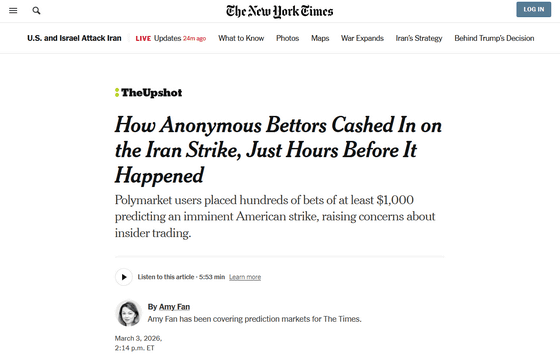
How Anonymous Bettors Cashed In on the Iran Strike, Just Hours Before It Happened - The New York Times
Polymarket shelves nuclear detonation markets after outcry
https://www.coindesk.com/markets/2026/03/04/polymarket-shelves-nuclear-detonation-markets-after-outcry
Polymarket is a decentralized prediction market platform that uses cryptocurrency to predict the outcomes of future events and bet on their success or failure. It covers a wide range of areas, including politics, economics, sports, and geopolitical risk, and reflects the predictions of a large number of participants in its prices. However, the platform has also been the subject of controversy due to ethical issues surrounding speculation on real-life disasters and wars, as well as the fact that it operates outside the framework of specific legal regulations.

In the past, betting on when the United States would invade Venezuela attracted attention when more than 1.7 billion yen was raised in total. At the time, criticism was raised that 'it was unclear what actions would be considered a military invasion.'
Online gambling site Polymarket has raised over 1.7 billion yen in bets on when the US will invade Venezuela, but has been criticized for its vague rules for winning and losing - GIGAZINE
The reason behind this market removal is suspicion of insider trading due to an influx of funds at an unnatural time. Since the end of 2025, there have been few users placing large amounts of bets on the prediction that the United States will launch a military attack on Iran within the next day, and the market has been in a state of wait-and-see mode.
However, the day before the actual attack on Iran was launched, more than 150 specific accounts suddenly invested large amounts of money in those predicting the attack, suggesting that those who had advance knowledge of the military operation may have used the market to profit from it.
Polymarket offered betting not only on whether or not nuclear weapons would be used, but also on a variety of military and political scenarios, such as whether Israel would directly attack Iran's nuclear facilities, whether the United States would officially declare war, and even the specific date a specific military demarcation line would be breached. Trading volume on these markets increased every time a conflict intensified, and for some investors they served as a means of speculation and a way to avoid geopolitical crises.

In addition, these betting markets have been subject to strong ethical criticism that they are exploiting humanitarian tragedies and international disasters for profit, and the decisions of the operators have been attracting attention. In particular, suspicious activity immediately before an attack has come under scrutiny from regulatory authorities, who see it as a significant undermining of information transparency and market integrity.
Polymarket's decision to remove all related markets is believed to have been an emergency measure to prevent prediction markets from becoming a breeding ground for the leaking of military information and insider activity. However, further detailed investigations are expected to be conducted in the future, including into the whereabouts of the large amounts of money that were invested.
Related Posts:







in Note, Posted by log1i_yk