People will lose empathy for even human-made artwork if they are told it is an AI-generated image.
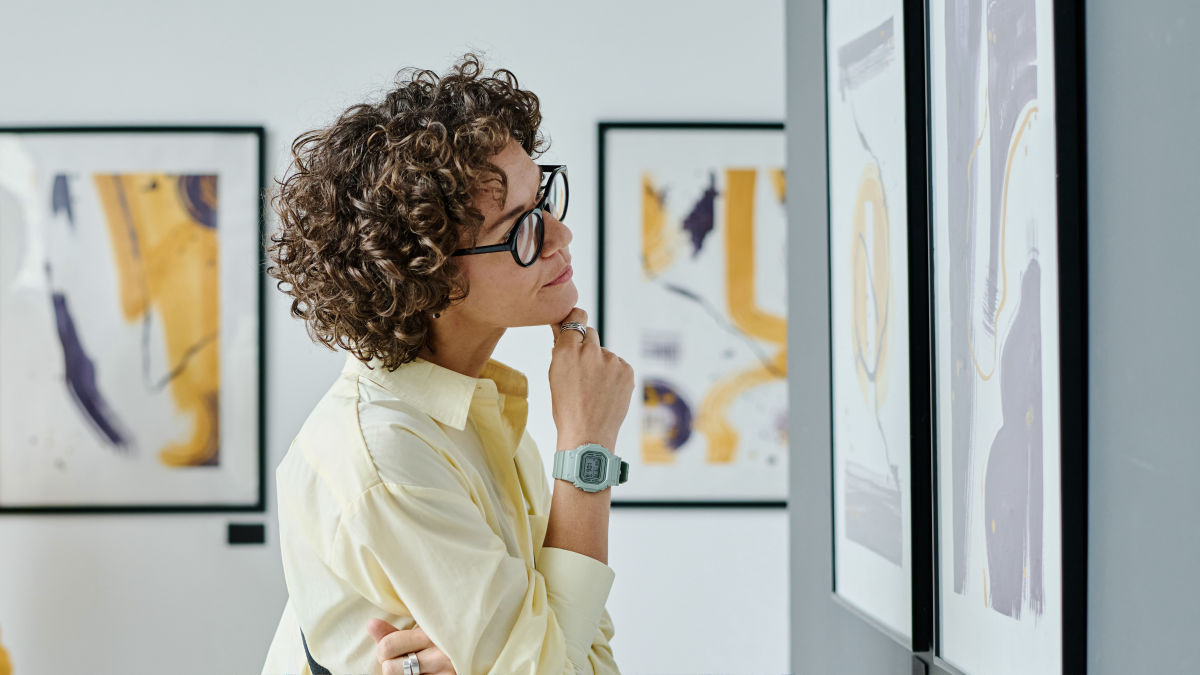
In recent years, advances in generative AI have led some users to use AI to create artworks such as paintings and literature. A research paper published in January 2026 found that the results of experiments in which AI-generated images were passed off as human-created and human-created artworks were passed off as AI-generated images confirmed that information about how something was created has a significant impact on human empathy. A similar trend has also been observed in literary works.
Less “awe”-some art: How AI diminishes the empathic power of the arts - ScienceDirect
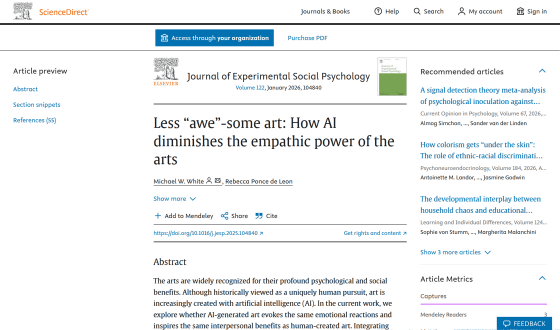
AI art fails to trigger the same empathy as human works
https://www.psypost.org/ai-art-fails-to-trigger-the-same-empathy-as-human-works/
Philosophers and psychologists have long argued that art is not merely a source of visual pleasure, but serves as a psychological bridge that connects people. When people appreciate a painting or a poem, they do not simply process visual and linguistic information; they seek to understand the artist's intentions and perspective through the work.
PsyPost points out that the process of viewing these works of art evokes a sense of awe in viewers—the feeling we get when we encounter something spectacular that challenges our worldview. Psychological theory suggests that awe can make us less self-focused and more connected to others.
However, in recent years, AI has rapidly begun to make inroads into the arts, and it is now possible for AI to generate paintings, poems, novels, music, etc. that faithfully imitate human styles. So, a research team led by Michael White , a doctoral student at Columbia Business School, and Rebecca Ponce de Leon, an assistant professor of business at Columbia Business School, conducted a study to compare AI-generated artworks with human artworks.
White and his colleagues wanted to know how knowing the origins of a work of art affects viewers' emotions. They hypothesized that if there was no human being behind the work of art, viewers would feel less awe from it. They conducted five experiments with a total of approximately 1,600 subjects.
In the first experiment, subjects were recruited from a large city art museum and asked to view paintings depicting human suffering, such as miners, garment workers, and survivors of natural disasters. In reality, all of these paintings were generated by AI, but the research team told half of the subjects that they had been painted by a human artist named Jamie Kendricks, and the other half that they had been created by AI. After viewing the paintings, the research team assessed the degree of empathy the subjects felt for the people depicted in the paintings.
The results showed that subjects who believed they were viewing paintings created by AI clearly showed less empathy for the people depicted in the paintings than subjects who believed they were viewing paintings created by humans.
In the second experiment, a similar experiment was conducted using paintings created by human artists rather than AI.
The results of the experiment showed that subjects who were told the painting was 'created by AI' felt less empathy for the subject depicted in the painting, even though the painting was actually created by a human. This suggests that the emotional impact of a painting is determined by the viewer's beliefs, not the quality of the painting.
In the third experiment, the researchers expanded their scope to literary works. They had subjects read poems on the themes of 'love,' 'nature,' and 'family,' and measured their sense of awe by asking them how surprised or moved they were by the poems. As in the previous experiments, they found that subjects who were told the poems were 'generated by AI' felt less awe. Statistical analysis also showed that a lack of awe led to a decrease in empathy.
The fourth experiment focused on whether differences in the emotions felt by artworks influence behavior. The researchers set up a viewing zone in the lobby of an office building, inviting passersby to view paintings of disaster survivors and then donate to charity. Participants who believed the paintings were generated by AI reported lower levels of awe and empathy, and were less likely to donate than those who believed the paintings were created by humans.
In the fifth experiment, we explored why AI art doesn't evoke awe by examining two components of awe: vastness and the need for accommodation. Vastness is the feeling that something is bigger than oneself or one's usual experiences, while the need for accommodation is the feeling that a new experience challenges one's existing mental framework.
'The subjects in the experiment viewed paintings of tsunami survivors and rated their perceptions of vastness and the need for adaptation. The results showed that subjects who believed the paintings were created by AI rated the artworks' vastness and need for adaptation lower. The lack of cognitive challenge suppressed awe and led to lower empathy.
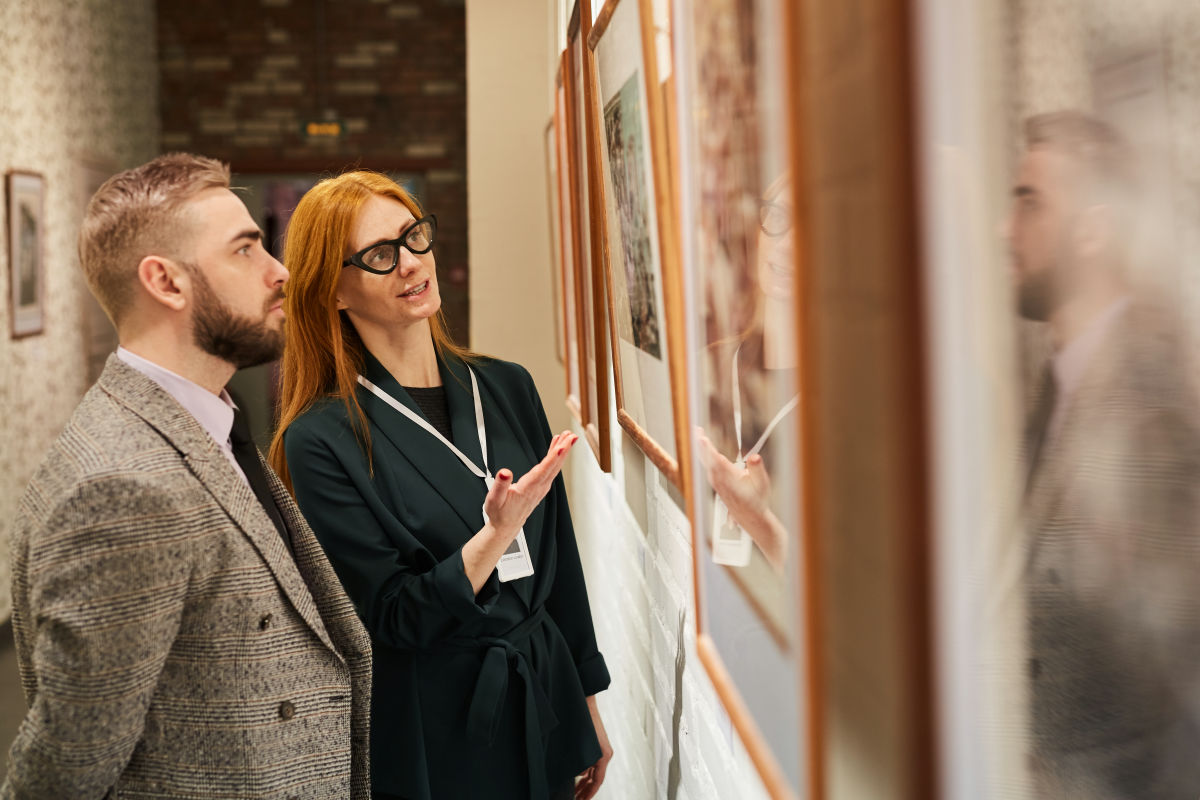
The findings of this study are consistent with other research examining human reactions to AI-generated artwork. Systematic analyses of data from multiple studies have shown that knowing a painting was generated by AI affects the interpretation and visual perception of the artwork. A 2023 study also found that being told a painting was created by AI reduced feelings of liking and awe.
The paintings used in this study primarily depicted suffering or serious themes, so it's unclear whether similar effects would be seen with artwork that evokes emotions like joy. Furthermore, younger generations who grew up with generative AI tools may have weaker prejudices against AI, so different results may be seen.
PsyPost, a psychology media outlet, said that future research could explore other forms of art, such as music and film, and examine partnerships between AI and humans. It added, 'Current data suggests that automating creativity has hidden costs. While image generation may become more efficient, we risk losing the deep connection we get from witnessing the expression of other humans.'
Related Posts:



in Free Member, AI, Science, Creation, Posted by log1h_ik