Claude developer Anthropic releases report on AI's economic impact, revealing significant variations in the effectiveness of AI across countries and tasks

Anthropic, the developer of the chat AI Claude, has released the fourth installment of its 'Anthropic Economic Index,' a report assessing the economic impact of AI. This report introduces five new 'economic primitives' to track Claude's economic impact over time.
We're publishing our 4th Anthropic Economic Index report.
— Anthropic (@AnthropicAI) January 15, 2026
This version introduces 'economic primitives'—simple and foundational metrics on how AI is used: task complexity, education level, purpose (work, school, personal), AI autonomy, and success rates.
Anthropic Economic Index report: Economic primitives \ Anthropic
https://www.anthropic.com/research/anthropic-economic-index-january-2026-report
Anthropic Economic Index: new building blocks for understanding AI use \ Anthropic
https://www.anthropic.com/research/economic-index-primitives
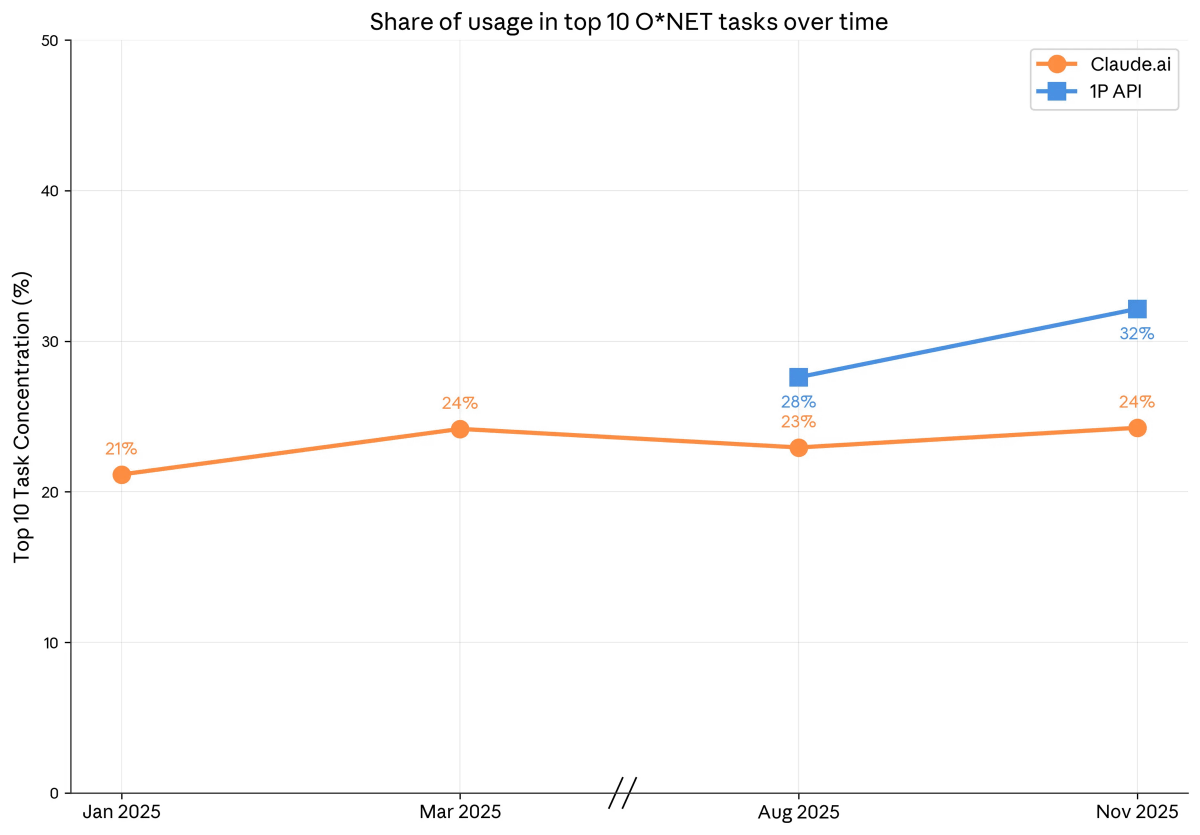
To assess the potential impact of AI on the economy, Anthropic conducted an analysis based on Claude usage history collected in November 2025. It reported that 24% of chats with Claude in November were focused on the 10 most frequently used tasks, and this percentage is on the rise. Additionally, an analysis of API customer usage to track Claude adoption in businesses found that the 10 most frequently used tasks accounted for 32% of the total.
We also found that there are regional differences in Claude usage patterns. The graph below shows the Anthropic AI Usage Index (AUI), which shows how frequently Claude is used relative to the population; the higher the number, the higher the percentage of the population using Claude. The horizontal axis shows the percentage of workers in computer- and math-related occupations in that state. Overall, the higher the percentage of people working in computer- and math-related occupations, the higher the Claude usage rate. However, Anthropic predicts that the gap will close over time, as usage rates are growing more rapidly in areas with low Claude penetration.

This report introduces an indicator called economic primitives, which consists of five items: 'task complexity,' 'skill level,' 'purpose of AI use,' 'AI autonomy,' and 'task success rate.'
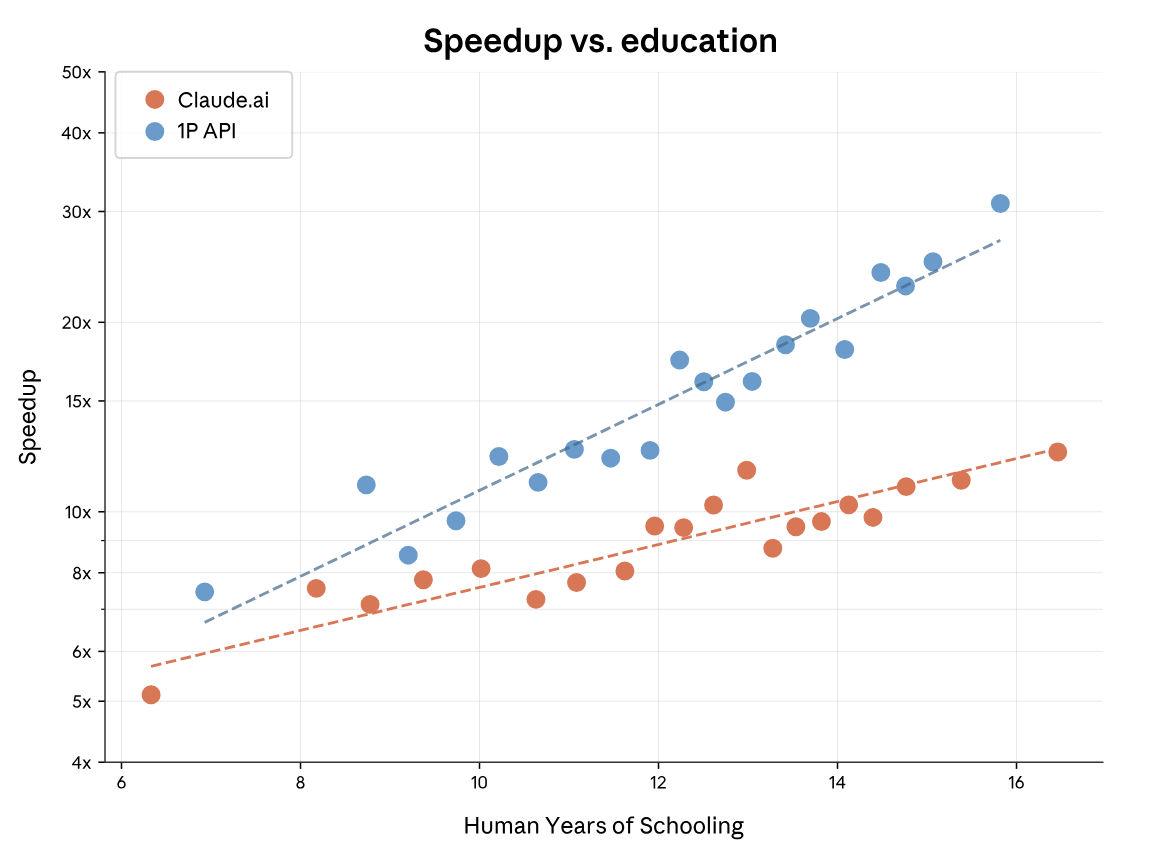
Claude's greatest speedup was seen in more complex tasks, with tasks involving prompts requiring high school graduate level comprehension reportedly being 9x faster and tasks involving prompts requiring college graduate level comprehension reportedly being 12x faster. This result suggests that productivity gains from AI are most pronounced in tasks requiring relatively high levels of human capital.
The graph below shows how much a task is accelerated by Claude on the vertical axis, and how many years of schooling are required for that task on the horizontal axis. The red dots represent standard Claude, and the blue dots represent the Claude API. It can be seen that the more advanced the task, the faster it is.
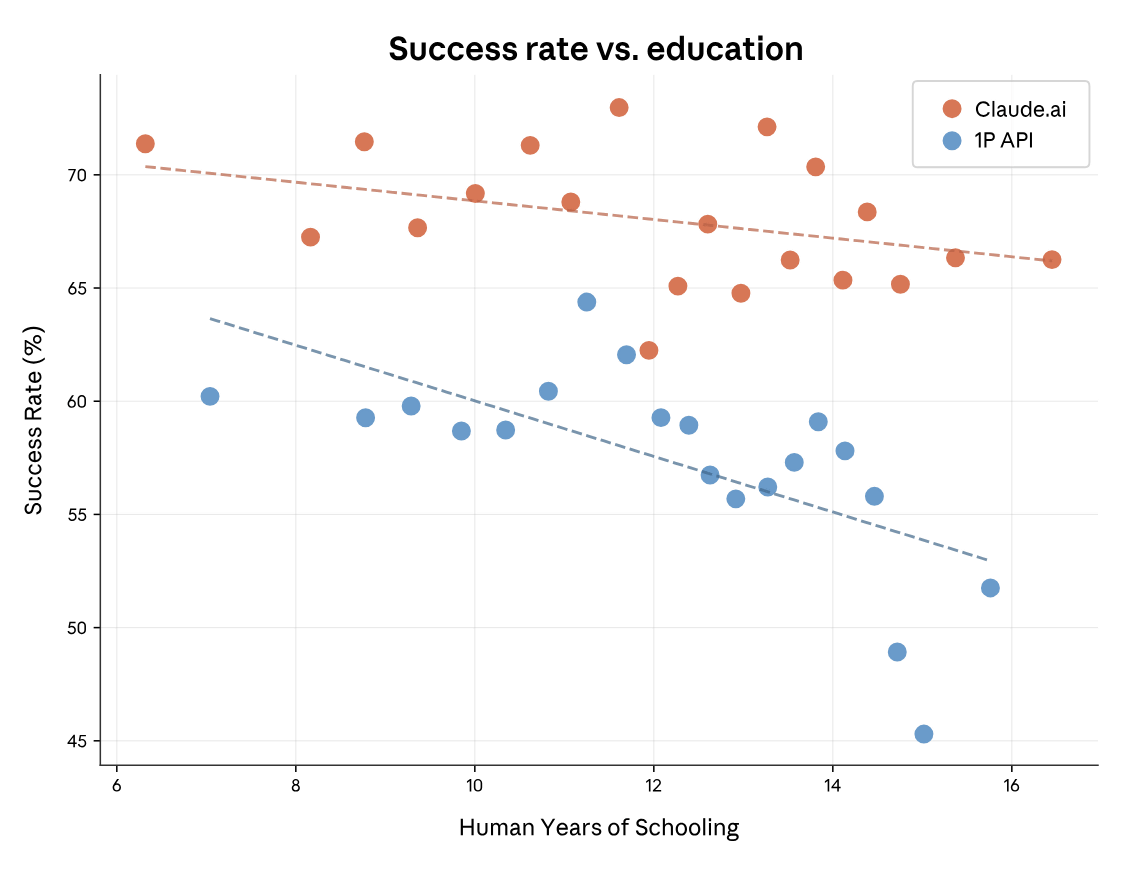
The graph below shows the success rate of Claude's tasks on the vertical axis and the number of years of schooling required for the tasks on the horizontal axis. While the success rate tends to decrease with more advanced tasks, Anthropic stated, 'This weakens the overall effect, but does not completely eliminate it,' and argued that this is not enough to offset the efficiency gained by Claude.
The researchers also found that the types of tasks Claude performs differ between countries at different stages of economic development. Countries with higher GDP per capita are more likely to use Claude for work and personal purposes, while countries with lower GDP are more likely to use Claude for educational purposes. This suggests that low-income countries use AI more in education, but fewer tasks require AI for work.
The graphs below show the percentage of Claude users in a specific field (vertical axis) and the GDP of each country (horizontal axis). The leftmost column shows the percentage of Claude users in work, the middle column shows the percentage of Claude users in education, and the rightmost column shows the percentage of Claude users in personal use. There is a correlation between the GDP of each country and the percentage of Claude users.

In the January 2025 report, 36% of the sample's occupations used Claude for at least a quarter of their tasks, but when multiple reports were combined, that percentage rose to 49%. However, this does not simply mean that 'the more frequently tasks are handled by Claude, the higher the success rate of Claude'.
In the graph below, the vertical axis shows 'the percentage of tasks that Claude can successfully complete in a day,' and the horizontal axis shows 'the extent to which Claude is attempting to complete the task (task coverage).' Basically, the higher the Claude success rate for an occupation, the higher the task coverage. However, occupations such as 'Data Entry Keyers' and 'Radiologists' tend to have higher success rates compared to task coverage. On the other hand, 'Psychology Teachers, Postsecondary' and 'Microbiologists' have a low task success rate compared to their task coverage.

'The most immediate conclusion to be drawn from our Economic Indicators report is that the impact of AI on the global workforce remains highly uneven. AI use remains concentrated in certain countries and occupations, and evidence on task coverage suggests that different occupations will be affected very differently,' Anthropic said.
Related Posts:






in AI, Posted by log1h_ik