OpenAI has signed a strategic partnership with Broadcom to develop its own AI processing chips, with the contract value estimated at hundreds of billions of yen and plans to produce 10 gigawatt-class chips.

OpenAI, known for ChatGPT and other projects, has announced plans to collaborate with semiconductor company Broadcom to develop and deploy a 10GW (gigawatt) class custom AI chip.
OpenAI and Broadcom announce strategic collaboration to deploy 10 gigawatts of OpenAI-designed AI accelerators | OpenAI
OpenAI and Broadcom announce strategic collaboration to deploy 10 gigawatts of OpenAI-designed AI accelerators
https://jp.broadcom.com/company/news/product-releases/63631
OpenAI Partners With Broadcom to Build Its Own AI Chip
https://www.eweek.com/news/openai-partners-with-broadcom-oct-2025/
OpenAI partners with Broadcom custom AI chips alongside Nvidia, AMD
https://www.cnbc.com/2025/10/13/openai-partners-with-broadcom-custom-ai-chips-alongside-nvidia-amd.html
Dedicated chips (accelerators) for AI processing are becoming essential to improving the performance of AI models. Many AI companies rely on AI accelerator manufacturers such as NVIDIA and AMD, but face challenges such as unstable supply, rising costs, and limited optimization. As a result, many AI-focused companies are pursuing in-house chip strategies, such as SoftBank's acquisition of a data center semiconductor company for approximately 970 billion yen and Meta's pilot deployment of the first in-house AI training chip.
Meanwhile, at the end of September 2025, OpenAI announced a strategic partnership with NVIDIA to build a 10GW system, equivalent to millions of NVIDIA GPUs . Furthermore, on October 6, 2025, OpenAI also announced a partnership with AMD, revealing a multi-generation contract to introduce a total of 6GW of AMD Instinct GPUs.
OpenAI and AMD partner, OpenAI acquires up to 10% of AMD shares to deploy 6 gigawatt-class AMD systems - GIGAZINE

Furthermore, OpenAI announced a strategic partnership with Broadcom on October 13, 2025 for 10GW of custom AI accelerators. OpenAI will design AI processing chips and systems, and aim to achieve higher performance AI by incorporating knowledge gained from the development of cutting-edge AI models and products directly into the hardware. Broadcom will provide communication and connection technologies such as Ethernet to help enable AI systems to operate at large scale.
'Our collaboration with Broadcom marks an important step in building the infrastructure needed to unlock the potential of AI and bring real benefits to people and businesses,' said Sam Altman, CEO of OpenAI. 'By developing our own accelerator, we will contribute to a broader ecosystem that will push the boundaries of AI and build the capabilities needed to benefit all of humanity.'
Broadcom CEO Hock Tan commented, 'The collaboration between Broadcom and OpenAI marks a crucial milestone in the realization of artificial general intelligence (AGI). OpenAI has been at the forefront of the AI revolution since ChatGPT. We are thrilled to jointly develop and deploy 10GW of next-generation accelerators and network systems to pave the way for the future of AI.' Also, when appearing on a podcast after the deal, Tan said, 'As we move toward better models and even superintelligence, we will continue to need the best and latest computing power. By developing our own chips, we can control our own destiny.'
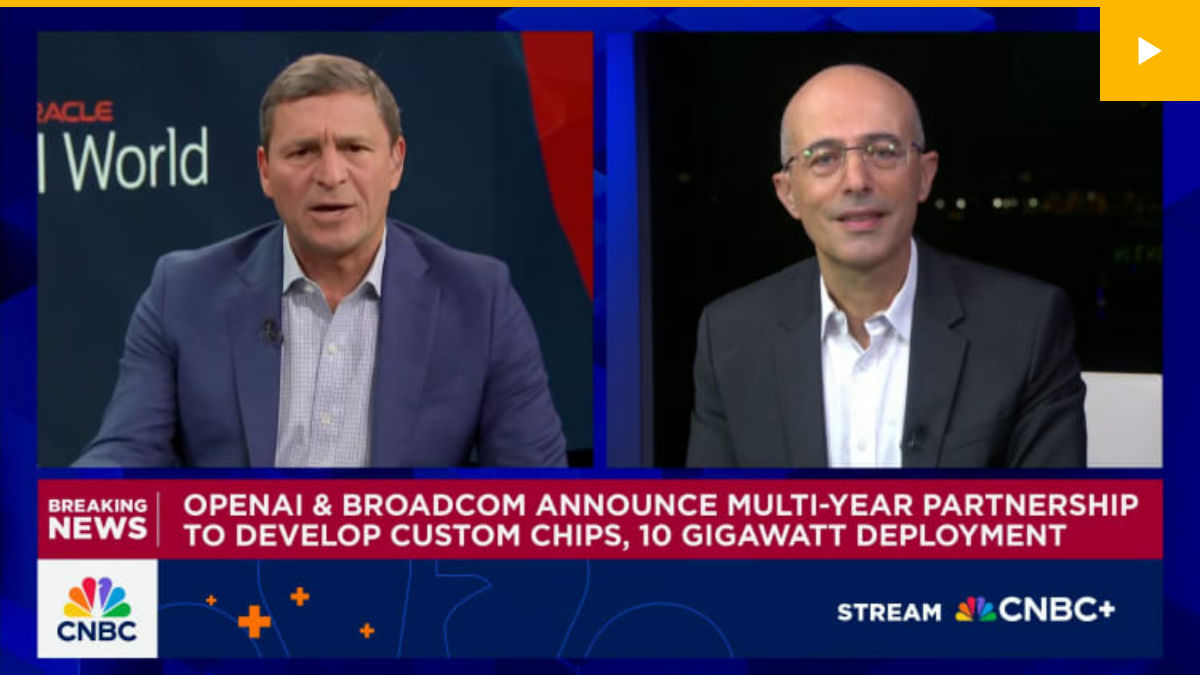
The cost and financial terms of the OpenAI-Broadcom deal have not been disclosed at the time of writing. Broadcom's September 2025 financial report included a $10 billion customer, but Charlie Kowas, president of Broadcom's semiconductor solutions division, denied the rumors in a CNBC podcast appearance after the deal was signed, saying, 'OpenAI is not the $10 billion partner.'
According to a report in the Wall Street Journal, the contract is expected to be worth billions of dollars, and Broadcom's stock price rose nearly 10% as of the morning of the day of the announcement. According to a person familiar with the matter, CEO Altman has told employees that he wants to build 250 gigawatts of computing power by 2033. Attention is focused on how the company will raise funds to cover the cost of the contract, which will exceed trillions of yen.
American technology and business media outlet eWeek described the partnership between OpenAI and Broadcom as a 'major gamble,' noting that if successful, it could have an impact on the industry, revolutionizing the very foundations of AI computing. However, chip design and manufacturing are complex, expensive, and prone to delays, so 'even with Broadcom's expertise, integrating new hardware at the scale OpenAI aims for will be a difficult road.' Some analysts have said that despite skyrocketing costs and schedule delays, it may be inferior to NVIDIA's CPUs, posing 'extreme execution risk.'
Related Posts: