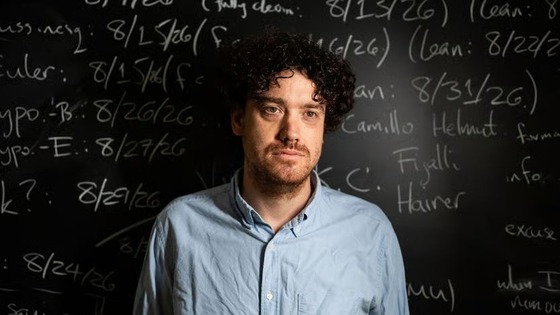
A Fields Medal-winning mathematics professor has changed his system to 'evaluate students simply for submitting their homework,' arguing that AI has rendered grading homework pointless.
Surveys have shown that
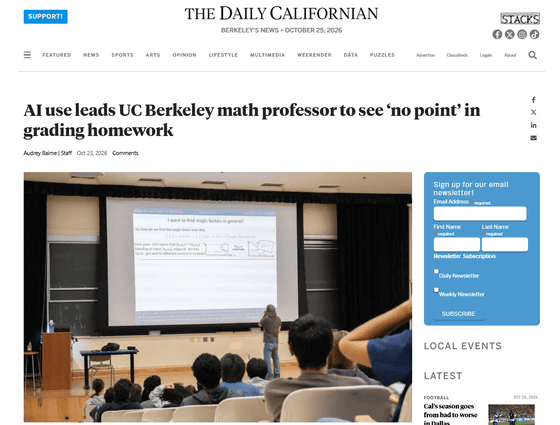
AI use leads UC Berkeley math professor to see 'no point' in grading homework | Academics | dailycal.org
https://www.dailycal.org/news/campus/academics/ai-use-leads-uc-berkeley-math-professor-to-see-no-point-in-grading-homework/article_bdf1eae2-c08b-491f-b9f1-81a7cea177de.html
On September 8, 2026, OpenAI announced that it had discovered a solution to the Navier-Stokes equations, one of the Millennium Prize Problems, which has a $1 million (approximately 150 million yen) prize at its root. According to OpenAI's announcement, they obtained a proof leading to the solution of the Navier-Stokes problem using a multi-AI agent system with an internal model that is far more powerful than GPT-6 Astra, and they have already completed formalizing the solution using Lean.
OpenAI claims to have solved the difficult mathematical problem of Navier-Stokes equations using a 'model that is more powerful than GPT-6 Astra,' but suspicions have arisen that it may have plagiarized the work of human mathematicians - GIGAZINE
In an interview conducted following this announcement, Bolchers stated, 'If AI continues to progress at its current pace, in a few years there will be nothing that human mathematicians can do that AI cannot do in a better way.'
In the interview, he also revealed that since many students are consistently getting high scores using AI, he felt it was 'pointless' to pay graders to check the correctness of homework, and that he now grades homework based on the 'degree of completion.' Borchers said, 'It's not a very good system, but we don't have any other options right now.'
Furthermore, regarding the significant impact of AI development on the mathematical community, such as OpenAI's announcement of mathematical results on 722 unsolved problems using its in-house AI model, Borchers stated, 'Five years ago, it was thought that becoming a mathematician was one of the safest professions in the AI boom. But now I don't know whether I should recommend students major in mathematics. I have no idea what advice to give. I asked ChatGPT the same question, and they also said they have no idea what will happen.' However, Borchers added that there is what he calls 'inertia' in academic systems, and it is possible that the situation in mathematics departments may not change for some time despite the development of AI.
According to Anne-Marie Richard, Assistant Vice President for Undergraduate Education and Chief Academic and Technology Officer at the University of California, Berkeley, the policy on the use of AI in the classroom is left to the discretion of the faculty. On the other hand, Richard said that the 'AI Hub,' a campus directory for AI tools and training policies, is expanding its database of examples of how faculty can describe the use of AI in their syllabi, and that policies on the use of AI are being put in place.
Related Posts:

in AI, Posted by log1e_dh