Linux 7.3 has been released, featuring support for Mac's Time Machine backup function and improvements to CPU and memory management.

Linus Torvalds, the creator of Linux, released the latest version of the Linux kernel, 'Linux 7.3,' on October 18, 2026. Linux 7.3 includes numerous changes, such as support for Apple's backup function 'Time Machine,' improved CPU and memory management efficiency, and enhanced file system functionality.
The 7.3 kernel has been released [LWN.net]
https://lwn.net/Articles/1101143/
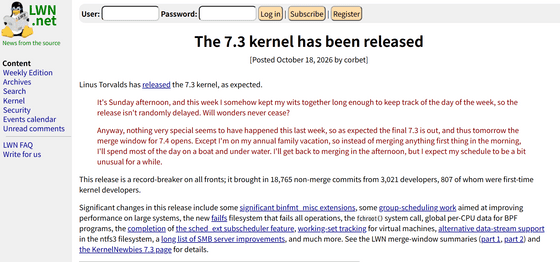
The kernel, the fundamental part of the OS, manages the CPU, memory, storage, and other components. In Linux, performance improvements and feature additions are made with each new version release. The following changes were made in Linux 7.3:
◆ Compatible with Apple's 'Time Machine'
The Linux kernel-based file sharing server 'ksmbd' now supports Apple's backup feature, 'Time Machine.' While it was previously possible to back up Mac data to a Linux server using the file sharing software 'Samba,' Linux 7.3 allows network-based backups using ksmbd as well. Note that Time Machine support must be enabled in the settings.
◆Improved CPU and memory management efficiency
The mechanism for efficiently allocating processing on servers with multiple CPUs has been improved. In addition, 'sched_ext,' which allows for flexible adjustment of the order in which processes are executed on the CPU, has been enhanced, enabling the use of different processing allocation methods for each group.
sched_ext is used in a wide range of applications, from game consoles to large-scale servers, and in the past, Meta even adopted a Linux scheduler developed for Steam Deck for its own servers.
Meta uses a Linux scheduler designed for Valve's Steam Deck on its own servers - GIGAZINE

For virtual machines, a feature has been added that tracks frequently used memory areas, allowing for a more detailed understanding of memory usage.
◆ Added 'failfs' to restrict file access.
A new filesystem called 'failfs' has been added to restrict programmatic file access. Combined with the new system call 'fchroot()', it prevents programs from accessing files using normal file paths, limiting access to only pre-authorized files. This is intended to reduce the risk of other files being accessed even if a program malfunctions.
◆Improve file system performance
The read and write performance of the Linux file systems 'Btrfs' and 'ext4' has been improved. Btrfs is a file system that includes features such as data corruption detection and a 'snapshot' function that saves data at a specific point in time.
A record of using the Linux file system 'Btrfs' for 5 years - GIGAZINE

Furthermore, ntfs3, which handles the NTFS format used in Windows, now supports 'alternate data streams,' which allow information separate from regular data to be stored in a single file. Regarding NTFS support in Linux, a kernel patch containing as many as 27,000 lines of code was proposed in the past, which has also generated considerable discussion.
A Linux kernel patch containing 27,000 lines of code in a single file was sent to someone - GIGAZINE

In addition, Linux 7.3 includes the following new features and improvements:
◆Processor Platform Related
- Added a function to manage data for each CPU in the BPF program.
- Preparing for support of AMD's next-generation CPU architecture, 'Zen 6'
◆Graphics related
- Improved memory management for GPUs with limited video memory.
- Improved game performance on some GPU environments.
- Various improvements to graphics-related drivers
◆File System and Storage Related
- Streamlining file processing in FUSE
- Added 'fchroot()' to change the program's root directory.
◆Network and virtualization related
- Enhanced encryption capabilities for SMB servers, etc.
- Improved communication security and compatibility on SMB servers
Linux 7.3 incorporated 18,765 changes, excluding merge commits, with 3,021 developers participating. Of these, 807 were first-time participants, setting new records in terms of both the number of changes and participants.
Torvalds explained that 'nothing particularly unusual happened' with the release of Linux 7.3, and that development on the next version, Linux 7.4, has already begun. He also mentioned that because he is currently on his annual family trip, the development schedule for Linux 7.4 may be extended by one week from the usual two-week change incorporation period.
Related Posts:








in Software, Posted by log1d_ts