A YouTuber built an 'automatic license plate photography system' to track police cars, which resulted in police officers showing up at his home.
In the United States,
YouTuber Says Cops Paid Him a Visit After He Built Flock-Style Camera to Track Cops
https://gizmodo.com/youtuber-says-cops-paid-him-a-visit-after-he-built-flock-style-camera-to-track-cops-2000824306
While ALPR cameras themselves are not particularly rare, their use has exploded in recent years. However, the discovery of numerous cases of misuse by law enforcement officials has drastically changed public perception of ALPR cameras.
Police chief found to have used 'Flock' license plate tracking system to stalk his ex-girlfriend - GIGAZINE

Anthony Sistilli, a software engineer and YouTuber, was inspired to build his own ALPR camera to track police car movements after a high-resolution camera and ALPR system was installed in Brampton, Ontario, Canada, where he lives, at a cost of 2 million Canadian dollars (approximately 222 million yen).
Sistilli has posted several videos on TikTok about the ALPR camera, explaining how it's made and how it works, and posting that he's 'using Flock's surveillance cameras to Flock's friends (the police).'
@anthonysistilli i built a personal flock surveillance camera to flock the flockers (only tracks police cars)
♬ original sound - Anthony sistilli
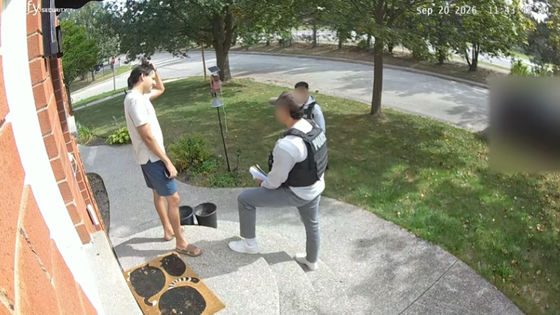
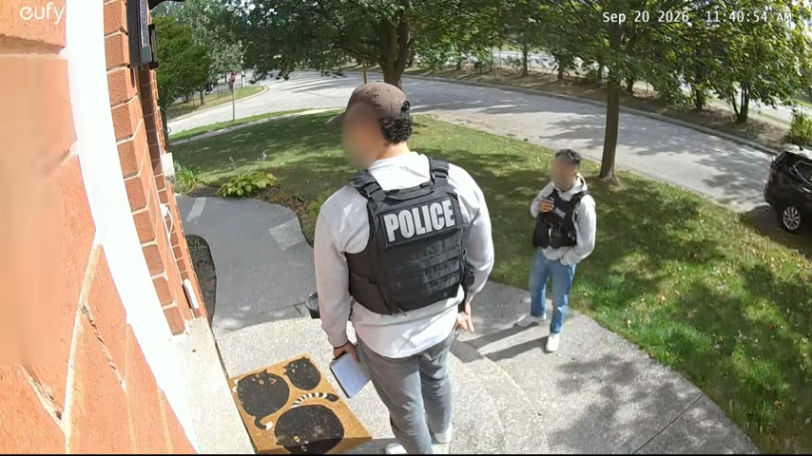
While he was engaged in these activities, local police became aware of Mr. Sistilli's homemade ALPR camera and visited his home to inquire about the 'intention' behind the data he was collecting.
I Investigated Flock Cameras. Then Police Came to My Door. - YouTube
According to Sistilli, one of the police officers who visited his home specifically mentioned how terrifying it would be for police officers if people could find out where they are, what their working hours are, and what they do during the day.
Sistilli conducted his own investigation into why ALPR cameras, which are viewed with suspicion by both the police (the surveillance side) and the general public (the monitored side), continue to increase in number in the United States and Canada.
The first person Sistilli spoke to was Jonathan Kaufman, a city council member in Fulgarville, Texas, where the Flock Safety cameras were to be removed. According to Kaufman, the reason for removing the Flock Safety cameras in Fulgarville was that a citizen asked Flock Safety how police officers were searching data in Fulgarville.
The citizen simply wanted to know the number of searches and their details, but upon reviewing the data provided by Flock Safety, it was discovered that not only the Fulgarville police but also 459 other agencies had searched and viewed the data collected by Flock Safety cameras in Fulgarville. It was also revealed that while Fulgarville's data was searched more than 1.6 million times, only 3% (5,078 times) of those searches were conducted by Fulgarville's government agencies.
When the Fulgarville City Council contacted Flock Safety about this, the company responded, 'It appears there is some kind of problem with the system. We apologize and will fix it,' explaining that the data being shared with organizations outside of Fulgarville was due to some kind of bug. However, a similar situation occurred in Richmond, California, where an update automatically enabled the sharing of collected data, making it possible for external organizations to inspect and view the data.
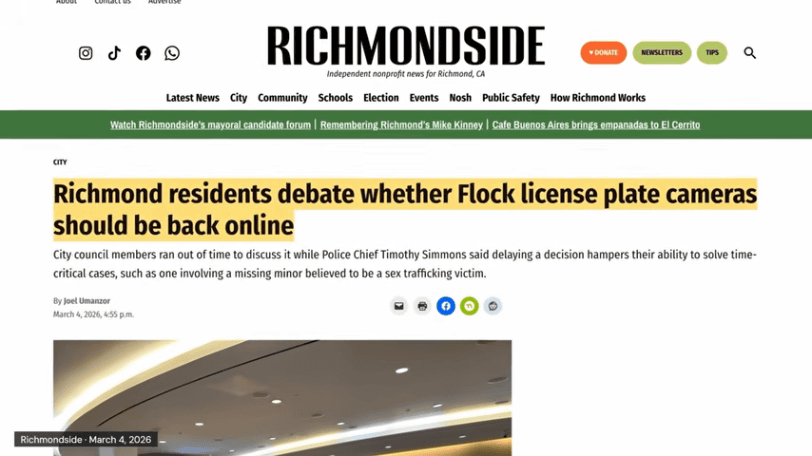
Regarding Flock Safety cameras, law enforcement agencies such as the police have commented that they are 'effective in maintaining public order,' and in fact, in Richmond, where Flock Safety cameras were temporarily suspended, they have been reactivated at the request of the police.
However, Sistilli points out that there is no research actually showing that Flock Safety cameras are effective in maintaining public order. In August 2026, the University of South Carolina compared police departments using Flock Safety cameras with those not using them and announced that the introduction of Flock Safety cameras reduced vehicle theft by 11% and improved the resolution rate of cases after vehicle theft by 16%. However,
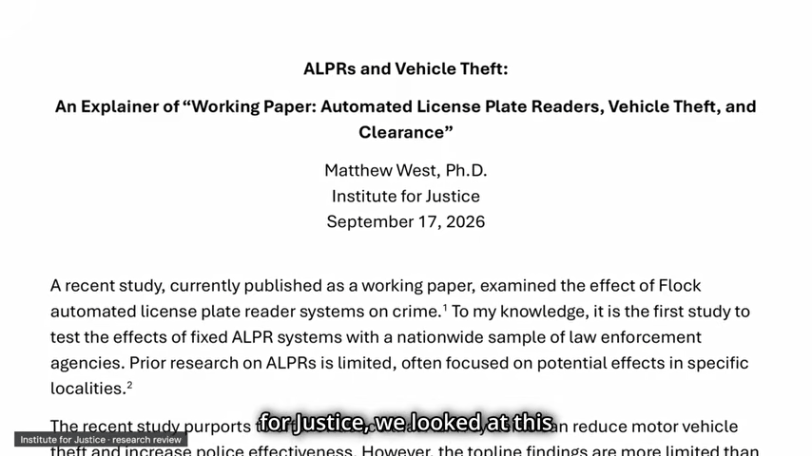
'I wondered why so many government agencies were installing Flock Safety cameras when the effectiveness of doing so hadn't been clearly proven by data,' Sistilli said.
According to his research, many cities were initially marketed Flock Safety as a 'solution to increase the recovery rate of stolen vehicles' when it wasn't yet a large-scale surveillance system. Over the next few years, Flock Safety updated its system and transformed into a large-scale surveillance system.
After the system transformed into a large-scale surveillance system, Flock Safety changed its marketing strategy. They created a thick manual to persuade skeptical city council members and others regarding the Flock Safety system. This manual reportedly describes methods for pressuring law enforcement agencies, such as the police, to make city council members believe that if crime occurs without the Flock Safety system being implemented, it will be the politicians' responsibility.
In other words, politicians end up supporting the introduction of the Flock Safety system because they fear being politically challenged by the police, who might say, 'We could have saved the kidnapped child at that time, but because you regulated Flock Safety, the child died.' This tactic is known as the Willie Horton effect .
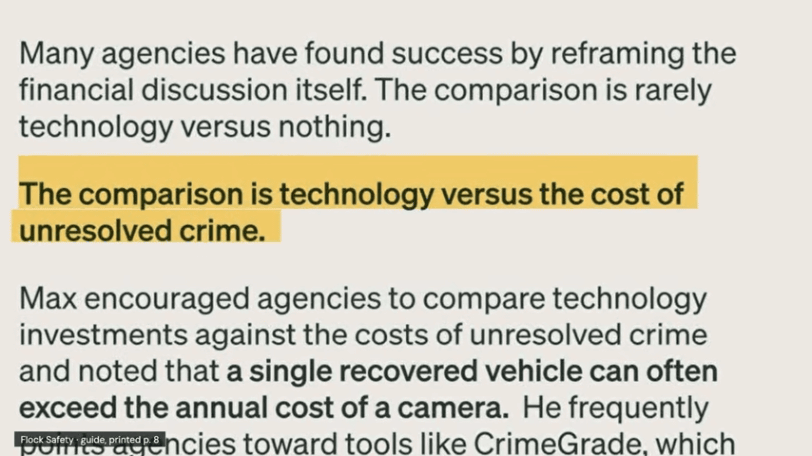
Regarding the Flock Safety manual, Sistilli pointed out that it was 'like creating a guide to cheating.' He added, 'I honestly thought it was a satirical PDF someone had made to mock Flock Safety,' expressing his astonishment at the sloppiness of the content.
Related Posts:




in Video, Posted by logu_ii