Raw chicken food poisoning may be reduced with 'blue light,' and it may also be effective against antibiotic-resistant bacteria.
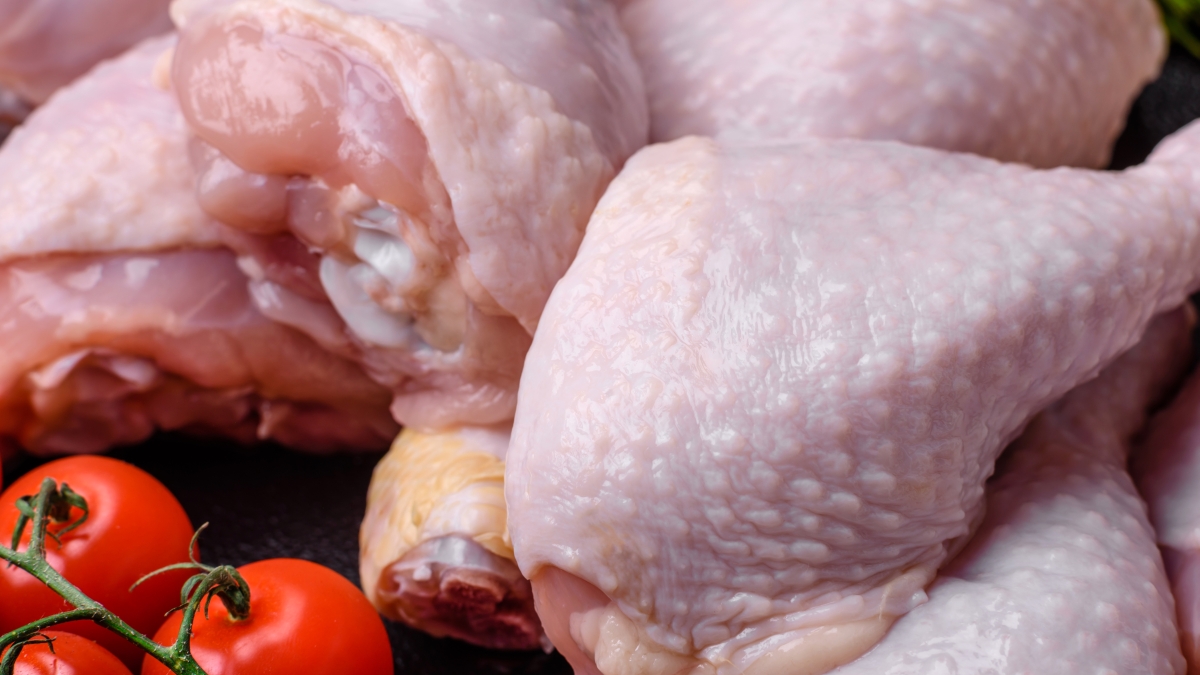
Campylobacter bacteria present on raw chicken can be transferred to other foods via hands or cooking utensils during preparation, potentially causing food poisoning. A research team from the University of Reading and the Animal and Plant Health Agency (APHA) in the UK investigated the effectiveness of blue light sterilization using 64 strains of Campylobacter from three different species.
One light to rule them all: photodynamic inactivation of diverse Campylobacter | Microbiology Society
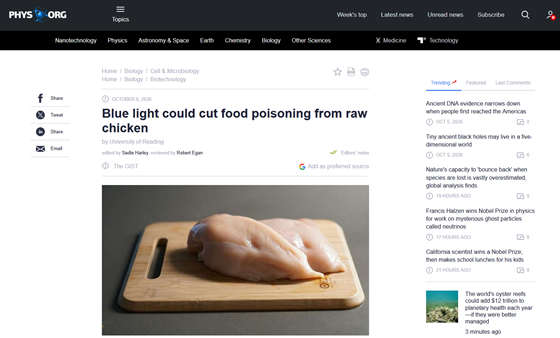
Blue light could cut food poisoning from raw chicken
https://phys.org/news/2026-10-blue-food-poisoning-raw-chicken.html
Campylobacter is one of the main causes of bacterial food poisoning. Infection can cause abdominal pain, fever, and diarrhea, and symptoms usually last for about a week.
A research team led by Aidan Taylor, a lecturer in microbiology at the University of Reading, has tested a method called 'photodynamic inactivation (VB-PDI),' which uses blue-violet light with a wavelength of 405 nm. In this method, molecules naturally present in bacterial cells react to light and generate reactive oxygen species, which damage the cells and kill the bacteria. Because it does not require the addition of chemicals or contact of equipment with food, the research team hopes that it can be used as a method to sterilize the surface of chicken at processing plants before it reaches consumers.
In previous studies, the research team had confirmed the bactericidal effect on 'standard strains' used as a reference in experiments, but this time they investigated whether the same effect would be observed on bacteria collected from chickens, turkeys, and poultry farms. They used 64 strains of Campylobacter from three species collected by APHA through surveillance surveys from 2008 to 2024. After exposing the liquid containing the bacteria to light of varying intensities for 20 minutes, they measured the number of bacteria that could grow in culture and compared it to the number of bacteria when no light was applied.
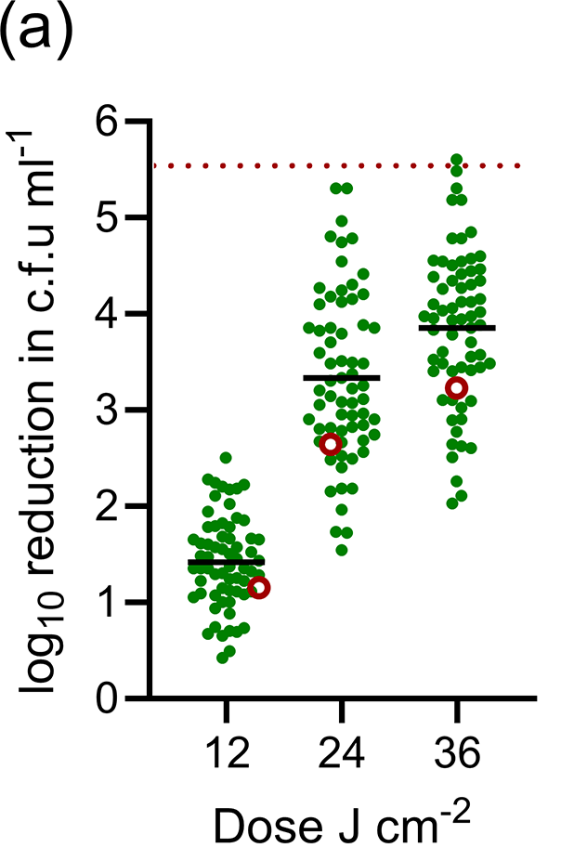
The results showed that the number of surviving bacteria decreased with increasing light exposure. When exposed to the maximum dose of 36 joules per square centimeter, the number of bacteria in all 64 strains decreased by at least 99% compared to when no light was applied. No difference in bactericidal effect was observed depending on the type of bacteria.
The graph below shows the amount of light irradiation per square centimeter on the horizontal axis and the reduction in bacterial count compared to when no light was applied on the vertical axis. A value of '2' on the vertical axis means that the bacterial count was reduced to 1/100th (99% reduction), and a value of '3' means that it was reduced to 1/1000th (99.9% reduction). The green dots represent the results for each bacterial strain, the black horizontal line is the median of the results for 64 strains, and the red circles represent the results of the standard strain used for comparison. The red dotted line also indicates the limit at which the number of surviving bacteria becomes too small to measure using this method.
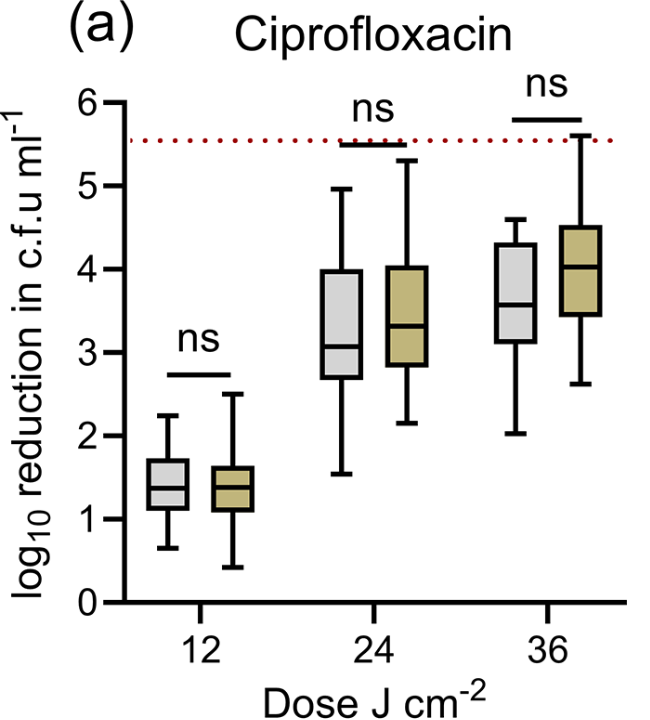
Next, the research team compared the bactericidal effect of blue light on antibiotic-resistant and non-antibiotic bacteria. No difference in bactericidal effect was observed between ciprofloxacin, tetracycline, and ertapenem based on antibiotic resistance. Furthermore, the bactericidal effect of blue light was confirmed even in multidrug-resistant bacteria resistant to three or more antibiotic classes.
The graph below compares the bactericidal effect of blue light on bacteria resistant to ciprofloxacin and those that are not. The gray boxes represent results for non-resistant bacteria, and the light yellow boxes represent results for resistant bacteria. The horizontal axis represents the amount of light irradiation per square centimeter, and the vertical axis represents the reduction in bacterial count compared to when no light was applied.
The research team also investigated whether the bacteria would acquire resistance to blue light after repeated exposure, making them less likely to die when exposed to light. Using one strain of Campylobacter jejuni, they cultured and increased the number of bacteria that survived exposure to light, and repeated the process of exposure to light 15 times. They found no signs of increased resistance to blue light. However, the research team states that further investigation is needed to completely rule out the possibility of resistance developing.
The research team estimates that if they can reduce the number of Campylobacter bacteria on chicken meat to one-hundredth of its original level, they can lower the percentage of chicken meat with more than 1,000 bacteria per gram of skin from 10% to 2%. This 2% figure is based on past survey data of commercially available chicken meat, assuming that the bacterial count will be reduced to one-hundredth. Because the low-power LEDs used for blue light irradiation have a long lifespan and low maintenance costs, the research team hopes that they can introduce blue light sterilization at a reduced cost.
This experiment focused on bacteria in liquid, and according to the research team, bacteria on chicken skin may be more likely to survive light exposure compared to bacteria in liquid. They also suggest that the biofilm, a film-like aggregate formed when bacteria adhere to the surface, may block the light. The research team states that for practical application, it is necessary to conduct tests in actual processing facilities, shining light on chicken meat that already has bacteria on it to confirm the sterilization effect.
Related Posts: