Research suggests that the impact of AI adoption on employment is concentrated among younger generations.
While concerns are growing that AI will take away human jobs, simply looking at the labor market as a whole doesn't reveal which segments are being affected. A research team at Stanford University's Digital Economy Institute has reported the results of an analysis of employment changes that have occurred since the proliferation of generative AI, broken down by age and occupation.
Canaries in the Coal Mine? Six Facts about the Recent Employment Effects of Artificial Intelligence - Stanford Digital Economy Lab
AI is hitting entry-level jobs hardest, Stanford study finds - Ars Technica
https://arstechnica.com/ai/2026/08/ai-is-hitting-entry-level-jobs-hardest-stanford-study-finds/
A research team led by Eric Brynjolfsson, a professor at Stanford University's Digital Economy Institute and one of the most cited authors in the field of information economics, analyzed anonymized payroll records of millions of people held by payroll service company ADP and published 'six facts' about the changes in employment observed after the proliferation of generative AI. The first edition, published in August 2025, estimated that employment for 22-25 year olds in occupations most vulnerable to the impact of AI, such as software developers and customer service representatives, had decreased by a relative 13%.
A Stanford University study found that introducing AI could reduce the employment of young workers by as much as 13% - GIGAZINE

The research team then revised their paper on August 12, 2026, extending the analysis period to June 2026. The analysis primarily used company records that could be continuously verified monthly from January 2021 to June 2026, including 3.5 million to 5 million full-time workers per month.
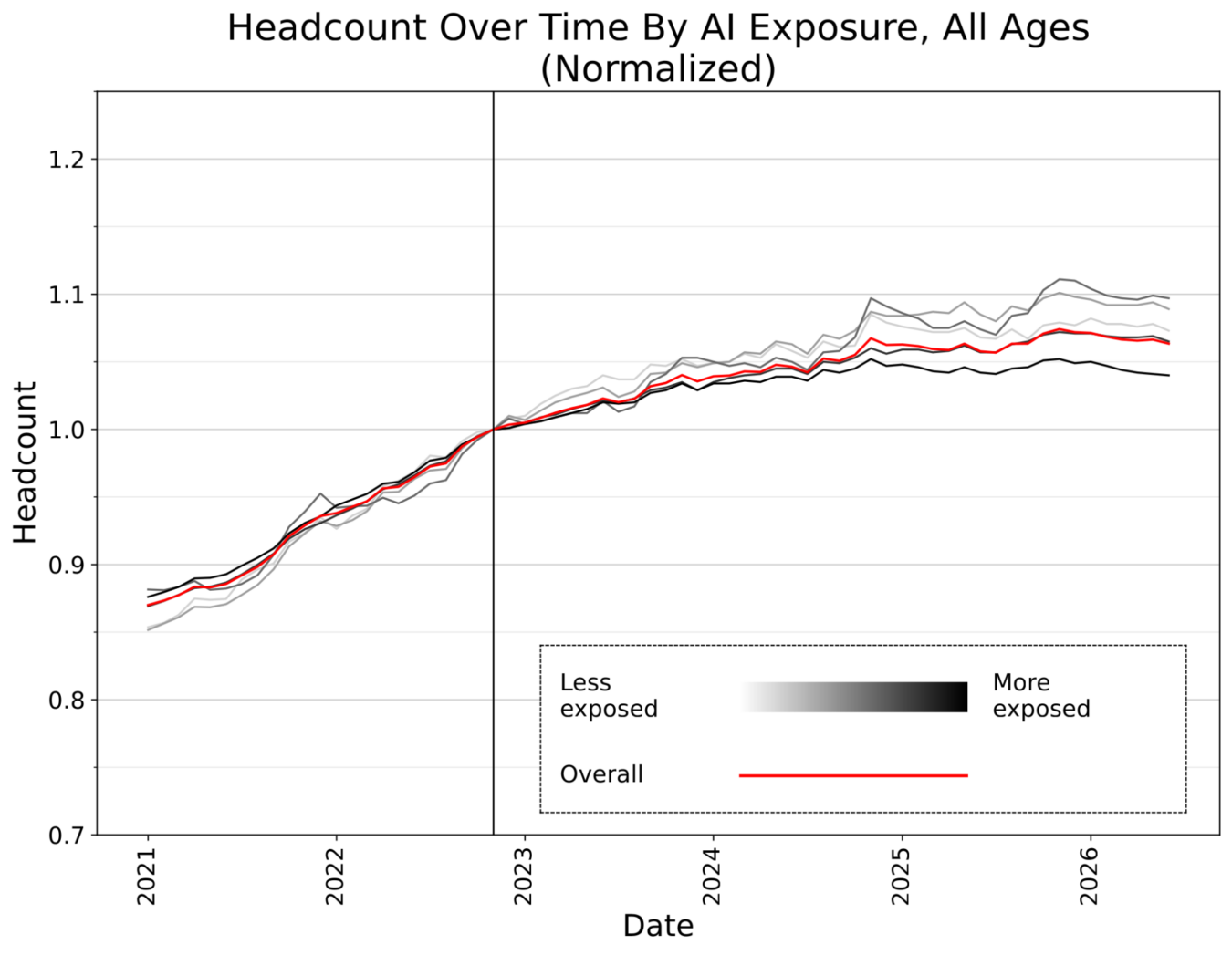
The research team used existing assessments showing the extent to which each job function could be automated with GPT-4 to categorize jobs into five levels based on their susceptibility to AI. The results showed that overall employment increased by approximately 6% between November 2022 and June 2026, and even the group most susceptible to AI increased by approximately 4%, indicating that AI was not causing widespread job losses across a broad range of occupations. The horizontal axis of the graph below represents the month and year, while the vertical axis is an index with the number of employees in November 2022 set to a baseline of 1. Darker black lines represent jobs more susceptible to AI, while the red line represents the overall trend across the surveyed area.
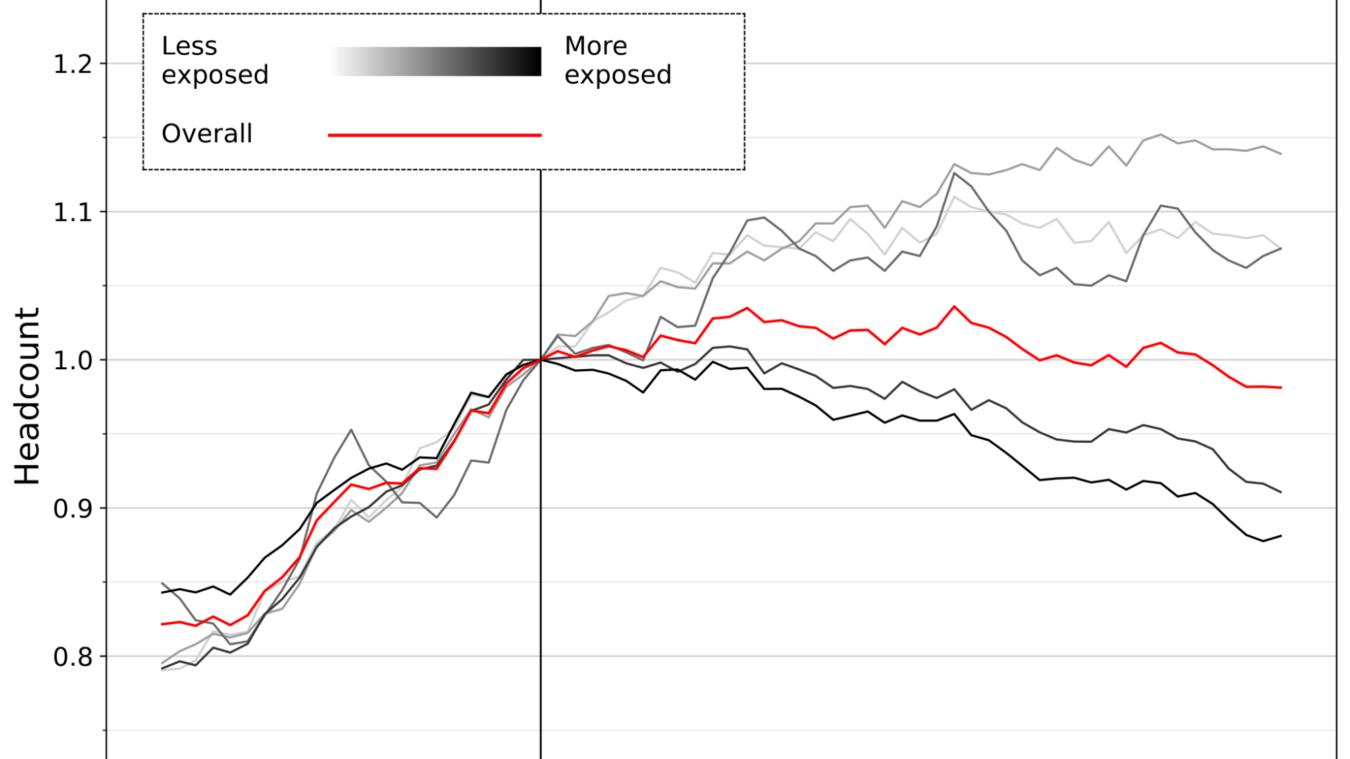
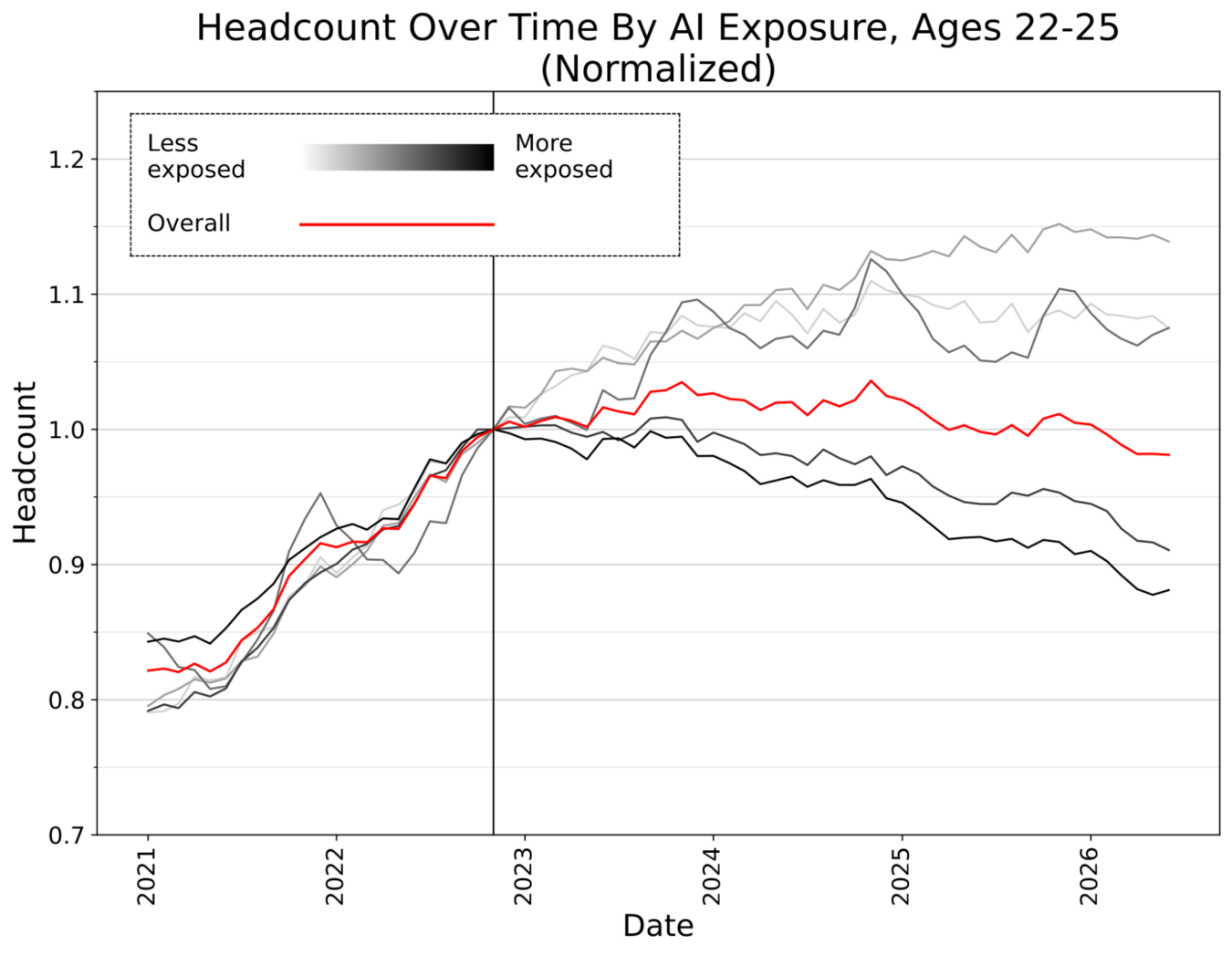
However, a significant difference emerged when the analysis was narrowed to those aged 22-25. Employment in the top 40% of occupations most susceptible to AI declined by approximately 11%, while it increased by approximately 10% in the remaining 60%. Assuming that employment in susceptible occupations increased at the same pace as other occupations, actual employment would be 19% lower than the level it should have reached.
On the other hand, a similar disparity was not observed among veteran workers, and the research team reported that employment increased by approximately 10% even in the top 40% of occupations susceptible to AI impact among those aged 35 to 49. In the graph below, the horizontal axis represents the year and month, and the vertical axis is an index with the number of employed persons in November 2022 set to a baseline of 1. The darker the black line, the more susceptible the occupation is to AI impact, and the red line represents the overall trend for those aged 22 to 25.
It should be noted that the 13% employment decline for young workers shown in the first edition was calculated taking into account factors such as economic fluctuations for each company, and the calculation method differs from the 19% shown in the revised edition. Looking at the same simple comparison, the gap, which was 15% in July 2025, has widened to 19% by June 2026.
The research team reported that the main reason for the decline in young people's employment was 'a decrease in hiring, not an increase in layoffs or resignations.' Since 2022, the turnover rate has decreased in both occupations heavily and less affected by AI, and an increase in the number of people leaving cannot explain the difference between the two. On the other hand, the hiring rate for those aged 22-25 was lower in occupations heavily affected by AI, and the gap widened since 2022.
Furthermore, using Anthropic's 'Anthropic Economic Index,' which compiles Claude usage data, a comparison was made between uses where AI 'replaces' human work and uses where AI 'supplements' human work. The results showed that the higher the proportion of jobs where AI replaces human work, the greater the decrease in employment among 22-25 year olds.
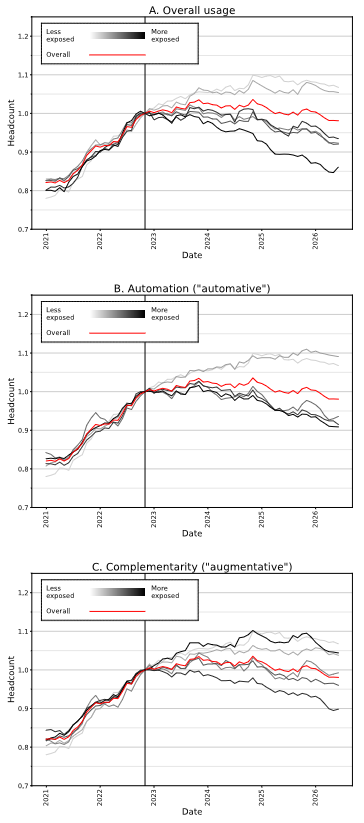
On the other hand, the research team reports that in occupations where AI largely replaces human work, a similar decline in employment among younger workers was not observed, and employment among mid-career and veteran workers remained stable or increased. The following three graphs show the employment trends for 22-25 year olds, categorized by occupation based on 'overall use of Claude,' 'use to replace human work,' and 'use to supplement human work.' The horizontal axis represents the year and month, and the vertical axis is an index with the number of employees in November 2022 set to a baseline of 1. The darker the black line, the higher the utilization rate in each occupation, and the red line represents the overall trend for 22-25 year olds.
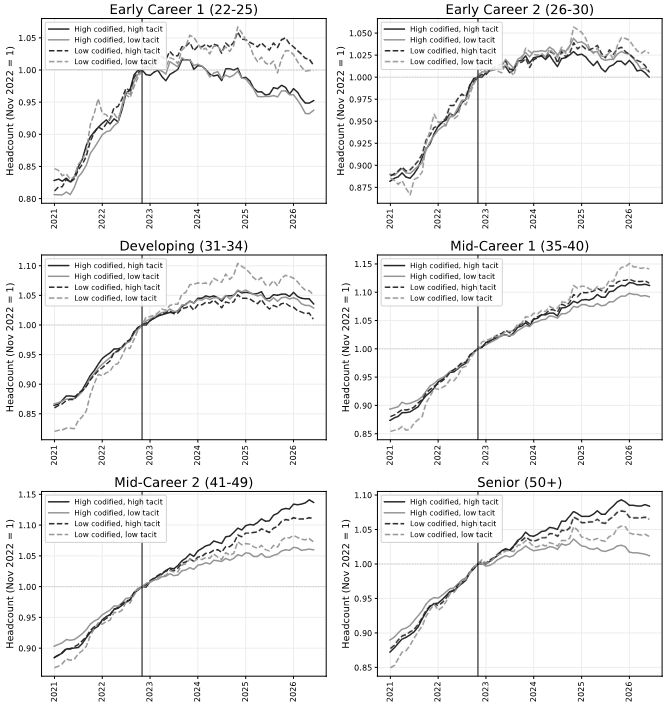
The research team considered that this age difference suggests that 'explicit knowledge,' which can be learned in schools, textbooks, and manuals, is easily replaced by generative AI, while 'tacit knowledge,' which is acquired through practice, instruction, and accumulated experience, has a greater potential for AI to compensate for the skills of experts. The analysis showed that the higher the proportion of explicit knowledge, the slower the employment growth for those aged 22-25, while the higher the proportion of tacit knowledge, the greater the employment growth for mid-career and veteran workers. The following six graphs show employment trends by age group, dividing occupations into four categories based on whether the proportion of explicit or tacit knowledge is high or low. The horizontal axis represents the year and month, and the vertical axis is an index with the number of employees in November 2022 set to a baseline of 1. Solid lines represent occupations with a high proportion of explicit knowledge, dashed lines represent occupations with a low proportion of explicit knowledge, black lines represent occupations with a high proportion of tacit knowledge, and gray lines represent occupations with a low proportion of tacit knowledge.
Even when excluding technology companies and computer-related jobs, and when considering the impact of rising interest rates and remote work, the trend of declining employment among young people in jobs susceptible to the effects of AI remained unchanged.
However, there were already different trends in employment for occupations heavily influenced by AI and those less so, even before the advent of ChatGPT, and the gap narrowed when considering the proportion of university graduates in each occupation. The research team points out that factors other than AI, such as the impact of the COVID-19 pandemic on education, may also be involved.
It should be noted that the ADP data includes more large corporations and occupations susceptible to AI impact than the data for the entire United States. While similar trends were observed in national statistics, the magnitude of the changes was smaller than in the ADP data.
The research team concluded that while this analysis alone cannot definitively conclude that generative AI caused a decline in employment among young people, the results are consistent with the hypothesis that generative AI has begun to influence employment among young people.
Related Posts: