In the United States, while racial differences in political ideology have narrowed, differences based on educational attainment have widened.
Major political ideologies in the United States can be broadly divided into three categories: '
Americans' ideological differences have decreased by race, increased by education | PNAS Nexus | Oxford Academic
https://academic.oup.com/pnasnexus/article/5/4/pgag102/8586457
The political realignment of America: Education overtakes race as key ideological divider
https://www.psypost.org/the-political-realignment-of-america-education-overtakes-race-as-key-ideological-divider/
American conservatism generally emphasizes 'reduced government size,' 'tax cuts,' 'emphasis on a market economy,' 'strict immigration control,' 'respect for traditional values,' and 'strong police and national defense.' Liberalism, on the other hand, emphasizes 'a government that is proactive in social welfare and economic regulation,' 'strong protection of minority and reproductive rights,' 'environmental protection activities,' and 'relatively lenient immigration policies.' Moderates often combine the positions of both camps, but in elections, they usually vote for either the conservative Republican Party or the liberal Democratic Party .
A 2025 survey by the research firm Gallup found that 35% of Americans identified as conservative, 33% as moderate, and 28% as liberal. Demographic differences are evident in political ideology, with trends in the U.S. such as 'women are slightly more liberal and more likely to vote for the Democratic Party than men,' 'heterosexual men are more likely to vote for the Republican Party,' and 'Black, Hispanic, and Asian voters tend to support the Democratic Party.'
In this study, Professor
Jesse analyzed data from the Cooperative Election Study , conducted during the US presidential elections of 2008, 2012, 2016, 2020, and 2024. This study collected responses from over 250,000 respondents to policy questions on issues such as taxes, abortion, immigration, healthcare, and the environment, and assessed where respondents' political ideologies fell, ranging from conservative to liberal. Data on respondents' race and educational background was also collected.
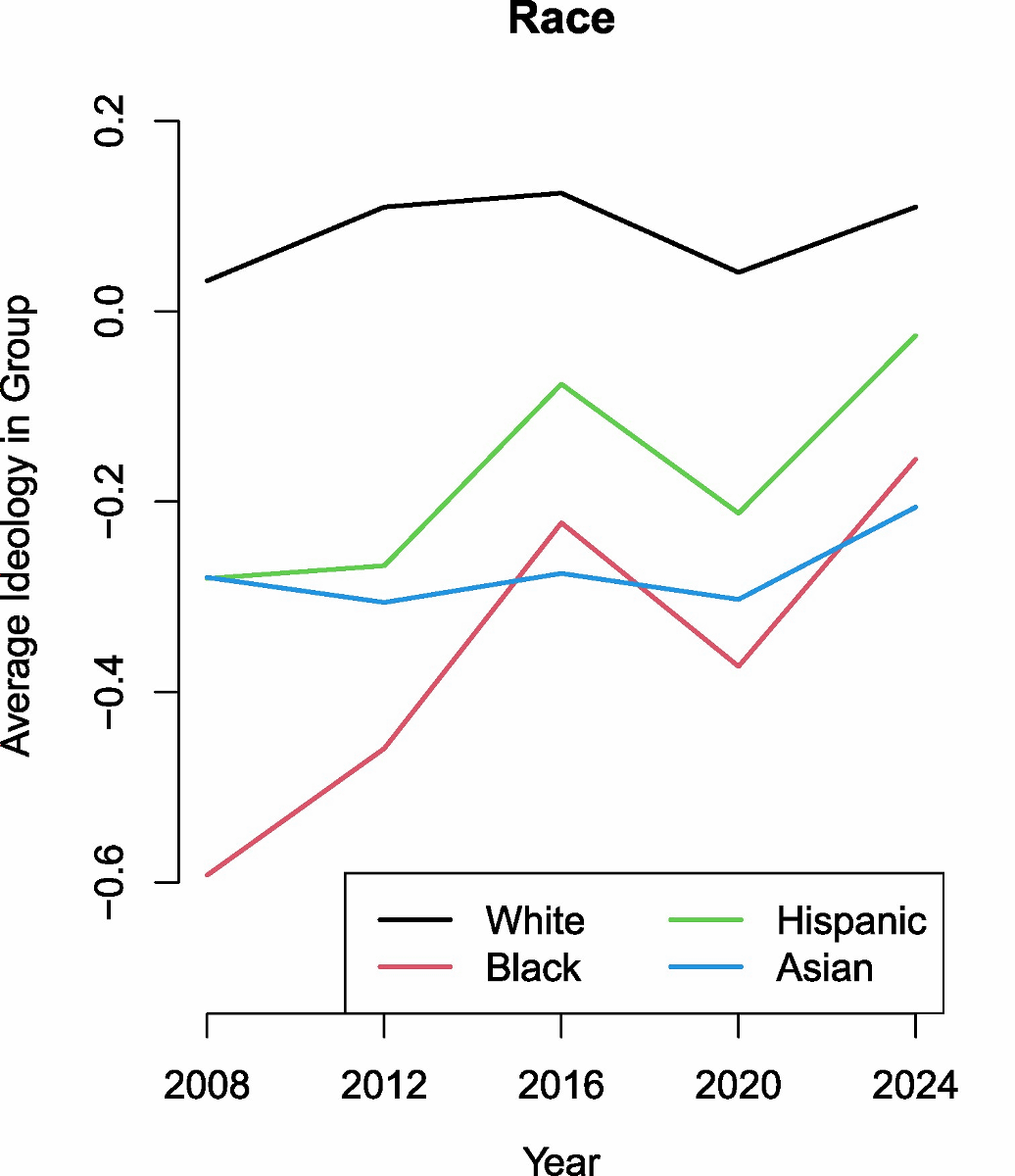
Analysis of the data revealed that in 2008, whites tended to be the most conservative, while blacks tended to be the most liberal. However, by 2024, black and Hispanic respondents had become, on average, more conservative, significantly reducing these racial ideological differences.
In contrast, ideological differences based on educational attainment have widened. As of 2008, there was a tendency for college graduates to be liberal and those with less education to be conservative, but by 2024, it has been reported that those with only a high school education or less, or those who dropped out of college, have become even more conservative, while college and graduate school graduates have become even more liberal.
The most pronounced ideological differences based on educational attainment were in 2020, when university and graduate school graduates became significantly more liberal compared to 2016. However, by 2024, respondents across all education levels had shifted generally towards conservatism, resulting in a return to liberalism among university and graduate school graduates to the same level as in 2016, while those with only a high school education became even more conservative. This polarization of political ideology based on education level was observed across all races, but was particularly pronounced among white people.
The following graph shows the ideological differences between races, with the vertical axis representing the average ideology of each group and the horizontal axis representing the year of the survey. Looking at the data for White (black line), Black (red line), Hispanic (green line), and Asian (blue line), we can see that the ideological differences between races gradually narrow.
The following graph shows the differences in ideology based on educational level. Looking at the lines for high school or junior high school graduates (black line), university dropouts (red line), university graduates (green line), and graduate school graduates (blue line), it is clear that the differences in ideology based on educational attainment gradually widen.
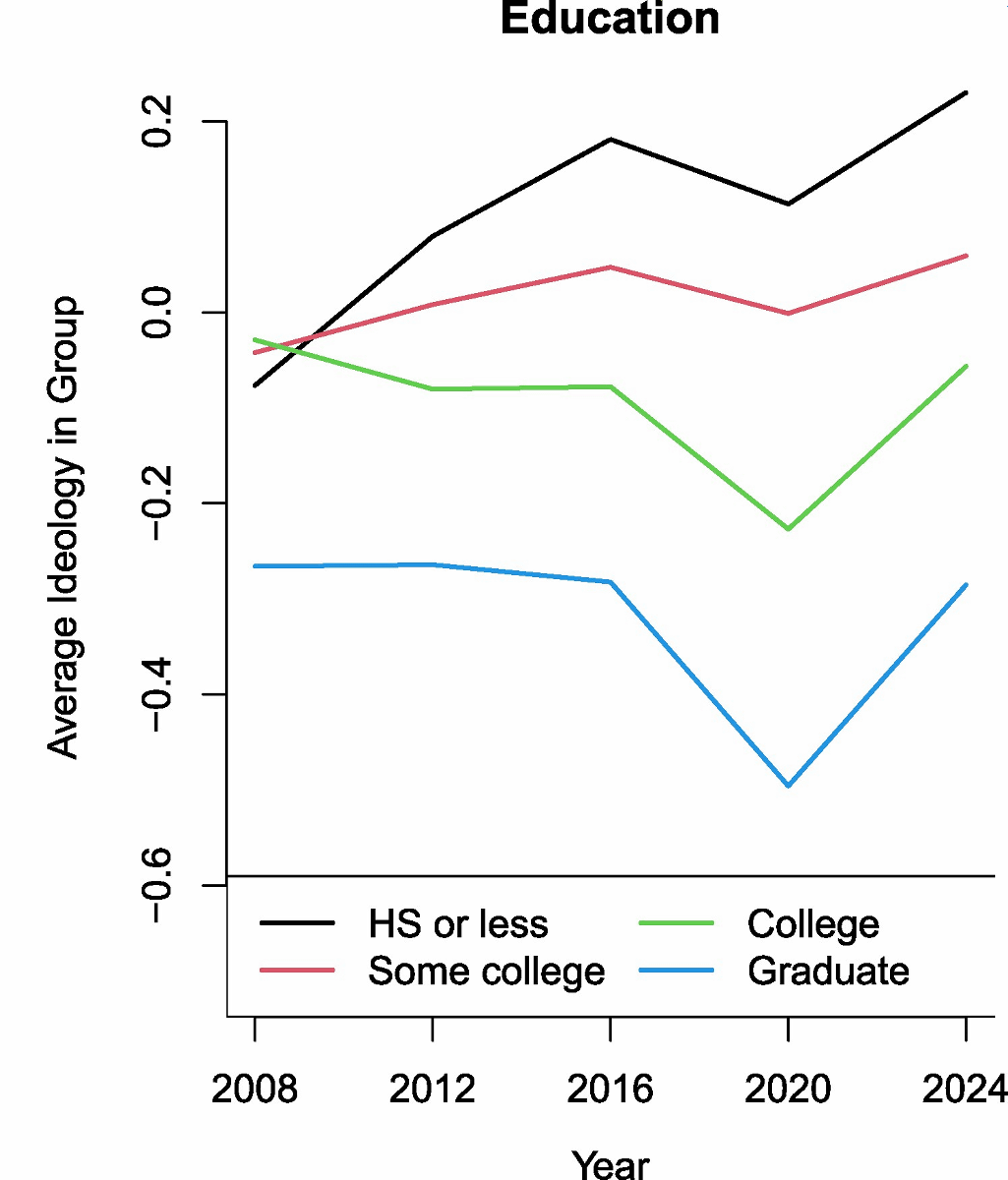
In his paper, Jesse stated, 'These results indicate that while racial ideological differences have dramatically narrowed in the last five presidential election years, educational attainment has become an increasingly prominent ideological divide. American ideologies are becoming more similar across races, primarily due to the sharp shift to the right among Black people, but also partly due to a slight shift towards conservatism among Hispanics. Differences based on educational attainment are widening across all racial groups, albeit to varying degrees.'
Related Posts:







in Science, Posted by log1h_ik