The Trump administration is reconsidering its de facto ban on foreign-made open-source AI models, citing concerns over China's rise.
The U.S. government is attempting to effectively ban foreign-made open-source AI models, and sources say that the release of the massive open AI model '
The secret Trump administration battle to fight Chinese AI
https://www.axios.com/2026/07/20/ai-us-china-open-source-kimi
The U.S. Department of Commerce announced in 2025 that it had added 80 companies based in China, the United Arab Emirates (UAE), South Africa, Iran, Taiwan, and other countries to its ' Entity List' (a list of companies subject to trade restrictions) . The government is also considering adding several other Chinese AI research institutes to the Entity List, and according to sources close to the administration who spoke to Axios, the government was considering issuing an executive order stating that 'U.S. companies can only host Chinese models if they can guarantee security and take responsibility in the event of a breach.'
The US adds 50 Chinese technology companies to its export control list, aiming to limit China's artificial intelligence and advanced computing capabilities - GIGAZINE
On the other hand, government officials, concerned that regulation would stifle innovation, had rejected proposed regulations to restrict AI in China. However, reports suggest that the movement to ban AI is gaining momentum again, coupled with the reshuffling of key figures who opposed the regulations, the rise of more powerful Chinese AI models, and new cybersecurity concerns.
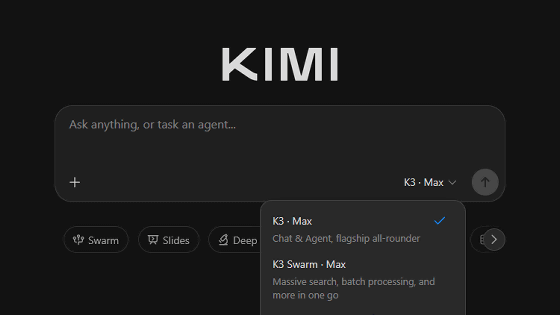
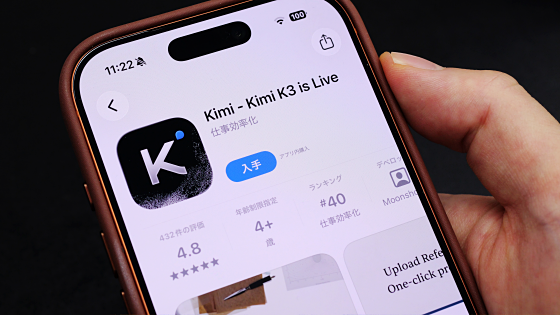
In fact, it has been reported that the US government is taking more aggressive steps to regulate competition against Moonshot AI, a Chinese company, regarding its AI model 'Kimi K3,' which was announced on July 17, 2026, Japan time. Kimi K3 has achieved scores exceeding GPT-5.6 Sol and Claude Fable 5 in some benchmark tests and has been promoted as the 'world's first open 3T-class model.' Following the rise of this open model that rivals cutting-edge American-made AI models, the Nasdaq Composite Index, which is heavily weighted towards technology stocks, fell 1.4% the following day, and the stock prices of Alphabet, Google's parent company, and Meta fell 2-4%.
'Kimi K3,' a Chinese-made AI model comparable to GPT-5.6 Sol, has emerged, a massive open model with 2.8 trillion parameters - GIGAZINE
Dean W. Ball, head of Strategic Futures at OpenAI, revealed in an X post: 'The Department of War, the Department of Transportation, the Department of Energy, the Department of Agriculture, the Department of Commerce, NASA, and Congress have all banned their employees from using Chinese-made AI on the grounds of unsubstantiated claims of danger. This is already sending a message to regulated companies. All of this has happened under this administration.'
The departments of war, transportation, energy, agriculture, commerce, NASA, and Congress have all blocked their employees from using Chinese AI, citing ill-justified claims of danger. This already has sent a message to regulated firms. All of this happened during this admin.
— Dean W. Ball (@deanwball) July 19, 2026
Furthermore, investor and co-chair of the President's Advisory Council on Science and Technology, David Sachs, posted, 'We are at a critical turning point in AI policy. The two dominant AI research institutions, already in terms of revenue from AI models, are calling on governments to eliminate open-source competitors.' These two dominant AI research institutions are likely OpenAI and Anthropic.
I'm not sure whether Dean Ball is confessing to a regulatory capture strategy or simply predicting this will happen (he now says the latter). Either way, the weaponization of regulatory uncertainty as a competitive tool should be completely unacceptable.
— David Sacks (@DavidSacks) July 19, 2026
He argues there's no… https://t.co/ZxIFabAJZW pic.twitter.com/0eLk6ltU0F
Ben Thompson, author of the Stratechery column which analyzes the impact of technology on society, challenges the view that Chinese openweight AI models are an overreach of threat. While Chinese models such as Kimi K3 are rapidly approaching the cutting edge in terms of performance, Thompson analyzes that the AI market will need a better cost structure to increase profitability in the future. According to Thompson, Anthropic and OpenAI are simply setting high prices due to the current excess demand, and Chinese models have not yet reached the stage where they can offer performance equivalent to OpenAI and Anthropic at a lower price. On the other hand, he analyzes that as GPU supply increases and AI becomes commoditized, price competition will become important.
It is believed that China's aim in promoting its open weight strategy is not to develop AI models themselves, but rather to develop entire industries in which China has strengths, such as robotics. Therefore, Thompson argues that the United States should not exclude the Chinese model, but rather foster an open AI ecosystem within its own country to promote innovation so that it can compete with China on an equal footing. In the field of cybersecurity, he also points out that an environment is needed where high-performance American-made AI can be used more freely in order to avoid dependence on Chinese models.

In response to Thompson's analysis, the social news site Hacker News is discussing the possibility that 'the ones most afraid of Chinese-made models are venture capital firms that invested astronomically high valuations in Anthropic and OpenAI.' Anthropic's valuation is projected at $1.2 trillion (approximately 194 trillion yen), and OpenAI's is projected at $850 billion (approximately 138 trillion yen), both based on the assumption that the research institutes would generate enormous profits. However, Chinese research institutes are freely releasing excellent open models, and if cutting-edge research institutes lower their prices in competition with Chinese companies, the valuation targets may not be met, and VCs could suffer significant losses. On the other hand, Thompson has pointed out that 'Chinese models are not yet good enough to trigger a price war,' and Hacker News has also noted that 'open models release training and data, and can be downloaded for free, but they cannot be run for free,' indicating that there are opposing viewpoints.
The Washington Post argues that China's restrictions on open models are 'actually a welcome form of legitimate competition.' According to The Washington Post, making AI models publicly available is not a manifestation of technological ideals or a geopolitical strategy, but a business strategy that has a proven track record of building large, profitable companies over 30 years. Therefore, it points out that viewing open model AI as a threat that should be managed through licensing is a misunderstanding of the very normal activity of competition as a threat that should be regulated.
Perry Metzger, a software developer with over 20 years of experience in AI development, told The New York Times that the decline in technology stocks following the release of Kimi K3 'doesn't fundamentally change anything. The problem is that the vast majority of investors have absolutely no idea what these systems actually do, how companies are making money from them, or what the news means .'
Related Posts:






in AI, Posted by log1e_dh