Psychologist Peter Gray argues that the main cause of the mental health crisis among teenagers is not smartphones, but 'the stress of having to get good grades at school,' challenging Jonathan Haidt's theory that 'social media is to blame for the deterioration of youth mental health.'

Psychologist Peter Gray says the reason why teenagers' mental health is deteriorating is not because social media is having a negative impact on them, but because of the stress of having to do well in school.
What if It's Not the Phones? - The Atlantic
What's the matter with kids today? Phones? Common Core?
https://www.joannejacobs.com/post/what-s-the-matter-with-kids-today-phones-common-core
Peter Gray, an 82-year-old psychologist, defines 'play' as a self-directed activity undertaken for its own sake. Gray believes that 'through play, children can learn to solve their own problems, develop relationships, create their own rules, and overcome disappointment.'
However, Gray feels that it has become increasingly difficult for children to learn through play compared to his own childhood. Modern children spend most of their day indoors, have less free time, are forced to participate in organized sports under adult supervision, and rarely go anywhere on their own. Gray was convinced that this loss of independence was negatively impacting children's mental health.
Gray presented these claims in her 2013 book, ' Play is Essential for Learning: Fostering Independent Learners .' Gray argues that children thrive when they have ample experience with unsupervised and unstructured outdoor play, and this argument quickly gained many supporters, particularly those who advocate for laissez-faire parenting.
Amazon.co.jp: Why Play is Essential to Learning: Fostering Independent Learners: Peter Gray, Shinichiro Yoshida: Book

Jonathan Haidt, a social psychologist who co-founded the non-profit organization Let Grow, which promotes children's independence, with Gray, published a book in 2023 titled ' The Anxious Generation: Why Smartphones and Social Media are Eroding the Minds of Children and Young People, ' in which he argued that 'the deterioration of youth mental health is due to social media.' This book quickly became a bestseller and has had a significant impact, urging schools to ban children's smartphone use and prompting politicians to introduce legislation banning social media use for children under 16.
The Anxious Generation: Why Smartphones and Social Media are Corroding the Minds of Children and Young People | Jonathan Haidt, Yukiko Nishikawa | Book | Online Shopping | Amazon

Gray countered a former colleague's claim that 'social decline in youth mental health is due to social media,' stating, 'As a society, we tend to almost reflexively think that the solution to any problem children face is to take away even more of their freedom. And this book (Haidt's 'The Anxious Generation') only exacerbates that reflexive thinking.'
Furthermore, Gray is planning to release a new book, ' Restoring Childhood: How to Set Kids Free in the Age of Anxiety,' which will refute Haidt's claim that 'social media is to blame for the deterioration of youth mental health.'
Amazon | Restoring Childhood: How to Set Kids Free in the Age of Anxiety (English Edition) [Kindle edition] by Gray, Peter | Mental Health | Kindle Store
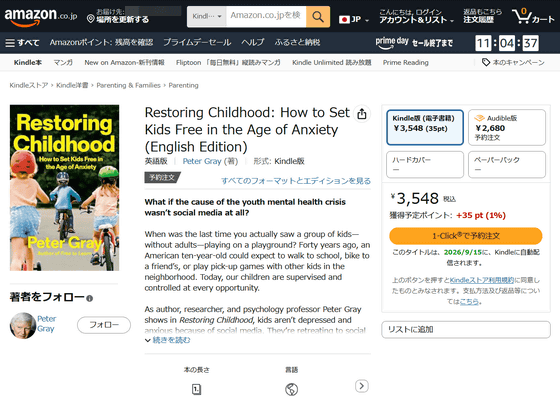
In this book, Gray argues that the children's mental health crisis is caused by school-centered stress. In particular, Gray claims that the Common Core , a set of educational standards adopted in 2010, 'narrowed teachers' creative curriculum options and increased the amount of time the average American student spends taking tests.'
Common Core is a multi-state educational initiative launched in 2010 in the United States, aiming to increase consistency in the content that American students should master in English and mathematics at the end of each school year, from kindergarten through high school. Common Core is sponsored by the National Association of State Governors and the Council of State Superintendents of Education .
According to Gray, the percentage of American teenagers who said that 'achieving good grades at school is a source of stress' jumped from 43% in 2009, before Common Core was implemented, to 83% in 2013, after Common Core was introduced. This is based on data from the ' Stress in America' report published annually by the American Psychological Association . Gray also states that similar increases in student stress levels have been observed in Sweden and the UK after school reforms were implemented, just as in the US.
However, Caitlin Tiffany of The Atlantic points out that 'it wasn't just school policies that changed between 2009 and 2013. For example, smartphone usage also surged during this period.'
Joan Jacob argues that the establishment of common educational standards like Common Core and the emphasis on accountability lead to an increase in testing. She further points out that such movements existed long before Common Core, in the 1980s. Jacob also stated that there is no evidence that common educational standards like Common Core have increased students' motivation to learn.

According to The New York Times, in the 1950s, less than half of all children attended kindergarten . Furthermore, only about 50% graduated from high school, and there were apparently no significant employment disadvantages. In contrast, today, three- and four-year-olds attend middle school full days, and kindergarteners are now working through the curriculum of what was once first grade.
It should be noted that many scholars have refuted Haidt's claim that 'the deterioration of young people's mental health is due to social media,' and Haidt has also refuted this claim.
Social psychologists directly refute criticism that 'the deterioration of youth mental health is not due to social media' - GIGAZINE

Related Posts:








in Note, Posted by logu_ii