A man suffering from severe paralysis can now communicate of his own volition thanks to an implant placed in his brain.
Long-term independent use of an intracortical brain–computer interface for speech and cursor control | Nature Medicine
https://www.nature.com/articles/s41591-026-04414-6
Brain-computer interface enables independent, accurate communication for man living with ALS
https://health.ucdavis.edu/news/headlines/brain-computer-interface-enables-independent-accurate-communication-for-man-living-with-als/2026/06
Brain Implant Lets Man With Severe Paralysis Speak in His Own Voice Again : ScienceAlert
https://www.sciencealert.com/brain-implant-lets-man-with-severe-paralysis-speak-in-his-own-voice-again
Researchers at the University of California, Davis, and the Brigham Institute for Neuroscience at Massachusetts General Hospital have jointly developed a BCI (Brain-Computer Interface) for communication among people with severe paralysis. The system features an advanced decoding algorithm that converts neural signals read through an implanted implant in the brain into text, and also allows for cursor control on a connected computer.
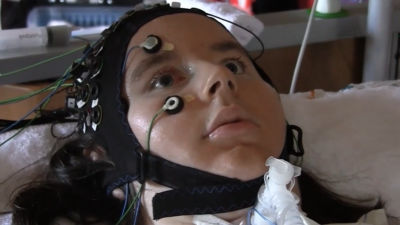
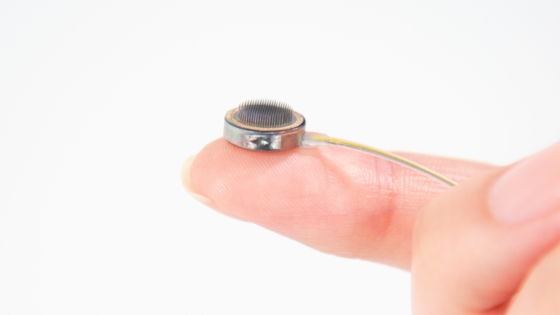
Casey Harrell, 47 years old at the time of writing and suffering from severe paralysis due to ALS, participated in a clinical trial called ' BrainGate 2 ' conducted by David Brandman and colleagues at the University of California, Davis. In 2023, Brandman and his team implanted four microelectrode arrays designed to record brain activity from 256 cortical electrodes into Harrell's left precentral gyrus , the brain region responsible for speech.
Initially, Harrell could only use the BCI system when someone on the research team set it up for him, but it was later improved so he could use it at home. Over the next two years, Harrell used the BCI system at home for a total of over 3,800 hours, during which time he was able to communicate independently for more than 183,000 sentences and approximately 2 million words. He also reported an average communication speed of 56 words per minute, and that his communication speed had improved significantly since he started using the system.
You can see Mr. Harrell actually using the BCI system to communicate in the following video.
Patient with severe paralysis 'speaks' through brain implant - YouTube
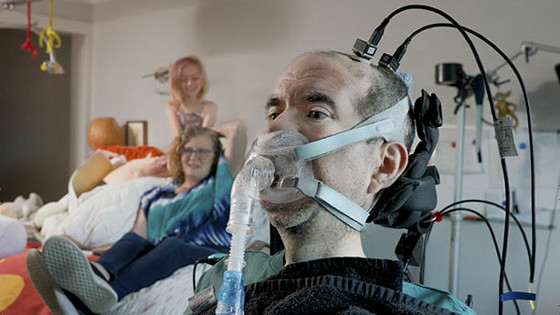
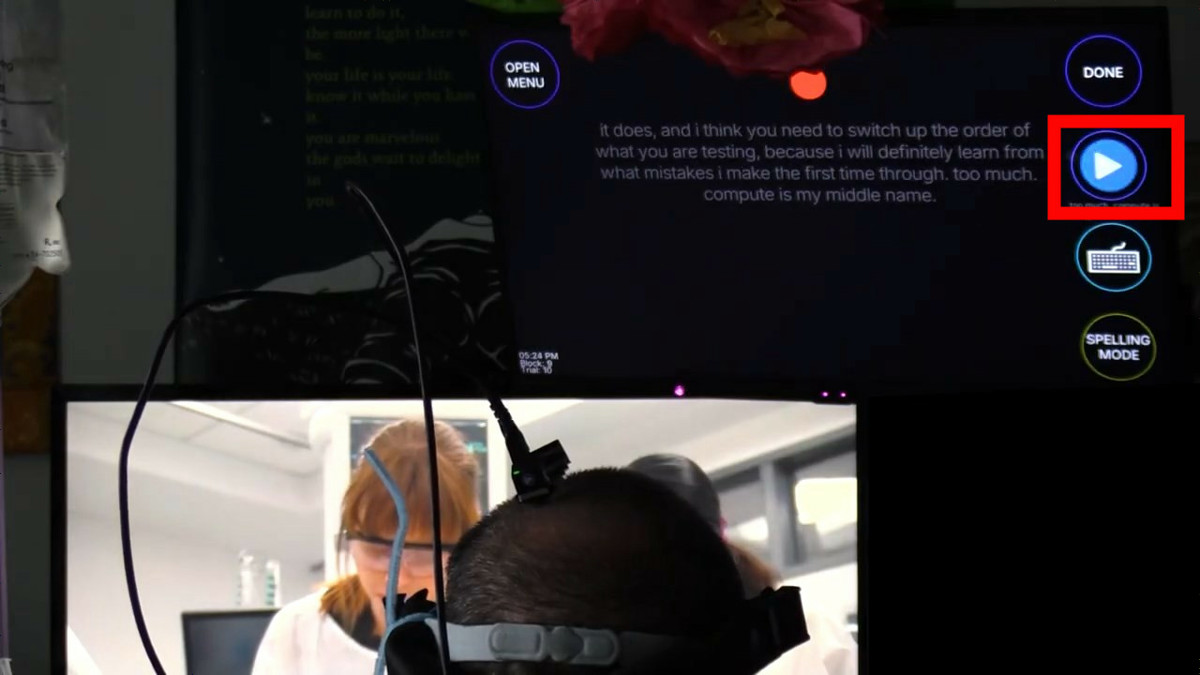
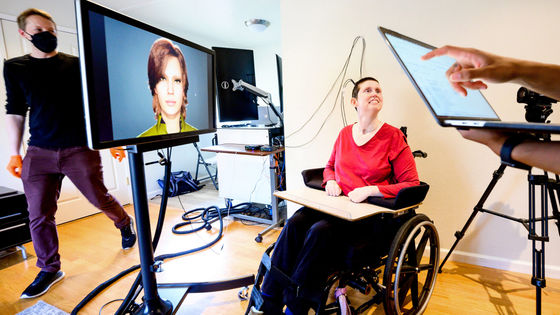
You can see that a BCI (Brain-Computer Interface) is connected to Mr. Harrell's head in the foreground, and text is displayed on the computer screen in the background. Mr. Harrell needs the help of a caregiver to connect to the BCI system, but after that, he can use it continuously throughout the day via a decoder attached to a mobile cart.
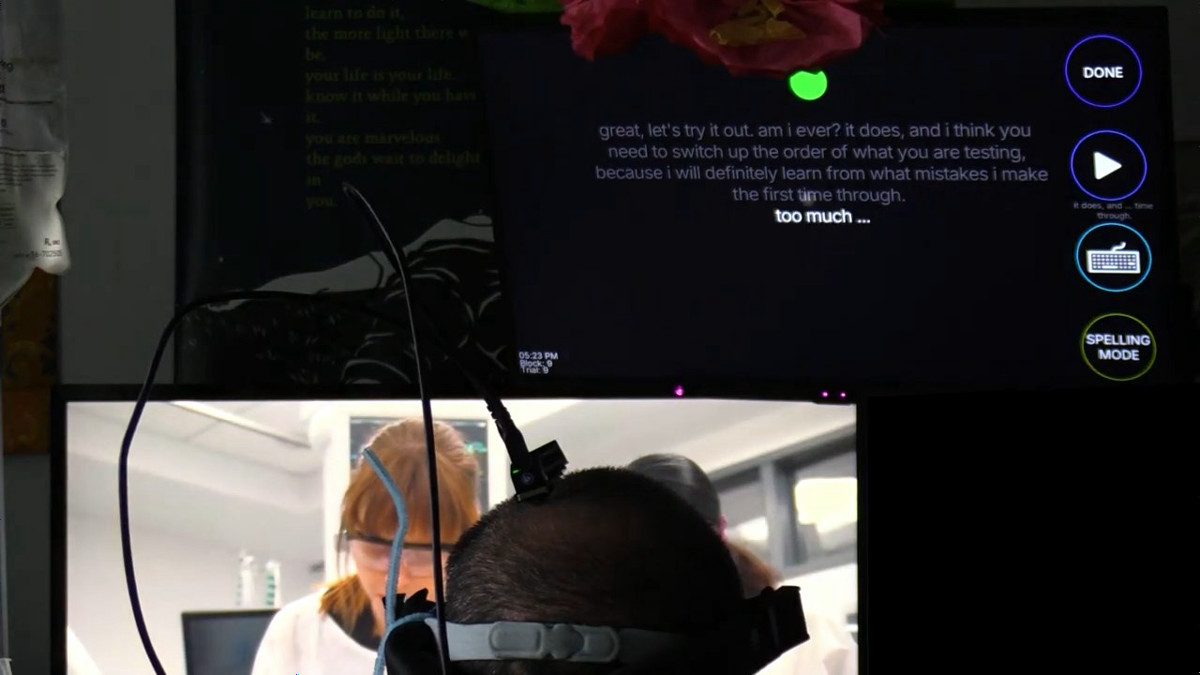
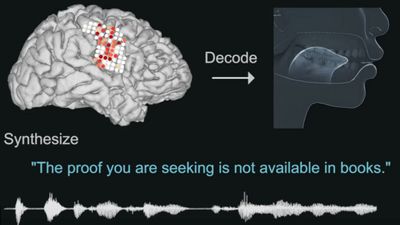
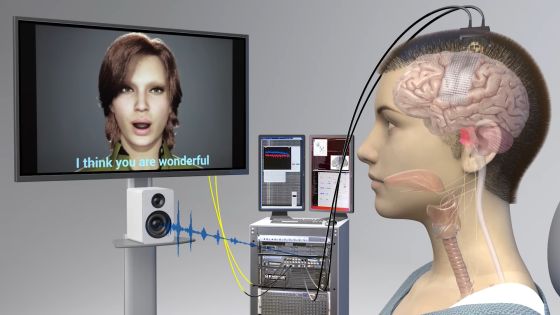
The BCI system detects the neural signals that Harrell uses when he tries to speak. This data is then converted into text by an external decoder and displayed on a computer screen in real time.
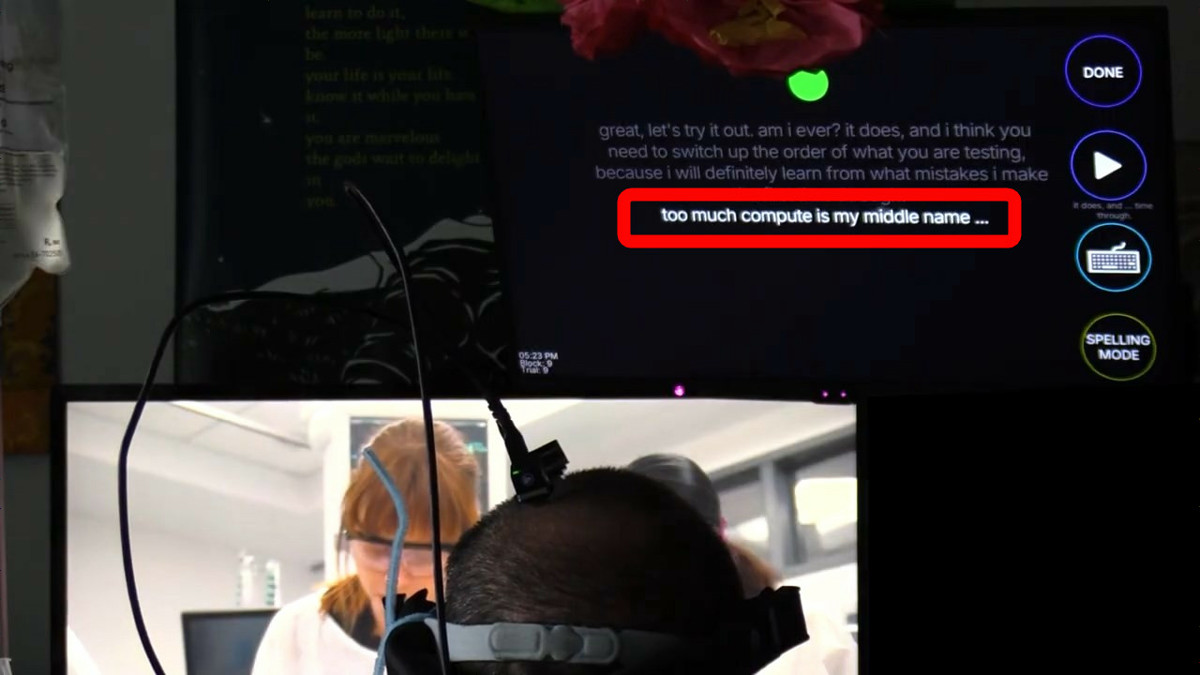
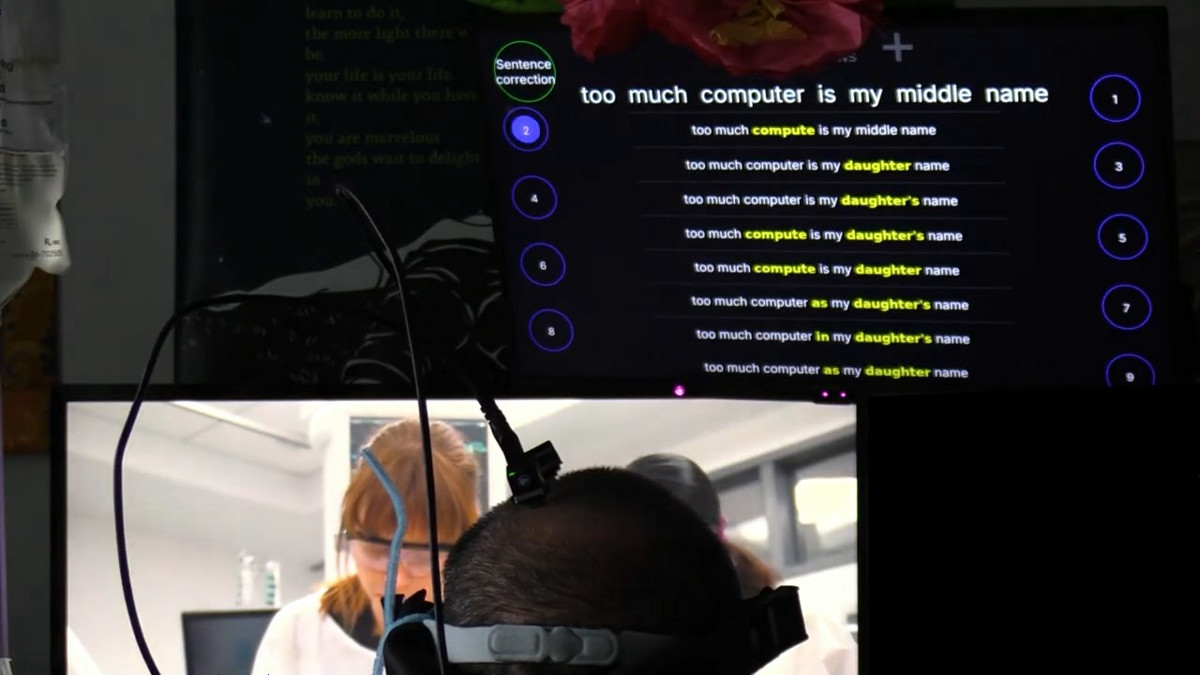
The BCI system also allows for cursor control on the computer, enabling fine-tuning of text. Harrell estimates that 92% of the text generated by the BCI system is correct.
The BCI system also features a digital voice reading function that mimics Mr. Harrell's voice before he developed ALS, allowing users to have their created texts read aloud. Mr. Harrell said, 'It's so wonderful to be able to look my wife in the eyes when she hears my voice. It brings back sweet memories, and I can explain to my daughter, who barely remembers when I used to talk to the children, what my voice used to sound like.'
Harrell says that the BCI system allows him to send emails and messages, browse the internet, and stay in touch with family and friends, and that he is still working full-time at the time of writing. Harrell says, 'This system has allowed me to live a more dynamic and fulfilling life with friends, family, and colleagues, and it has enabled me to communicate in a way that is more true to myself than any technology I have ever experienced before.'
Nicholas Card, lead author of the paper and postdoctoral researcher in the Department of Neurosurgery at the University of California, Davis, commented, 'Casey can use this system to communicate his thoughts whenever he wants, not just when we are in a controlled environment. On one occasion, he communicated for 12 hours straight. The system worked well, was reliable and stable, and produced consistent results. This is one of the strongest examples demonstrating that BCI is practical and useful.'
Brandman stated, 'For many years, BCIs have been proof-of-concept devices that exist in highly controlled laboratories. This research suggests that we may have reached a new stage by empowering paralyzed individuals to speak of their own volition.'
Related Posts:



in Free Member, Video, Science, Posted by log1h_ik