Scientists develop a 'universal kidney' that can fit all blood types.
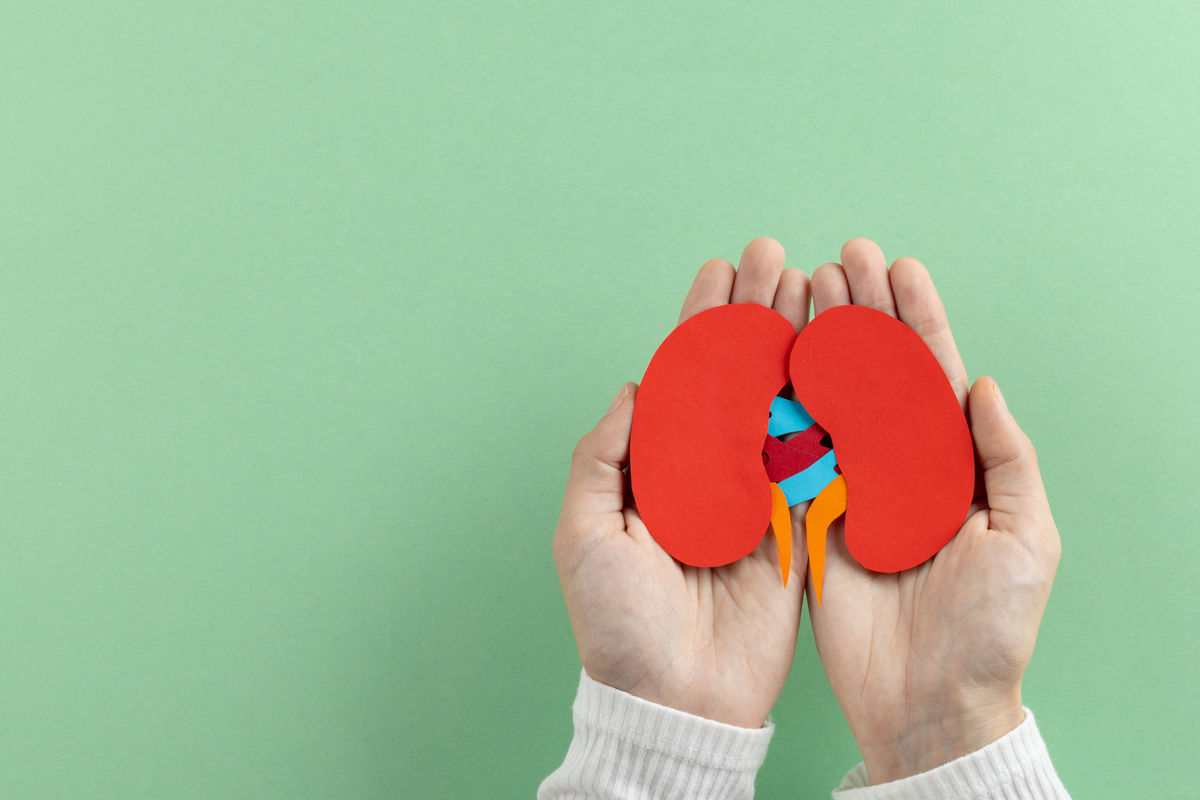
A technology has been developed that allows kidney transplants to be performed using donors with different blood types than the patient, and it has been found that, theoretically, kidneys that can be accepted by any patient have been created. This could significantly reduce the waiting time for patients awaiting kidney transplants and potentially save many lives.
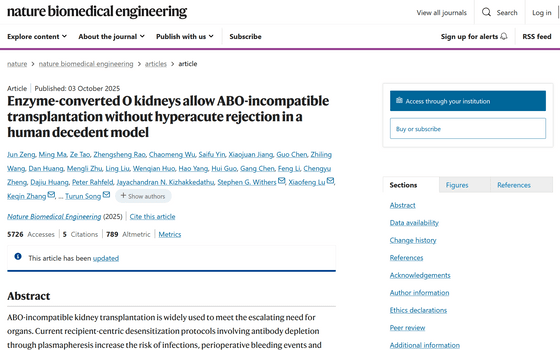
Enzyme-converted O kidneys allow ABO-incompatible transplantation without hyperacute rejection in a human decedent model | Nature Biomedical Engineering
UBC enzyme technology clears first human test toward universal donor organs for transplantation
Breakthrough: Scientists Created a 'Universal' Kidney To Match Any Blood Type : ScienceAlert
https://www.sciencealert.com/breakthrough-scientists-created-a-universal-kidney-to-match-any-blood-type
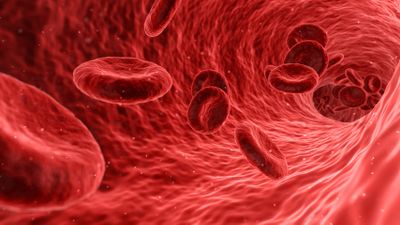
Blood type is determined by antigens present on red blood cells. Antibodies exist in the plasma and have the property of attacking different antigens when detected. Type A blood has the A antigen, type B blood has the B antigen, type AB blood has both the A and B antigens, but type O blood has neither antigen.
Currently, people who need a kidney usually have to wait for one from a donor with the same blood type, but because type O kidneys are universally compatible, they are often transplanted to other people. As a result, type O patients typically have to wait 2 to 4 years longer, and many die while waiting for a transplant. It is possible to transplant kidneys from different blood types through a procedure called ABO blood group incompatible kidney transplantation , but this requires several days of intensive treatment to prevent the body from rejecting the organ, and organ donation from a living donor has been essential.
Researchers from Sichuan University and the University of British Columbia have proposed a new approach that involves treating the organ to be transplanted, rather than the patient, making kidney transplants possible with different blood types.
The key to this approach was the discovery in 2019 by a research team at the University of British Columbia of two highly efficient enzymes that remove the sugars that characterize type A blood and convert it into type O blood. The researchers likened these enzymes to 'scissors,' explaining that 'by cutting off a portion of the type A antigen chain, they can change the blood into a state that lacks the ABO antigen, which is characteristic of type O blood.'
Enzyme-treated kidneys were transplanted into brain-dead patients with family consent, and functioned for two days post-surgery without showing any signs of a rapid immune response known as hyperacute rejection. A mild reaction occurred on the third day, but the damage was far less severe than in cases of blood type incompatibility.
Dr. Stephen Withers of the University of British Columbia, who co-led the research, said, 'This is the first time we have observed such a phenomenon in a human model. It provides valuable insights that will help improve long-term treatment outcomes.'
Related Posts:





in Science, Posted by log1p_kr