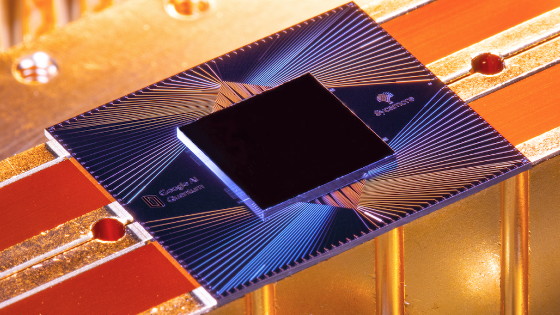
Google's AI 'AlphaEvolve' optimizes DNA analysis, power grids, quantum computing, and logistics in just one year: A summary of its achievements in algorithm discovery AI.

Google DeepMind has released the results of its Gemini-powered algorithm discovery AI, 'AlphaEvolve,' after one year of development.
AlphaEvolve: Gemini-powered coding agent scaling impact across fields — Google DeepMind
AlphaEvolve works by having Gemini generate candidate new code and computation methods, an automated evaluation system scoring their performance, and then further refining the best candidates. It's not just a code generation AI; it's an AI that finds better algorithms for problems where speed, accuracy, and cost reduction can be evaluated numerically.
When it was released in May 2025, it was touted as being able to 'discover unknown algorithms and new solutions to unsolved problems.'
Google's evolutionary AI, 'AlphaEvolve,' is capable of discovering unknown algorithms and new solutions to unsolved mathematical problems, and is already being used internally at Google to improve the efficiency of AI development and chip design - GIGAZINE
Approximately one year after its launch, on May 7, 2026, Google DeepMind announced the achievements that AlphaEvolve had made across a wide range of fields.
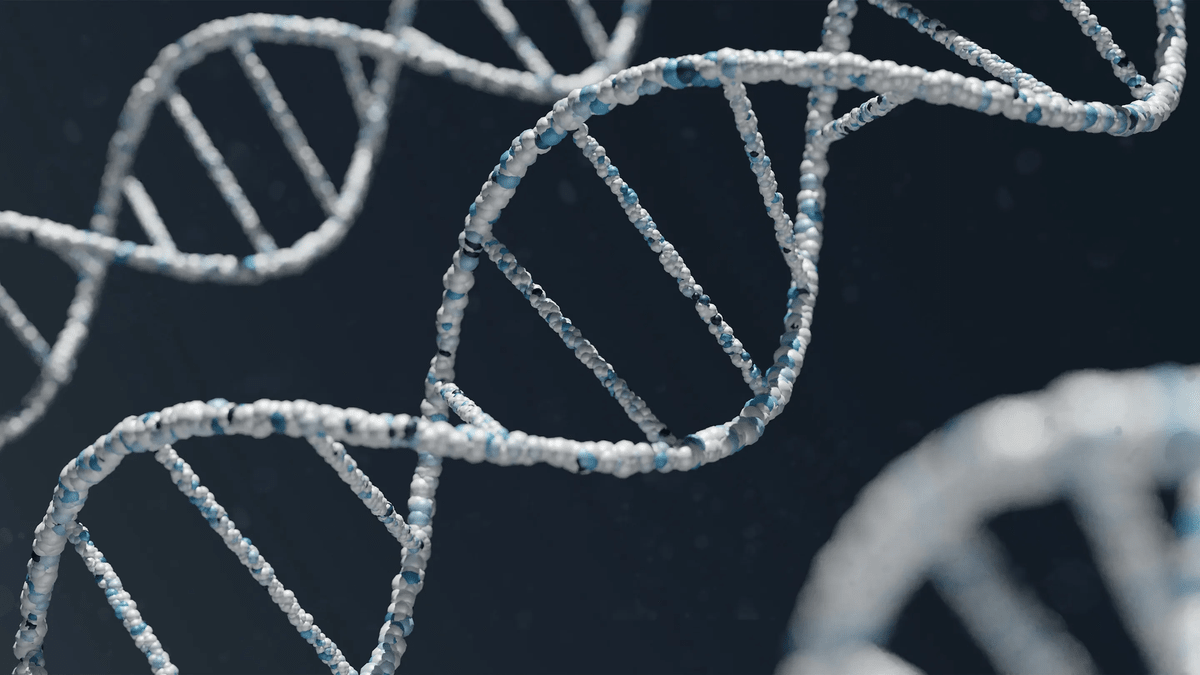
In the life sciences, AlphaEvolve was used to improve the DNA analysis model 'DeepConsensus,' reducing 'mutation detection errors'—where disease-related changes in DNA sequences are overlooked or non-existent changes are mistakenly detected—by 30%. This improved accuracy allows researchers to analyze genetic data more precisely and more easily identify disease-causing mutations.
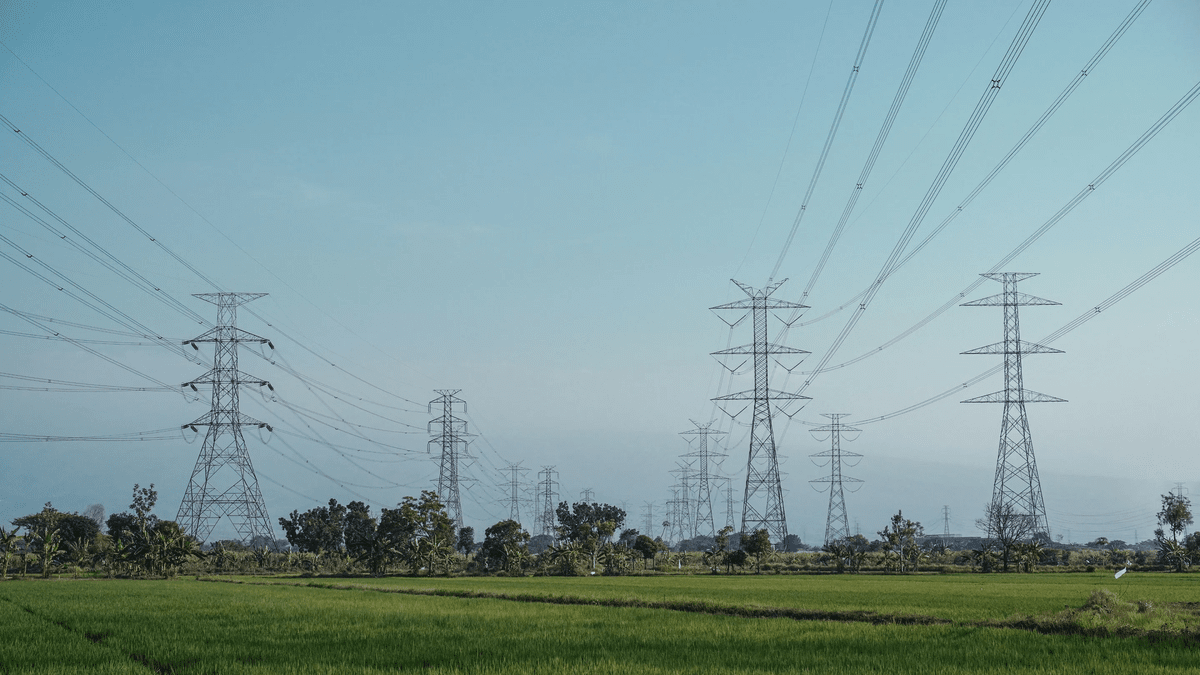
In the field of power grids, AlphaEvolve was used to tackle the challenging problem of 'AC Optimal Power Flow,' which involves efficiently distributing electricity while satisfying constraints on power plants and transmission lines. According to Google DeepMind, the percentage of AI models that can find feasible solutions for power grids increased from 14% to over 88%. An increase in feasible solutions reduces the need for correction work by humans or other systems, leading to a reduction in the operating costs of power grids.
AlphaEvolve has also achieved results in natural disaster prediction. Its AI model predicts the risks of 20 types of natural disasters, including wildfires, floods, and tornadoes. By improving the method for converting Earth observation data into a more manageable format, it has increased overall accuracy by 5%. Even a few percent improvement in disaster prediction can have a significant impact on disaster prevention planning, infrastructure development, and insurance risk assessment.
In the field of quantum computing, AlphaEvolve proposed a quantum circuit for running molecular simulations on Google's quantum processor, 'Willow.' The quantum circuit created by AlphaEvolve reportedly produced one-tenth fewer errors than conventional optimization methods.

In the field of mathematics, he collaborated with UCLA mathematician Terence Tao and others to support research into the Erdős problem, a group of unsolved problems. Furthermore, he is credited with improving lower bound records in classic mathematical problems such as the traveling salesman problem and Ramsey numbers. An lower bound is a boundary that can be shown to 'not fall below a certain value,' and even if a complete answer is not reached, it represents an important step forward in mathematical research.
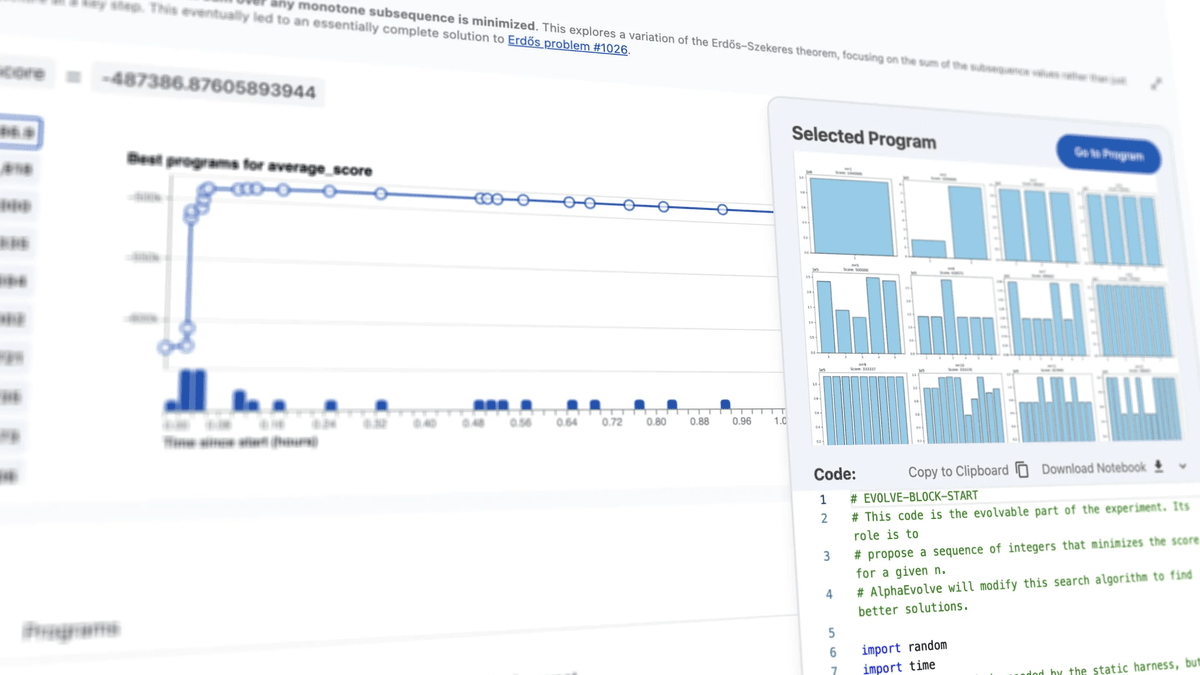
AlphaEvolve is already in practical use within Google's internal infrastructure. It's being used to optimize the design of next-generation TPUs, and in improving cache replacement policies, it achieved results in just two days that would have taken months with human-centered work. Cache replacement policies are rules that determine which data to keep in high-speed memory and which to move, and they directly impact the performance of AI calculations and large-scale data processing.
In the database area, we improved the internal processing of Google Spanner, reducing the 'write amplification ratio,' a metric that indicates the amount of extra writes occurring within the storage compared to the amount of data written by the user, by 20%. Lowering the write amplification ratio reduces storage load and operational costs. Furthermore, it led to a new compiler optimization strategy, reducing the software storage capacity by approximately 9%.
AlphaEvolve is also being adopted in the commercial sector. Fintech company Klarna doubled the training speed of its large-scale Transformer models, and semiconductor startup Substrate accelerated computational lithography used in semiconductor manufacturing by several times. Logistics company FM Logistics reduced travel distance by more than 15,000 km per year through delivery route optimization, and advertising agency WPP improved the accuracy of its AI models for advertising campaigns by 10%. Computational life sciences and materials science company Schrödinger accelerated molecular simulation-related models used in drug discovery and materials development by approximately four times.
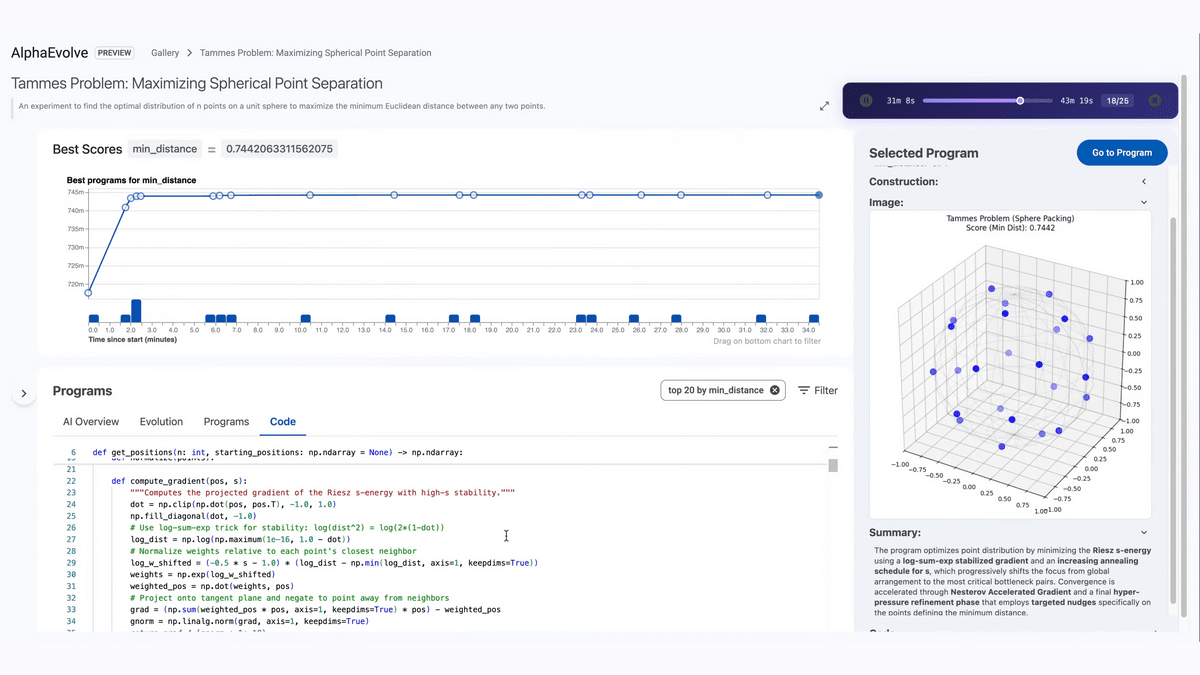
In summary, AlphaEvolve's achievements over the past year have resulted in optimization results across a wide range of fields, from DNA analysis, power grids, natural disaster prediction, quantum computing, mathematics, Google infrastructure, logistics, advertising, and drug discovery and materials science. Google DeepMind positioned AlphaEvolve as an important step towards 'an era where AI discovers and improves algorithms.'
Related Posts: