When did a dog's brain become smaller than a wolf's?
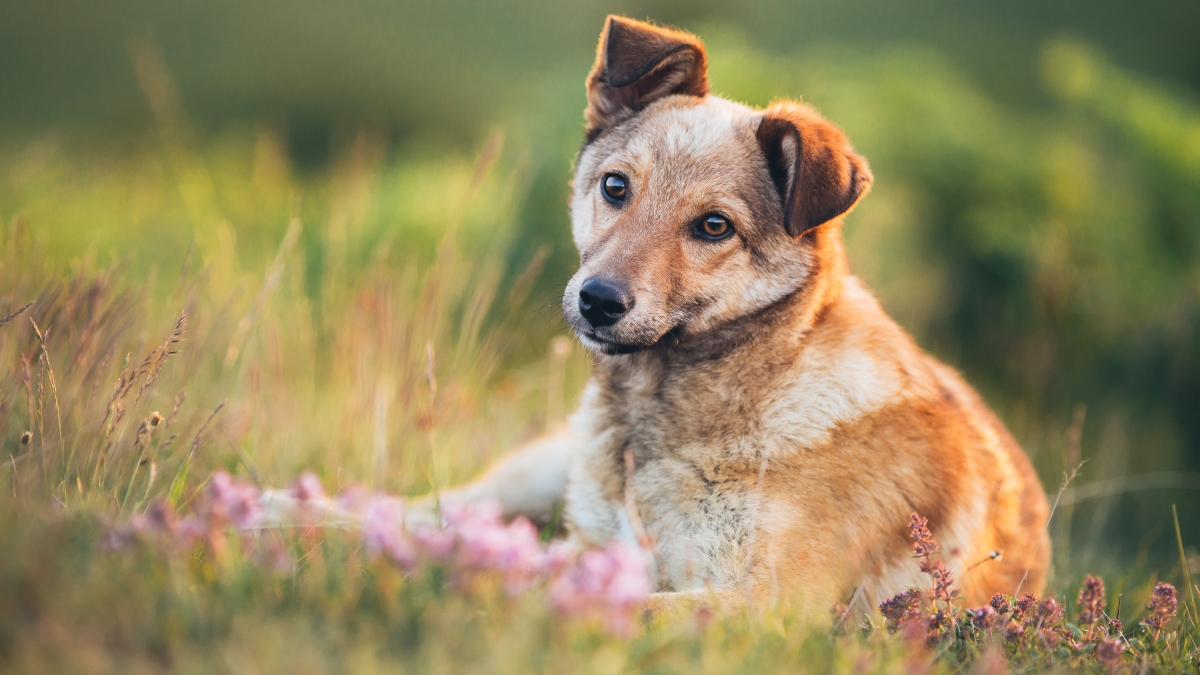
It is known that modern dogs have smaller brains than wolves. This has been thought to be one of the changes that came with domestication, but there has been ongoing debate about when the dog brain began to shrink. Research examining the skulls of ancient dogs and wolves has provided clues to when the dog brain began to become smaller than that of wolves.
Brain size reduction in dogs was already established at least by the Late Neolithic of western Europe, 5,000 years ago | Royal Society Open Science

The 'tail' of the shrinking dog brain: Study reveals they began getting smaller 5,000 years ago
https://phys.org/news/2026-04-tail-dog-brain-reveals-began.html
Thomas Cucci and his colleagues at the French National Centre for Scientific Research (CNRS) analyzed 22 prehistoric dogs and wolves dating from approximately 35,000 to 5,000 years ago, as well as 104 modern dogs and 59 modern wolves. The 104 modern dogs included free-roaming dogs and dingoes that are not managed as specific breeds.
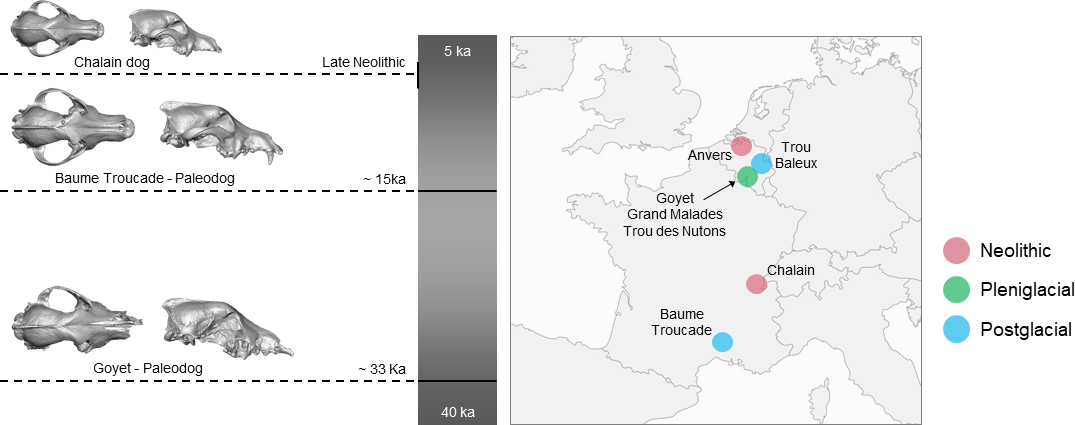
In this study, three primitive dogs—one approximately 33,000 years old, found in the Goyet Cave in Belgium; one approximately 15,000 years old, found in the Baume-Trocad Cave site in southern France; and three dogs (hereinafter referred to as Challans dogs) dating back approximately 5,000 to 4,500 years, found in Challans, a late Neolithic lakeside settlement in eastern France—were important subjects for comparing their brain size with that of wolves. The left side of the following diagram shows a model of each skull, and the right side shows the site of excavation.
Since the brain itself does not survive for thousands of years, Kutsch and his colleagues analyzed CT scan images of the skulls of various dogs and wolves. The 3D model of the space inside the skull, called an 'endocast,' provides clues to estimating the volume of the brain that once occupied that skull.
The space inside the skull is reconstructed from CT scan images as follows. The area shown in yellow is the endocast, which Kutsch et al. used to examine the cranial volume, a surrogate indicator of brain size.
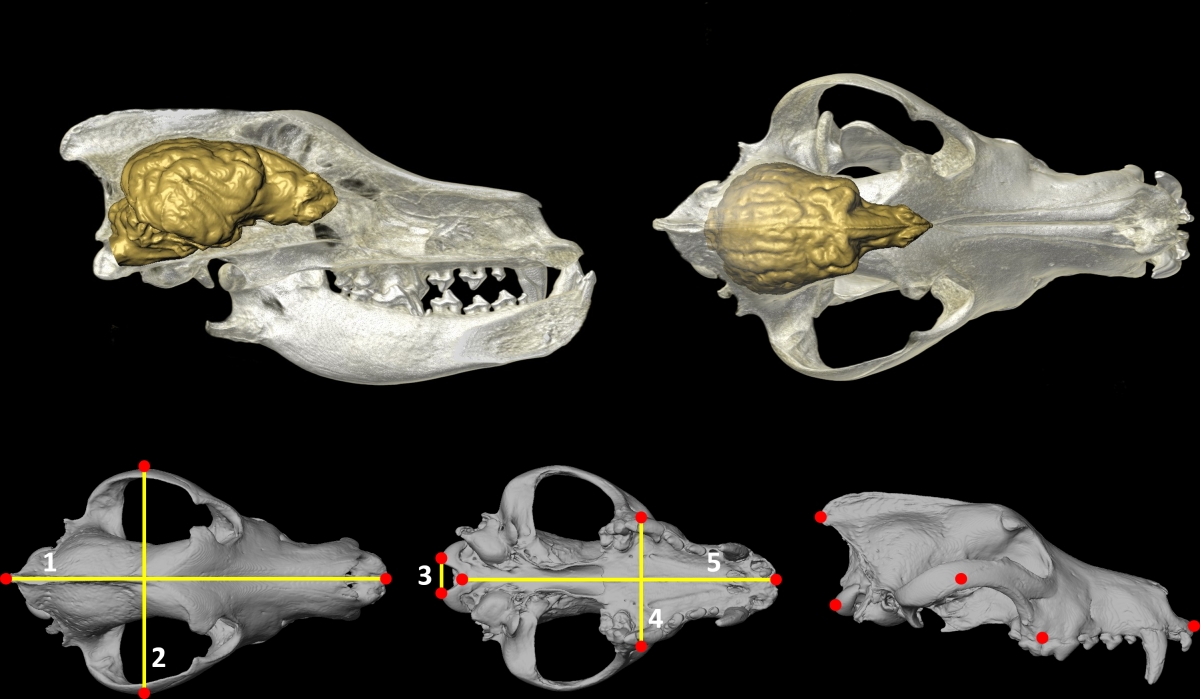
Kutsch and his colleagues compared not only the cranial volume, which roughly corresponds to the actual size of the brain, but also the cranial volume relative to the length of the skull. This ensured that small dogs would not be judged as having 'small brains' simply because of their small size.
Analysis revealed no evidence that the primitive dogs found in the Goyet Cave in Belgium (approximately 33,000 years old) or the Baume-Trocad Cave site in southern France (approximately 15,000 years old) had smaller brains than their contemporary wolves. Although these primitive dogs appear to have lived in close proximity to humans, their brain size was comparable to that of wolves. This suggests that it cannot be said that dogs' brains became smaller immediately after diverging from wolves and beginning to interact with humans.
On the other hand, a significant change was found in the Sharan dog. Kutsch et al. reported that 'Sharan dogs from about 5,000 to 4,500 years ago had a brain size 46% smaller than wolves of the same era,' and explained that their brain capacity was 'close to that of modern toy dog breeds.'
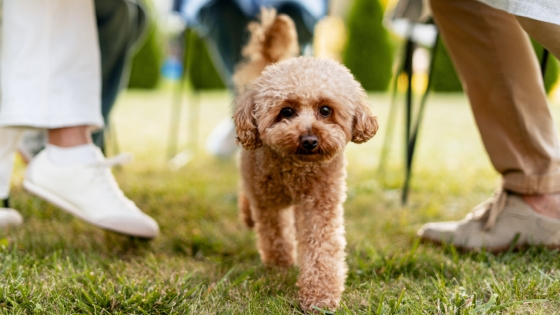
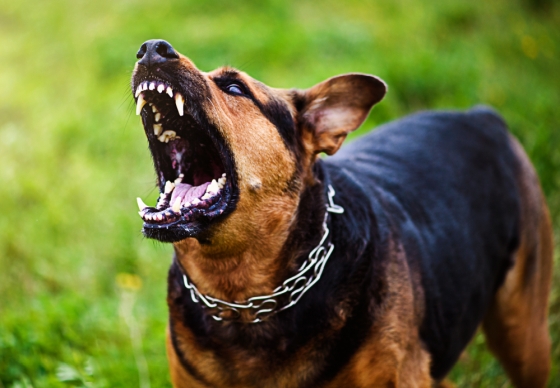
The reduction in brain size may have been associated with changes in the composition of brain tissue. Kutch et al. suggest that the proportion of the cerebral cortex, which is involved in complex processing, may have become relatively smaller, while reactive and instinctive responses may have become relatively more important. If such changes occurred, dogs may have become more anxious and vigilant, more sensitive to unfamiliar stimuli, and more prone to barking, which may have made them well-suited to a role as an 'alarm system' to signal anomalies in the settlement.
Kutsch and his colleagues say that the reduction in brain size in dogs during the Neolithic period provides an important clue that, in addition to their roles as scavengers, meat sources, and hunting animals, they may have also played a role in 'warning the settlement of threats.'
However, this study does not conclude that dogs' intelligence decreased because their brains became smaller. The brain size examined was estimated from the space inside the skull, and does not directly show which parts of the brain changed how, or how behavioral and cognitive abilities changed. Kutsch and his colleagues believe that by examining more ancient dog specimens, they can investigate in more detail when and in what context dogs' brains became smaller due to their relationship with humans.
Related Posts: