Claude Code is adding a routine feature that allows tasks to be executed automatically based on certain conditions, such as 'automatically checking pull requests.'
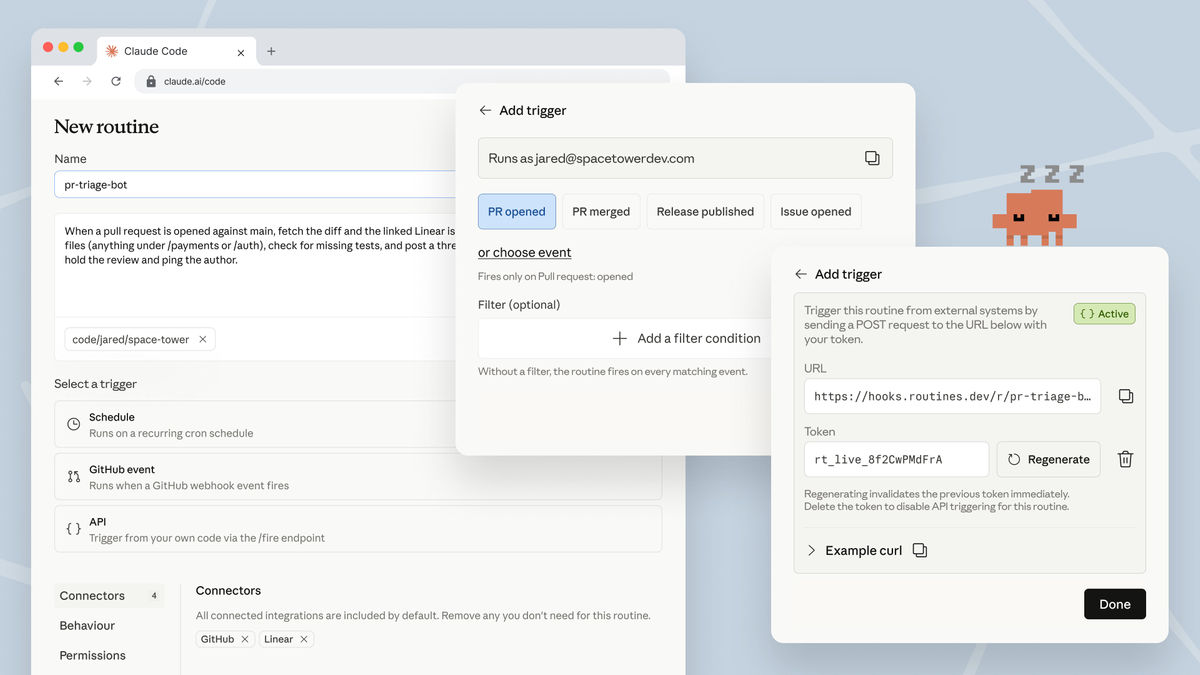
On April 14, 2026, Anthropic implemented a routine function in its autonomous coding support tool, 'Claude Code.' This routine function allows users to automatically execute specific tasks based on predefined conditions.
Introducing routines in Claude Code | Claude
https://claude.com/blog/introducing-routines-in-claude-code
Now in research preview: routines in Claude Code.
— Claude (@claudeai) April 14, 2026
Configure a routine once (a prompt, a repo, and your connectors), and it can run on a schedule, from an API call, or in response to an event.
Routines run on our web infrastructure, so you don't have to keep your laptop open. pic.twitter.com/m2XJWYqkf8
Routines are a feature that automatically runs Claude Code in response to various triggers. Since processing takes place on Anthropic's servers, you don't need to keep your PC powered on. You need to configure 'triggers' and 'prompts' beforehand, and you can also access repositories and connectors.
For example, setting a 'Schedule' trigger allows you to perform a specific action at a certain date and time. Anthropic seems to envision uses such as 'retrieving the top bugs from the project management tool Linear at 2 AM every day, attempting to fix them, and submitting a pull request.'
Scheduled routines let you give Claude a cadence and walk away. Try telling Claude to pull the top bug from Linear every night at 2am, attempt a fix, and open a draft PR.
— Claude (@claudeai) April 14, 2026
If you've been using /schedule in the CLI, those are routines now, and there's nothing to migrate.
Each routine has its own API endpoint, so it can be embedded anywhere an HTTP request can be made, such as sending alerts directly or setting up deployment hooks and internal tools. Apparently, sending a message via POST will return a session URL.
Routines each come with their own API endpoint, so you can point your alerts, deploy hooks, or internal tools at Claude directly. Try sending Claude an alert payload and asking it to find the owning service and post a triage summary to #oncall .
— Claude (@claudeai) April 14, 2026
POST a message and get back a…
Webhooks that can be triggered in specific situations are also available. As of the time of writing, it is possible to subscribe to 'GitHub repository events' and perform actions such as 'automatically checking pull requests.' It has been stated that there are plans to enable triggering for even more different events in the future.
Webhook routines subscribe to GitHub events and let Claude respond as they come in. Try pointing one at your repo and asking Claude to flag any PR that touches /auth-provider and post a summary in #auth -changes.
— Claude (@claudeai) April 14, 2026
More event sources are coming soon.
The routine feature is available to all paid plan users with the web version of Claude Code enabled. Running routines counts towards your subscription usage limit, just like interactive sessions, and there are also daily limits on the number of routines you can run, depending on your plan. Pro plan subscribers can run up to 5 routines per day, while Max plan users can run up to 15 routines per day.
Please note that the routine functionality is currently in a research preview release, and its operation, limitations, and API specifications may change in the future.
Related Posts:



in AI, Web Service, Posted by log1d_ts