How to prevent your child from thinking, 'This wasn't the present I wanted,' and how to comfort them if they do.

When parents give their children gifts, they sometimes hear them say, 'I don't want this,' and while they want to acknowledge their child's feelings, they may also feel disappointed, thinking, 'I put so much effort into choosing it.' A psychology expert offers some ways to deal with such situations.
It's (not) a new bike! How to manage kids' gift expectations at Christmas
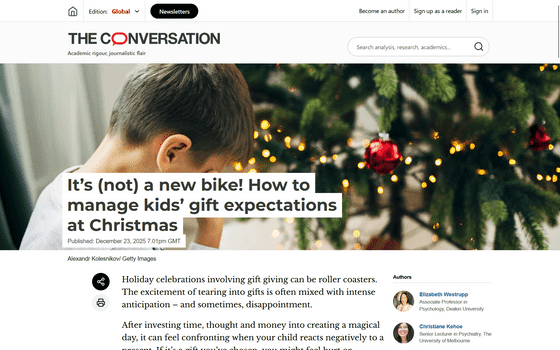
It can be painful to face when a child reacts negatively to a gift you've given them with their happiness in mind. If it was a gift they chose themselves, they might feel hurt or angry, and if it was a gift from a relative or friend, you might worry that it might offend the giver.
Psychologist Elizabeth Westrap and her colleagues point out that 'parents may worry that they haven't taught their children gratitude, or that their children seem spoiled. However, disappointment is difficult for children and is a normal reaction in their emotional development. These emotions can also be opportunities for connection and learning,' and they urged parents to understand the mechanism behind it.
From infancy through childhood (roughly from age 1 to 12), children develop a sense of self—who they are, what they like, and how they fit into the world. Certain toys, clothing, and brands become associated with them, and these can also be used to express their identity to others.
Consequently, children may want the same shoes or toys as their friends in order to stay connected. If this desire is not fulfilled, they may feel left out and completely excluded.
Understanding this explains why children's reactions may seem disproportionate to adults. A child's disappointment is not a reaction to the gift itself, but rather relates to strong emotions such as self-perception and relationships with others.
Children may also feel disappointed simply because they didn't get what they wanted. Westrap and his colleagues also offer advice on how parents should respond when their children ask for expensive items, things that are unrealistic to give, or things that their parents deem inappropriate.

According to Westrap and others, 'It's important to talk beforehand.' Parents need to tell their children what they spend their money and time on, what they value, and what kind of person they are. In addition, by listening to their children's values, they can learn information such as whether they are influenced by trends around them and what kind of gifts they are thinking of preparing.
The example sentences provided by Mr. Westrap and others are as follows:
Parent: What are you looking forward to this year?
Parent: What do you think is realistic?
Parent: You have high expectations, and sometimes they don't come true, right? How do you feel when that happens?
Also, when a child is feeling disappointed, it's best to avoid scolding them with phrases like, 'You should be grateful.' This is because when people are upset, it's difficult for them to think about others and they first need to process their own emotions. Instead, it's better to say something like, 'You really wanted that bicycle, didn't you? It must be tough when you can't get something you really wanted.'
When expectations for a gift are not met, dopamine levels drop, leading to feelings of disappointment. Westrap et al. point out that accepting this disappointment allows children to express strong emotions in a safe environment, develop resilience to unpleasant and disappointing feelings, and learn that emotions are manageable.
While it's perfectly normal for children to feel disappointed, it's unacceptable for them to become rude or lash out in anger. When they do react in this way, it's helpful to say something like, 'I know you were disappointed, but let's think together about how you can express your feelings without hurting others.'
It's also important to make the giver aware of the small acts of thoughtfulness. For example, 'Did you notice that your aunt wrapped your present in your favorite color?' Westrap and his colleagues also explained that letting children choose or make gifts for others helps them remember the experience of giving and fosters empathy.

Related Posts:






in Note, Posted by log1p_kr