The EU has banned its employees from using AI-generated images, in stark contrast to US President Trump, who frequently posts AI-generated content.
EU staff banned from using AI-generated content in official communications – POLITICO
https://www.politico.eu/article/brussels-eu-ban-deepfakes-ai-generation-official-messages/
The European Commission, the European Parliament, and the Council of the European Union have told POLITICO that, amid increased scrutiny of the online use of AI and deepfakes, they have established a policy prohibiting staff and press teams from using AI-generated content. In recent years, as the internet has been flooded with poor-quality and misleading AI-generated content, the EU has demonstrated its commitment to protecting the credibility of official messages.
Alexandre Vojka, head of policy at UK-based AI video generation company Synthesia, said, 'It is only natural that the EU considers risk first and foremost. Risk means whether the content could be perceived as deceptive or harmful, whether it is misrepresenting reality, and whether clear accountability and disclosure are possible.'
On the other hand, with the increasing geopolitical crisis, the importance of public institutions maintaining an online presence is also growing, raising questions about whether a complete ban on AI-generated content is the most reasonable option.
Renaud Van Zandicke, who runs the Belgian public relations agency Exposure and has advised several political parties, argues that even if deepfakes risk undermining trust, there are also disadvantages to public institutions completely avoiding the use of AI-generated content. Walter Pasqualelli , who studies AI-generated content at Cambridge University and serves as an advisor to the Organization for Economic Cooperation and Development (OECD) , also pointed out that 'responsible use is better than a complete ban.'
According to some estimates, the amount of AI-generated content has already surpassed that created by humans, with as many as 8 million deepfakes expected to be shared online by 2025. Political communication is no exception; deepfakes are influencing election campaigns in the Netherlands and Ireland, and an increasing number of politicians are using AI-generated content for official communications.
Since taking office, US President Donald Trump has posted a variety of AI-generated images and videos. His social networking site, Truth Social, has featured videos such as ' a video of President Trump wearing a crown and piloting a private jet, ' ' a video of Democratic leaders kneeling before President Trump with a drawn sword, ' and ' a video of the Gaza Strip being turned into a resort. ' It has been reported that as of October 2025, he had posted 36 pieces of AI-generated content.
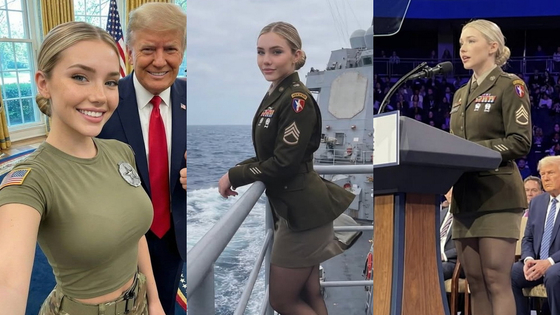
It was also reported that 'Jessica Foster,' a female U.S. Army soldier who had expressed strong support for President Trump on social media and stirred up patriotism among people, was actually a fictional character created entirely by AI.
Jessica Foster, the beautiful blonde Army soldier who supports President Trump, is a fake; she's 100% AI-generated to incite patriotic pornography on social media - GIGAZINE
The EU's approach is in stark contrast to that of the Trump administration in the United States. European Commission spokesperson Thomas Regnier told POLITICO, 'The images and videos we use and publish for journalistic use and for official informational purposes do not contain any AI-generated content.'
Regnier stated that the European Commission aims to foster public trust, and therefore, the credibility of the content it disseminates is the top priority in communication. He added that the use of AI for optimization, such as improving image quality, is permitted.
However, POLITICO points out that 'by downplaying AI-generated content, the European Commission risks falling behind in an era where diplomacy is increasingly conducted online.' Vojka of Synthesia also states that 'how quickly and effectively we can respond is more important than ever.'
Furthermore, some argue that by uniformly banning AI-generated content, the European Commission has missed an opportunity to educate people about AI-generated content. Pasqualelli of Cambridge University pointed out, 'By refusing to engage with AI at all, the European Commission is missing a leadership opportunity to demonstrate what responsible and transparent use of AI in political communication looks like.'
Related Posts:






in AI, Posted by log1h_ik