The secret to why cats always land on their feet no matter how they are dropped in mid-air lies in the twist of their spine.
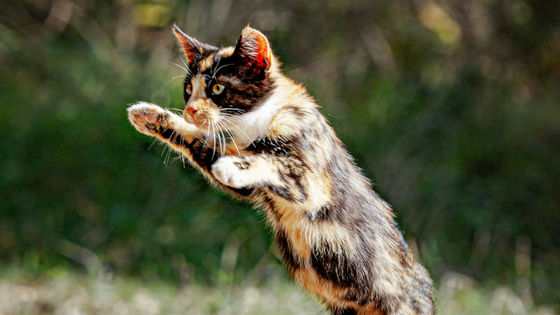
A new experimental study has been published that focuses on 'spine flexibility'
Torsional flexibility of the thoracic spine is superior to that of the lumbar spine in cats: Implications for the falling cat problem - Higurashi - The Anatomical Record - Wiley Online Library
https://anatomypubs.onlinelibrary.wiley.com/doi/10.1002/ar.70165
New falling cat paper just dropped! | Skulls in the Stars
https://skullsinthestars.com/2026/03/07/new-falling-cat-paper-just-dropped/
Flexible feline spines shed light on 'falling cat' problem - Ars Technica
https://arstechnica.com/science/2026/03/tuck-and-turn-or-bend-and-twist-how-falling-cats-land-on-their-feet/
The question of 'How can a falling cat land on its feet?' has been debated for a long time, at least since around 1700. Four different hypotheses have been proposed to answer this question.
One is the 'tuck and turn' model, in which a cat retracts one front paw and rotates a different part of its body. The second is the 'falling figure skater' hypothesis proposed by 19th-century physicist James Clerk Maxwell, which states that 'cats adjust their angular momentum by retracting and extending their front paws as needed.' The third is the 'bend and twist' theory, in which a cat bends its waist and rotates two parts of its body in opposite directions. And the fourth is the 'propeller tail' theory, in which a cat can reverse the direction of its body's rotation by rotating its tail in one direction like a propeller.
Regarding the question, 'Why can a falling cat land on its feet?', Greg Guber, a physicist at the University of North Carolina at Charlotte, commented, 'While various movements are at play, I believe the most important is the bending and twisting motion of the body.'
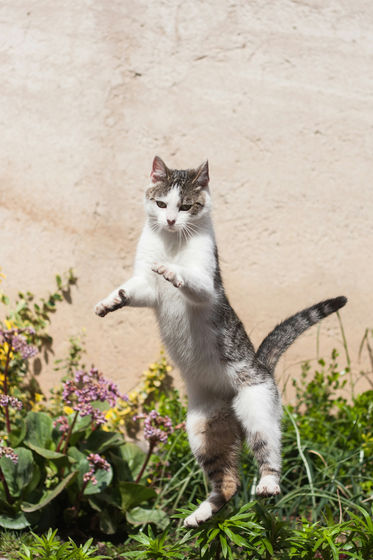
In a recent paper published in
The research team extracted the spines from the carcasses of five donated cats, preserving the ligaments and intervertebral discs, and then separated the thoracic and lumbar vertebrae. Next, they placed the separated vertebrae in a torsion device to investigate the force required to twist them and the limits of the twist. Furthermore, they dropped two cats from the air eight times, filming the process with a high-speed camera.
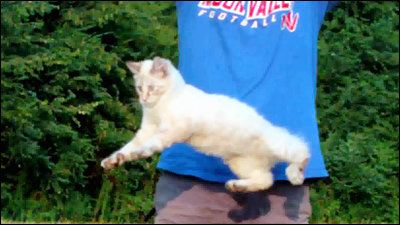
A photo of a cat as it falls.
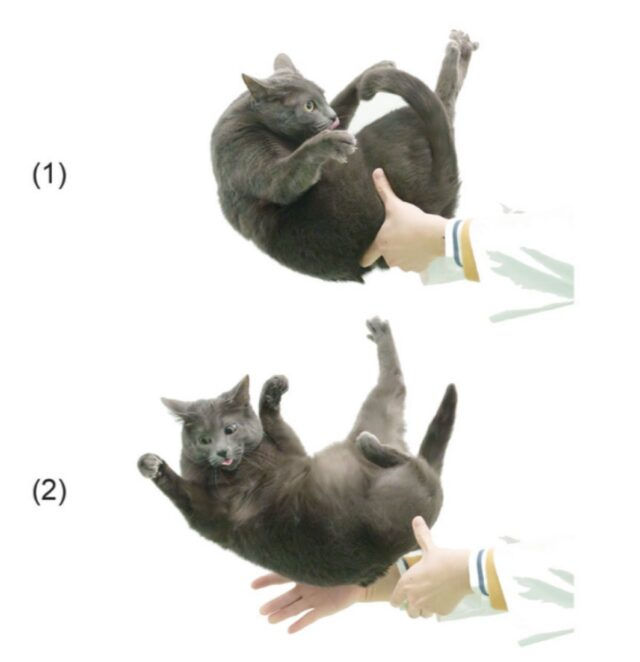
The photographs revealed that cats are capable of twisting their upper bodies more than their lower bodies. There appears to be a kind of sweet spot at a twisting angle of about 50 degrees, where there is almost no resistance to twisting movements. This sweet spot does not seem to exist in the lower part of the spine.
Regarding these results, Guber wrote, 'The flexibility of the upper spine strongly supports the idea that cats first rotate to orient their heads correctly, and that their biological structure is wired to make this as easy as possible.' Furthermore, a photograph taken with a high-speed camera (3)
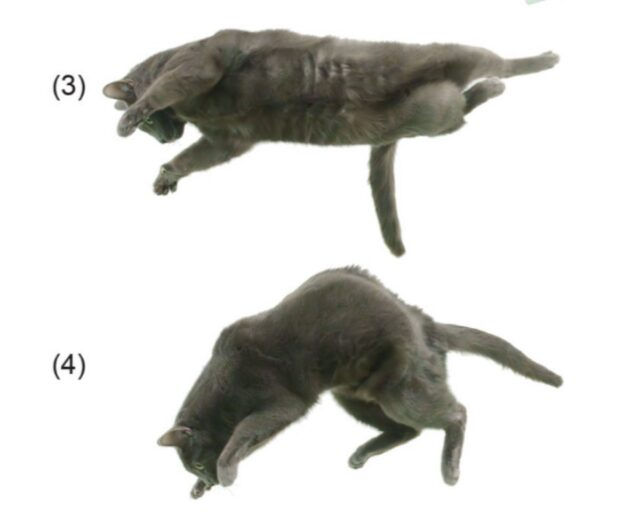
When photographs were taken of the cats in the fall, both of the test subjects clearly tried to turn to the right. One cat tried to turn to the right 8 out of 8 times, and the other tried to turn to the right 6 out of 8 times. Guber speculates, 'It seems that cats have a tendency to turn to the right, even though they can clearly turn in either direction.' 'My current guess is that the asymmetrical arrangement of their internal organs makes it slightly easier for them to go in one direction than the other.'
Guber also points out that because all the photos in the latest paper are taken from a single angle, it is difficult to analyze the movement of falling cats, and the discussion will likely continue. Guber added, 'In the future, it would be great if we could get photos taken from multiple angles that can be converted into 3D models. That would allow us to learn even more about how cats twist their bodies.'
Related Posts: