Online age verification tools are becoming more commonplace to 'protect children's safety,' but in reality, 'adults' are also being monitored.
In the United States, a law requiring platforms to verify the age of users is being considered to protect children online, and
Online age-verification tools for child safety are surveilling adults
https://www.cnbc.com/2026/03/08/social-media-child-safety-internet-ai-surveillance.html
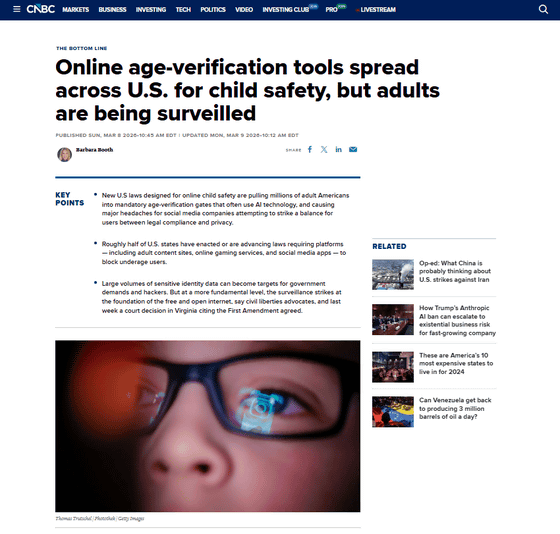
Age verification laws aimed at protecting minors in the US will require millions of adults to verify their age to access online content. Nearly half of US states have enacted or are considering enacting laws that require platforms, including adult content sites, online gaming services, and social media apps, to block underage users, forcing companies to implement age verification tools to comply.
Joe Kaufman, global privacy officer at Jumio , one of the world's largest digital identity verification and authentication platforms, said the state age verification laws are 'extremely broad in scope,' and that with different technical requirements and compliance expectations, 'regulations are moving in many different directions at the same time.'
In February 2026, Discord announced a new update to provide a safer experience for minors, targeting users aged 13 and over worldwide. Initially, Discord explained that it would use facial recognition on users' devices and immediately delete submitted data. However, this quickly drew backlash from users concerned about having to submit selfies or government-issued ID to access certain features, and Discord delayed the introduction of the age verification feature until later in 2026.
Discord announces postponement of age verification until late 2026 - GIGAZINE

Websites offering adult content, gambling, and financial services often employ full identity verification systems that scan government-issued IDs and match them against real-life images. However, the authentication systems behind these checkpoints are often run on behalf of websites by specialized identity verification vendors, who leverage AI like facial recognition and age estimation models that analyze selfies and videos to determine in seconds whether a person is old enough to access the content. Social media and other low-risk services use more lightweight estimation tools that verify age without permanently storing detailed identity records.
'Our business objective is to absolutely and safely keep out minors and allow adults in with as little friction as possible,' said Rivka Gewirtz Little, chief growth officer at identity verification platform Socure . She said excessive data collection creates user resistance.
Many platforms use age verification tools where the website itself does not verify the user's age; instead, the verification vendor processes and stores the ID information and returns only a 'pass' or 'fail' signal to the platform.
Socure, for example, says it doesn't sell authentication data, and stores little to no information if its platform uses simple age estimation based on quick facial recognition or other signals rather than government-issued documents.
However, if we conduct more advanced age verification, such as requiring an ID scan, we may retain certain adult verification records to demonstrate compliance. Socure also explained that it may store some adult verification data for up to three years, subject to applicable privacy and data deletion regulations.

Molly Buckley, a legislative analyst at the Electronic Frontier Foundation, warned that expanding age verification systems would not only pose usability challenges, but also pose a structural change in how identity and online behavior are linked.
Related Posts:








in Web Service, Posted by logu_ii