It has become easier to reconstruct code with AI, which has destroyed the rule that 'if you copy the code, you take over the license'

In the world of open source software, licenses stipulate the conditions for reusing and modifying source code, but AI could make it easier to reimplement open source code, potentially circumventing license obligations. Open source developer Hong Min-hee explains how AI is undermining the principles of open source in her article, 'Is legality the same as being legitimate?'
Is legal the same as legitimate: AI reimplementation and the erosion of copyleft — Hong Minhee on Things
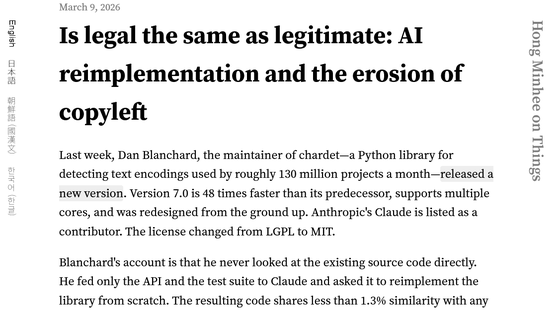
In early March 2026, a new version of chardet , a Python library for determining the character encoding of text, was released. The new version lists Anthropic's AI, Claude, as a contributor, and the license has been changed from the previous LGPL to the MIT license.
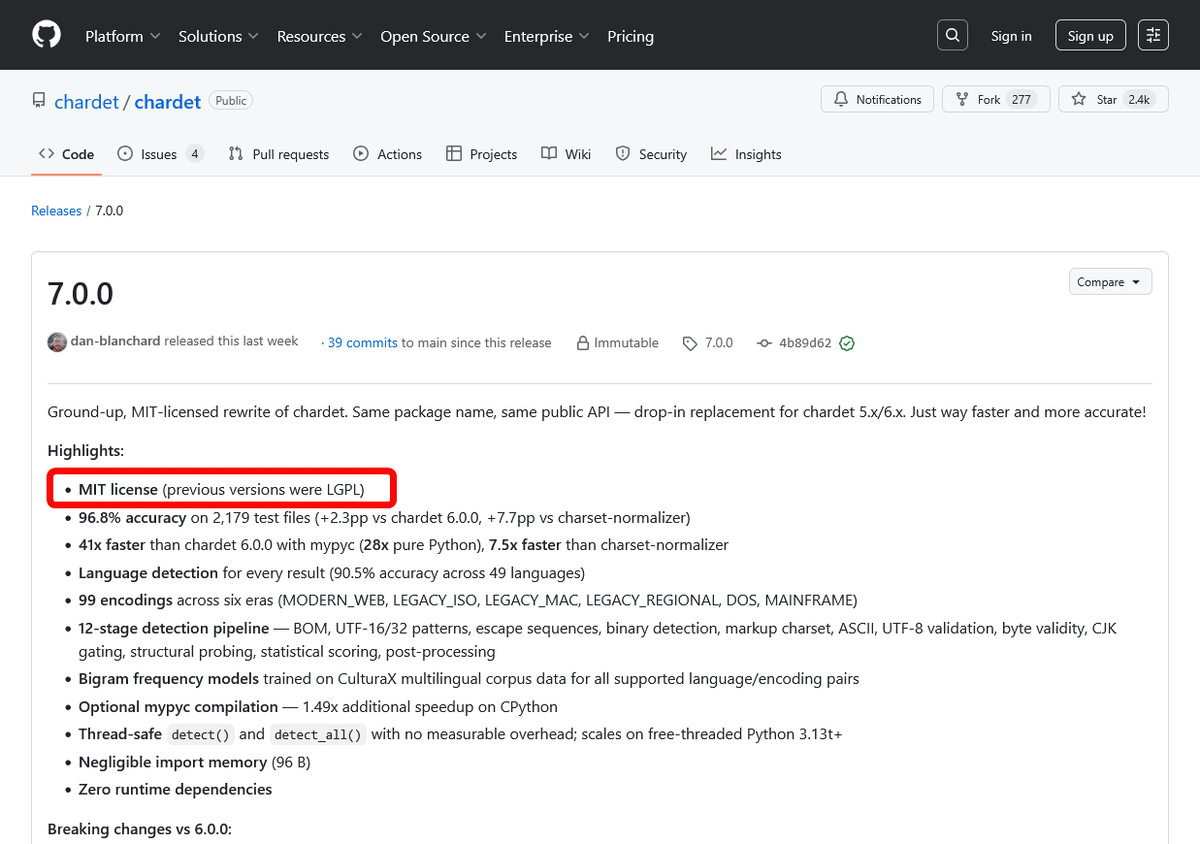
The LGPL license requires that any modifications to a library be made public, and the modified version must also be released under the same LGPL. However, according to chardet maintainer Dan Blanchard, in this implementation, the AI reimplemented the library from scratch without directly referencing the existing source code, providing only the library's API specifications and test code. Blanchard concluded, 'This is an independent, new work, and there's no obligation to continue the LGPL.' This method of reimplementing software based only on specifications and tests, without referencing existing code, is called '
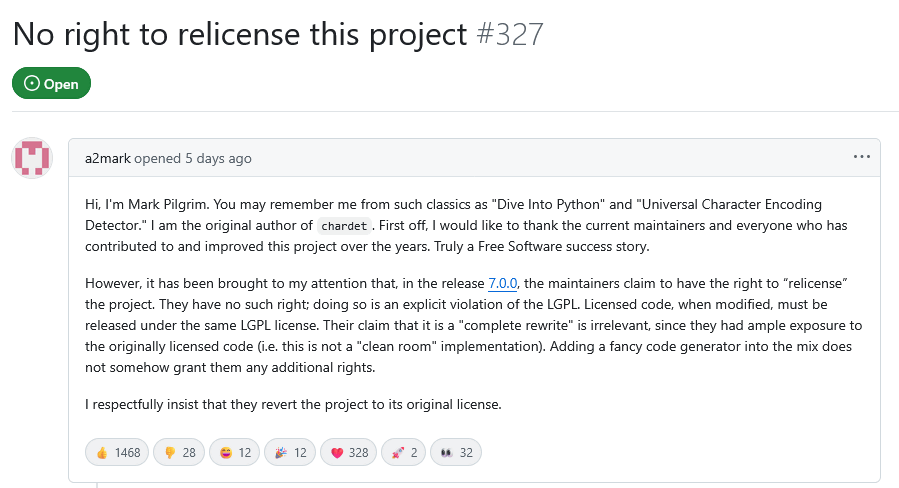
However, Mark Pilgrim, the original author of Chardet, countered Blanchard in a GitHub issue : 'Licensed code, if modified, must be released under the same LGPL license. They fully understand the original licensed code, and even if they claim to have created it from scratch using a sophisticated code generator, it does not give them any additional rights. This is a clear violation of the LGPL.'
There has been much discussion on this issue. Armin Ronacher, creator of the Python framework Flask , posted a blog post titled 'AI and the Ship of Theseus ,' questioning licensing issues in an era where AI has reduced the cost of code generation. Salvatore Sanfilippo, developer of the open-source in-memory database Redis , stated from the perspective of copyright law that 'copyright protects the expression of code, not ideas,' and added, 'Software has always developed by building on past ideas, and reimplementation using AI is merely an extension of that, and is therefore legitimate as long as it does not directly copy the code.'
Regarding the issue of open source licenses and code reimplementation, Ronacher and Sanfilippo defend Blanchard's reimplementation and license change on the grounds that, in broad terms, there is no legal issue. However, Minhee rejects their logic, saying, 'We need to distinguish between 'legal' and 'legitimate.''
Chardet is a library that has been built over the course of about 12 years through the contributions of many developers, and the LGPL license stipulates that 'if you benefit from it, you must share it under the same terms (license) if you create and publish it.' This mechanism, which requires the publication of derivative works, is called copyleft .
AI has made it easier to reimplement code, making it possible to copy almost anything without directly referencing libraries, eroding the concept of copyleft. However, Minhee points out that even if there is no legal problem with restructuring code, it does not mean that it is legitimate from a community perspective. Similarly, Zoe Kooyman, president of the Free Software Foundation, has stated, 'Refusing to grant others the rights you have received is antisocial, no matter what the method.'
According to Minhee, in a world where it's easier to reconstruct code, copyleft will likely become even more important rather than becoming unnecessary. The concept of copyleft was chosen because it aligns with the community's values, not because it's legally correct. As the rapid development of AI rapidly changes the social landscape, Minhee concludes that we should place emphasis on social legitimacy, that 'what we receive from the community should be given back to the community.'
The social news site Hacker News has also been discussing copyleft-eroding AI reimplementations, with some expressing concern that AI could dismantle the very concept of intellectual property.
Related Posts: