The ability to save varies depending on the type of job. Many people in finance and sales jobs save, but few creative people do.

The reasons for not being able to save money are generally attributed to 'not earning enough to begin with,' 'not being able to calculate money,' and 'not having a plan or discipline.' However, a study analyzing data from over 37,000 people living in the UK found that a person's 'type of job' may affect their ability to save.
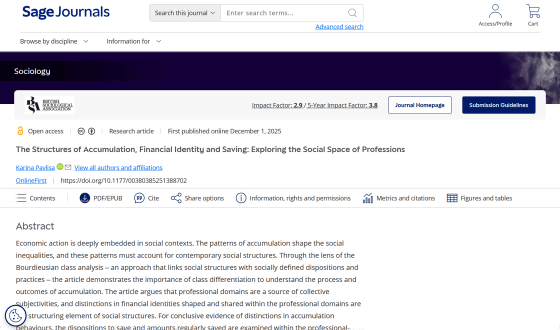
The Structures of Accumulation, Financial Identity and Saving: Exploring the Social Space of Professions - Karina Pavlisa, 2025
The type of job you do could be affecting your ability to save money – and not just because of the salary
https://theconversation.com/the-type-of-job-you-do-could-be-affecting-your-ability-to-save-money-and-not-just-because-of-the-salary-274694
A 2025 study (PDF file) showed that saving £2,000 (approximately ¥420,000) halves the risk of defaulting on payments later in life, and even relatively small savings can significantly improve financial resilience. However, one in ten UK adults reported having no savings at all , leaving many people in financial difficulty.
Reasons why people cannot save enough include income disparities , lack of arithmetic skills , and gender disparities . Even if people have the same income, their savings ability may differ depending on the type of job they have.
Dr Karina Pavlisa, a lecturer at the University of Bristol's School of Management in the UK, points out that 'workers in some jobs are much more likely to save than others, but that's not necessarily because they earn more. Different jobs require different skills, habits, attitudes and social influences.'
To investigate differences in savings habits across occupations, Pavlisa analyzed data collected by the Understanding Society study of approximately 40,000 British households between 2009 and 2019. She adjusted the data to account for characteristics such as income, age, and number of children, to see how much people in different occupations saved.

The analysis found that even if incomes increased by the same amount, people working in administrative, financial, and sales fields were 31
Professional occupations such as administrative, financial and sales jobs require commercial acumen and financial decision-making skills. These workplaces often emphasize explicit on-the-job training in commercial logic, the need for saving, risk assessment and financial decision-making, and money-related conversations are commonplace. This may have resulted in a greater tendency to save in proportion to income.
In contrast, professions such as writers and artists emphasize intrinsic motivation and creative achievement, and education systems are strongly oriented towards humanitarian rather than material goals, again unlike professions where commercial logic and financial decision-making are emphasized.
Across managers overall, those working in finance-aligned environments were 40 percentage points more likely to save monthly compared to those in retail, logistics and hospitality.
'Of course, finance-focused work environments tend to attract employees with relevant backgrounds, but these workplaces also tend to have more frequent financial conversations, which can strengthen individuals' financial management skills,' Pavlisa said. In other words, certain occupations and work environments may foster financial literacy and a desire to save while working, which could result in higher savings rates and amounts.

The findings of this study suggest that occupation, a hidden factor, may be a hidden factor shaping people's financial literacy. Differences in savings behaviors may lead to differences in financial resilience and ultimately contribute to widening economic inequality. 'Work quietly and subtly 'teaches' financial habits and norms, and workers should be aware that their work environment may bias their financial habits,' said Pavlisa.
Pavlisa recommends practical approaches to shaping savings habits, such as listening to people in finance-related professions and reading podcasts and articles that promote financial literacy. Employers can also bring in financial advisors to teach money management skills and practical approaches to boosting employees' financial resilience, and it may be helpful to teach financial literacy in schools.
'Good savings habits are not just a matter of personal choice; social and structural factors also influence economic resilience and inequality,' said Pavlisa. 'Rather than blaming yourself for not being able to save, recognizing that your social and professional environment can influence your economic resilience can help you feel more empowered and take positive steps forward.'
Related Posts: