What are the 10 habits that will help you have a stress-free day?

It's difficult to completely eliminate the sources of daily stress, such as work, relationships, and anxiety about the future. Psychotherapist John Tsirimpalis argues that rather than completely eliminating stress, you can 'create a state where you're less susceptible to stress' by building habits that you can easily maintain in your daily life. Psychology Today, a psychology media outlet, has compiled 10 habits that will help you create a day that's not overwhelmed by stress.
Want to Stress-Proof Your Day? | Psychology Today
https://www.psychologytoday.com/us/blog/the-magic-in-the-tragic/202602/want-to-stress-proof-your-day
◆1: Aim for progress, not perfection
Tsirimpalis describes perfectionism as an 'attractive but dangerous trap.' Striving for perfection sets the bar infinitely high, making even a score of 98 feel like a failure. What's necessary is to let go of the mindset that 'it has to be the best to be worthless,' and accept that even being 'good enough' is progress. He says it's important to see failure as merely an event, not a reflection of your own self-worth.
◆2: Don't try too hard to be liked by others
When you rely on the approval of others to support your self-esteem, your mood can easily become chronically anxious, as can the reactions of your boss, family, and friends. Tsirimpalis says it's important not to base your self-worth too much on other people's 'yes,' even if you disappoint someone. Saying 'no' when necessary can also help you regain control.
◆3: Let go of the belief that you can control everything
Trying to control things that are beyond your control, like economic trends, aging, or traffic congestion, can only increase feelings of helplessness. Tsirimpalis points out that instead of focusing solely on the outcome, you should shift your focus to the process. He says that stress is easier to manage if you focus on 'actions you can take' rather than seeking absolute guarantees.
◆4: Regulate your breathing
People under high stress tend to take shallow chest breaths, which can further increase tension. Therefore, Tsirimpalis recommends the 'inhale for seven seconds, exhale for 11 seconds' breathing technique. Place your hand on your stomach, take a deep breath for seven seconds, hold it for a short moment, and then exhale slowly for 11 seconds. He recommends doing this five times in a set, three times a day. It's also said to be a good way to switch off your mind when it's racing.
◆5: Release muscle tension
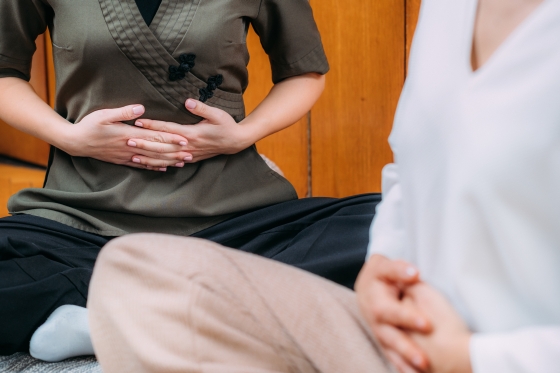
Stress manifests not only in your thoughts, but also as physical stiffness. For this reason, Tsirimpalis recommends ' progressive muscle relaxation, ' which involves tensing each muscle in turn, from your toes to your face, for 5 to 10 seconds, then releasing the tension. By intentionally tensing and then releasing the tension, your body will be able to more easily understand the difference between a tense and relaxed state, making it easier to notice everyday tension.
◆6: Bring your awareness back to the here and now
When you feel strong stress, it's easy for anxious thoughts to chain together in your head. In such cases, rather than trying to endure it with willpower, it's effective to use your senses to bring your attention back to reality. Tsirimpalis suggests holding ice in your hand and focusing on the coldness, touching an object that you can touch, or concentrating on a simple task like tidying your room. Whether it's a hobby or household chore, any activity that allows you to focus your attention on a concrete object seems to be helpful.
◆7: Replace pessimistic thoughts with other words
Tsirimpalis recommends that when a negative thought pops into your head, like 'I'm going to get fired because I'm late,' you should first say 'STOP' in your head and then come up with a more realistic alternative. For example, you could say, 'Anyone can get stuck in a traffic jam, and being late once doesn't define my self-worth. I'll call and take action.' She also suggests writing down your alternatives to help solidify a more realistic perspective.

8. Don't view stress as an enemy
If you try to push back stress by viewing it as something you shouldn't feel, it can actually make it more noticeable. Tsirimpalis says that the key here is acceptance. By being able to distinguish whether what you're feeling is actually dangerous or just discomfort, you'll be less likely to be overwhelmed by anticipatory anxiety. He points out that much stress is intensified by fearing events that haven't happened yet.
9. Imagine a safe place in your mind
Another method Tsirimpalis recommends is 'guided imagery,' which uses visual images to calm the mind and body. Imagine a place that makes you feel safe, like the seaside, a forest, or your living room, and imagine the sounds, smells, and atmosphere of that place in detail. When combined with breathing techniques, this can help calm the nervous system.
◆10: Move your body a little every day
Intense exercise is not necessarily required to change your mood. Tsirimpalis says that even light exercise such as a 15-30 minute walk, yoga, or cycling can be very helpful. He says that consistent light exercise is easier to stick to than occasional high-intensity exercise, and it's also more likely to change your mood. Sitting for long periods of time can easily lead to stress, so Tsirimpalis says it's a good idea to start by moving your body and changing the flow.
Tsirimpalis points out that perfectionism, which sees things in black and white, the attitude of placing one's self-worth in the approval of others, and the mindset of trying to control even uncertainty are causes of daily stress. He goes on to say that it's important to view yourself as your 'most important resource' and to frequently rebuild yourself before you run out.
Related Posts:







in Science, Posted by log1b_ok