Scientists warn that microplastics may be causing Parkinson's disease

Plastics are used in a wide range of applications, including tableware, furniture, daily necessities, and packaging, and are now an indispensable part of modern society. However, in recent years, concerns have arisen about the environmental pollution and adverse effects of
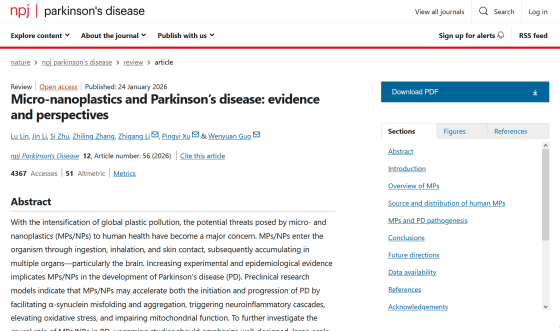
Micro-nanoplastics and Parkinson's disease: evidence and perspectives | npj Parkinson's Disease
https://www.nature.com/articles/s41531-026-01272-4
Microplastics May Be Fueling Parkinson's Disease, Scientists Warn : ScienceAlert
https://www.sciencealert.com/microplastics-may-be-fueling-parkinsons-disease-scientists-warn
Microplastics and nanoplastics not only pollute the environment, but are also known to invade the bodies of wild animals and humans , raising concerns about the adverse effects of accumulated plastic on the human body .
A research team from Guangzhou Medical University in China and elsewhere reviewed more than 100 studies to investigate the link between plastics and Parkinson's disease. Parkinson's disease is a neurodegenerative disease that causes movement disorders such as hand tremors and difficulty walking. The number of patients with Parkinson's disease has roughly doubled over the past 25 years, and it has been shown that at least some of the cases are related to pollutants such as pesticides in the environment.
Study finds that certain pesticides may increase Parkinson's disease risk by more than 2.5 times - GIGAZINE

The paper states, 'With the increasing severity of plastic pollution worldwide, the potential threat that micro- and nanoplastics pose to human health has become a major concern. Micro- and nanoplastics enter the body through ingestion, inhalation, and skin contact, and then accumulate in multiple organs, particularly the brain.'
Based on previous research, the team argues that microscopic plastic particles ingested by people can penetrate the blood-brain barrier or penetrate the nerve cell layer in the nasal cavity and enter the brain.
A 2023 study showed that micro- and nanoplastics promote the aggregation of a toxic protein called alpha-synuclein , which is known to accumulate and aggregate in the brains of Parkinson's disease patients and is believed to be the cause of the disease.
The researchers also found that plastics invading the body can cause neuroinflammation , disrupt communication between the gut and the brain, and allow toxic metals to enter the brain, triggering a cell death process called ferroptosis , all of which are linked to Parkinson's disease.
While this body of evidence is intriguing, it's important to note that most of the studies in this review were based on animal or laboratory cell experiments. The researchers note that research on micro- and nanoplastics and Parkinson's disease is limited, and the chronic effects of micro- and nanoplastics in humans remain poorly understood.
The research team argued that 'future studies should systematically compare how the characteristics of micro- and nanoplastics, such as size, shape, surface charge, polymer type, and degradation state, affect Parkinson's disease-related pathways.'

In recent years, research has shown that the concentration of micro- and nanoplastics in the brain is rapidly increasing , but this has been criticized for problems such as the accuracy of the research and a lack of verification procedures.
'A bombshell': doubt cast on discovery of microplastics throughout human body | Plastics | The Guardian
https://www.theguardian.com/environment/2026/jan/13/microplastics-human-body-doubt
Related Posts:








in Free Member, Science, Posted by log1h_ik