Research results show that estimating personality trends from 'wine reviews' reveals preferences for alcohol content
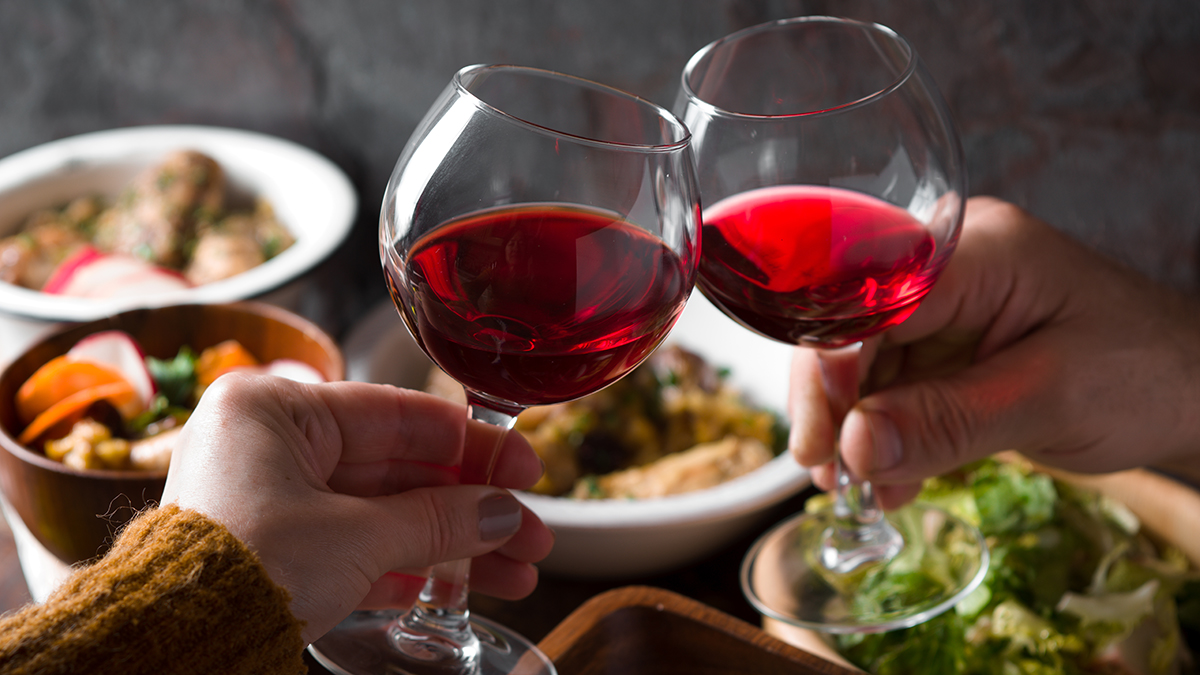
Research has shown that when choosing wine, people may choose based not only on taste and aroma, but also on 'personality traits that are difficult to notice.'
From Personality to Pour: How Consumer Traits Shape Wine Preferences and Alcohol Choices - Wang - Journal of Personality - Wiley Online Library
https://onlinelibrary.wiley.com/doi/10.1111/jopy.70034
An AI analyzed wine reviews and found a surprising link to personality
https://www.psypost.org/an-ai-analyzed-wine-reviews-and-found-a-surprising-link-to-personality/
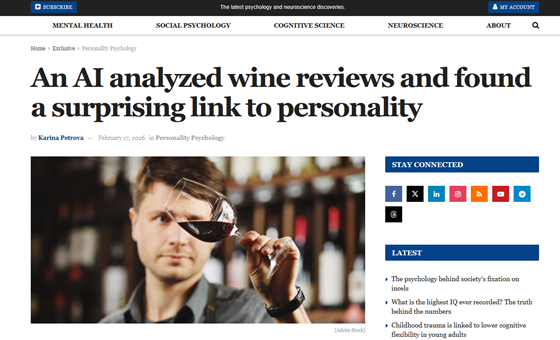
The research team, led by Xi Wang of Beijing Normal University and Hong Kong Baptist University Joint International School, conducted this study based on the ' Big Five ' framework, which divides human personality into five components: neuroticism, conscientiousness, extraversion, agreeableness, and openness. The purpose of the study was to investigate the relationship between personality traits and preferences for wine alcohol content, a topic that has not been sufficiently explored in wine marketing research.
The research team treated alcohol content as an indicator linked not only to 'how easily you get drunk' but also to the drinking experience, such as 'mouthfeel' and 'weight and thickness when you put it in your mouth.' They investigated whether personality traits inferred from reviews were related to alcohol content choices.
To conduct this study, the research team analyzed 9,917 reviews posted on e-commerce wine pages. First, they used an AI model to estimate the Big Five traits of the review writers based on their writing style and word usage, and then statistically examined the relationship between the estimated personality traits and the alcohol content of the reviewed wines.

The research team also used separate data sets in which the correspondence between 'text' and 'personality scores' was known in advance to train the AI to link sentence expressions with personality tendencies, and then applied the learning results to the analysis of wine reviews.
The research team then examined how each of the Big Five traits estimated from the reviews correlated with alcohol content. The results showed that people with higher openness and agreeableness tended to choose higher-alcohol wines, while people with higher extraversion and neuroticism tended to choose lower-alcohol wines. However, conscientiousness did not show a significant correlation with alcohol content.
Psychology media outlet PsyPost explains these results by saying, 'People who are high in openness may be more likely to seek excitement and complexity and be drawn to higher alcohol wines, while people who are high in extroversion may choose lower alcohol wines in order to enjoy social occasions for longer. People who are highly agreeable may choose higher alcohol wines to make choices that are more likely to be liked by others, while people who are high in neuroticism may choose lower alcohol wines to avoid the discomfort of strong intoxication.'
The research team claims that their findings will help understand consumer behavior and could be applied to displaying recommendations and marketing strategies for individual users on e-commerce sites and apps. They also suggest that if preferences can be inferred from clues left naturally by users, such as reviews, it may be possible to optimize recommendations to users without relying on explicit surveys.
The research team pointed out that one limitation of this study is that 'online wine review writers may not be representative of the overall wine consumer population.' Furthermore, because personality traits were estimated from written statements rather than directly measured using a questionnaire, there is room for interpretation regarding the accuracy of the estimates and the extent to which statements written in the specific context of a wine review reflect personality traits.
Related Posts: