Pink noise, which is said to help you sleep better, may actually be damaging your sleep quality
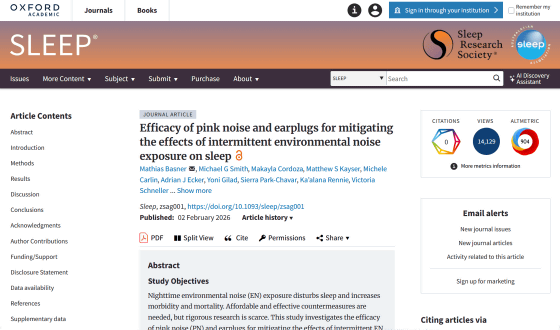
Efficacy of pink noise and earplugs for mitigating the effects of intermittent environmental noise exposure on sleep | SLEEP | Oxford Academic
https://academic.oup.com/sleep/advance-article/doi/10.1093/sleep/zsag001/8452884
'Pink Noise' Could Be Harming Your Sleep Quality, Study Warns : ScienceAlert
https://www.sciencealert.com/pink-noise-could-be-harming-your-sleep-quality-study-warns
Pink noise is a type of broadband noise that is said to be softer than white noise because it has lower high-frequency intensity. Pink noise is said to have a calming effect on sleep, and there are many pink noise songs available for sleep on sites like YouTube and Spotify.
Ultra-high-quality pink noise with explanations for improving memory, concentration, deep sleep, and tinnitus - YouTube
To investigate the effects of pink noise on sleep, an international research team from the University of Pennsylvania and other institutions invited 25 healthy subjects aged 21 to 41 to a sleep lab and conducted experiments under various conditions. None of the subjects had a sleep disorder and had previously used various types of noise to help them sleep.
The subjects first spent one night in a noise-free environment to acclimate to the lab environment. They then slept in various conditions: quiet (average noise level: 23.7 dB ), airplane noise (average noise level: 43.2 dB), 50 dB pink noise (average noise level: 50 dB), noise plus 40 dB pink noise (average noise level: 45 dB), noise plus 50 dB pink noise (average noise level: 50.9 dB), and noise with earplugs (average noise level: 43.2 dB). The subjects were divided into seven groups, and the order of the sleep conditions varied depending on the group.
The researchers measured each participant's sleep quality, asked them to complete a questionnaire assessing their sleep the night before, and performed cognitive and cardiovascular tests before and after each sleep session. Participants were also prohibited from engaging in daytime activities that could affect their sleep, such as exercise, napping, or drinking alcohol.
The results of the experiment showed that on nights with noise, compared to quiet nights without noise, the time spent in N3, the deepest stage of non-REM sleep , was reduced by an average of 23 minutes. On the other hand, on nights with 50dB pink noise, the time spent in REM sleep per sleep bout was reduced by an average of 19 minutes compared to nights without noise. The subjects also self-reported that they slept less soundly, woke more frequently, and had worse overall sleep quality on nights exposed to noise or pink noise compared to quiet nights.
Additionally, on nights when both pink noise and noise were heard, total sleep time was reduced by approximately 15 minutes, and both deep sleep and REM sleep time were shortened compared to nights without noise. However, total sleep time on nights when only noise or pink noise was heard was not significantly different from nights without noise.
Notably, when participants wore earplugs on noisy nights, sleep quality and duration were not significantly different from that of noise-free nights, suggesting that earplugs, rather than pink noise, may be more effective at improving sleep quality.
'While this study was small, it casts doubt on the usefulness of pink noise for sleep, given the importance of REM and deep sleep for brain health,' said lead author Matthias Basner, PhD, a sleep researcher at the University of Pennsylvania. 'We know that non-REM sleep is important for mental and physical recovery, while REM sleep is important for memory consolidation, emotional regulation, and brain development.'
'Our findings suggest that pink noise and other broadband noises during sleep may be harmful, particularly for children, whose brains are still developing and who spend much more time in REM sleep than adults,' Basner said.
Related Posts: