Research suggests society is no worse off than it was in the past
On social media, opinions such as 'violent crimes are on the rise' and 'moral people are becoming more prominent' are often seen, and many people feel that society is worse than it used to be. However,
Think society is in decline? Research gives us some reasons to be cheerful
https://theconversation.com/think-society-is-in-decline-research-gives-us-some-reasons-to-be-cheerful-268834
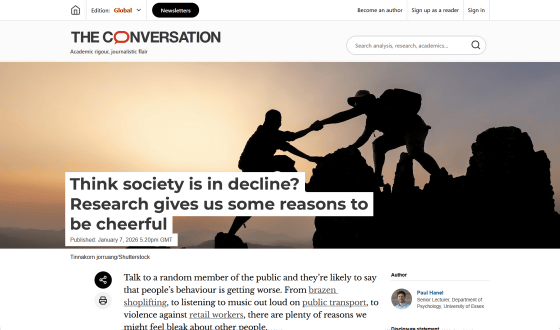
Various surveys support the idea that many people feel that society is worse than it used to be. A survey published in June 2023 showed that people in more than 60 countries felt that basic courtesy was declining, and a 2025 poll of 9,600 Americans found that 47% of respondents felt that people were behaving worse in public spaces than before the COVID-19 pandemic.
However, Hanel points out that people's perceptions are often inaccurate. Research that looks at the values that actually guide people's behavior has found results that contradict the perception that 'society is worse than it used to be.'
A 2022 study of 32,000 people across 49 cultures found that values such as loyalty, honesty, and helpfulness were highly rated, while values such as power and wealth were lowest. An interactive tool using data from the European Social Survey also showed that this trend was consistent across more than 30 European countries from 2002 to 2023.
Furthermore, research across more than 60 countries, across different educational levels, religions, and genders, has confirmed that people's values are generally consistent. These results do not support the idea that people's morals are declining.
Some people may feel that the morals of those with different political views are declining, regardless of whether they share their own views. However, studies that surveyed a total of approximately 2,500 Democrats and Republicans in the United States, as well as studies of Brexit and Remain supporters in the UK, have reported that values are surprisingly similar across people with different political views.
While these studies looked at the values that guide behavior, studies of actual behavior also show that most people do indeed behave morally. For example,
In a 2019 study in 355 cities in 40 countries, people dropped wallets containing various amounts of cash on the street. The results showed that in 38 of the 40 countries, wallets containing more cash were more likely to be returned. This suggests that people who noticed money in their wallets assumed that the owner of a wallet with so much money in it would be in trouble, and were more likely to turn the wallet in to a facility or the police.
In another experiment conducted in 2023, 200 people from seven countries were given $10,000 with almost no strings attached and asked to spend the money. The results showed that participants donated an average of $1,700 to charity and spent a total of $6,400 on behalf of others.
Some people may think, 'Yes, modern people have a certain degree of morality, but people in the past were more moral,' but a study analyzing data from the 1950s to the 2010s found that Americans have become slightly more cooperative with strangers than in the past.
Hanel points out that one reason many people believe society is in decline, even though there is no evidence that society as a whole is declining, is because the news media tends to focus on negative events. While people cooperate with each other during disasters like hurricanes, most media outlets tend to report on the panic and brutality of certain situations, and negative news is more likely to be shared on social media.
Furthermore, people with extreme political views, whether left-wing or right-wing, are more likely to express their opinions online, and the opinions we see on social media are by no means representative of the entire population. While some aspects of society are certainly worse than before, such as the rise in online child abuse, Hanel says it's problematic to be overly pessimistic about others.
Previous research has shown that people who mistakenly believe that other people prioritize selfish values and disregard compassionate values are less likely to volunteer or vote. This is likely because people are reluctant to show kindness to people who will never reciprocate.
On the other hand, many experiments have shown that realizing that 'other people, on average, have similar values and beliefs to you' increases your trust and hope for the future . Whether they are friends or strangers , talking to others can help you realize that 'the people around you are friendlier than you think.'
Hanel said, 'Simply put, the evidence shows that while there may be some instances of an increase in some bad behavior, there is no moral decline. If we all stopped assuming that others are going to harm us and stopped taking steps to help others, we risk becoming self-centered and society declining. The good news is that we and our societies can influence our own destiny.' He argued that we should be proactive in order to improve society.
Related Posts:




in Science, Posted by log1h_ik