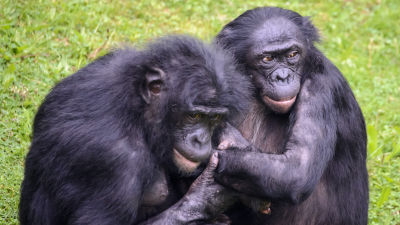
A new study reveals that bonobos can play house just like children do
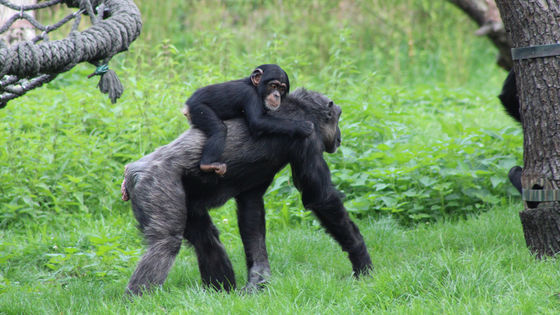
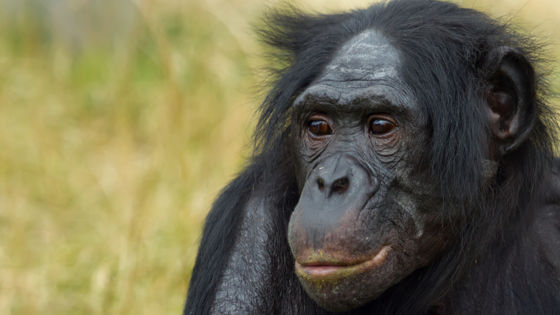
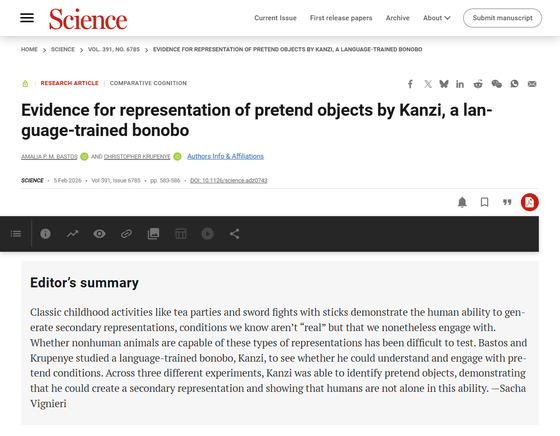
Playing house is a classic childhood pastime, but it was long thought to be exclusive to humans. However, a new study published in the academic journal Science reveals that a bonobo named Kanzi also plays house.
Evidence for representation of pretend objects by Kanzi, a language-trained bonobo | Science
Watch Kanzi the bonobo pretend to have a tea party - Ars Technica
https://arstechnica.com/science/2026/02/watch-kanzi-the-bonobo-pretend-to-have-a-tea-party/
A research team from Johns Hopkins University has revealed that bonobos, a type of great ape, have the same imaginative abilities as human infants.
According to Christopher Krupenje, one of the researchers, by the age of two, human children are able to understand imaginary situations like a tea party and act as if there is real tea in the teacup, even if the teacup and cup are actually empty. Cognitively, this is an example of secondary representation, which involves separating the 'imaginary or simulated state' of acting as if there is actual tea in the cup from the 'reality' of the cup being empty.
Scientists have long wondered whether other animals, especially primates, possess such mental abilities, and there is some anecdotal evidence to support this. For example, young chimpanzees have been observed in the past dragging imaginary building blocks across the floor in the same way they drag real building blocks across the floor. Some wild female chimpanzees have also been observed holding sticks and manipulating them like infants, a primitive form of doll play.
Additionally, a 2006 study observed that chimpanzees and bonobos exposed to human culture were able to respond to verbal commands and engage in role-play, such as feeding a puppet by placing a bowl over its mouth.
However, the interpretation of these findings as evidence of imaginative abilities in animals has been met with skepticism, as animals may solve these tasks by responding to behavioral cues, such as gaze direction.
The research team used Kanji, a 43-year-old bonobo living at
You can see the three experiments Kanji underwent in the video below.
Apes Share Human Ability to Imagine - YouTube
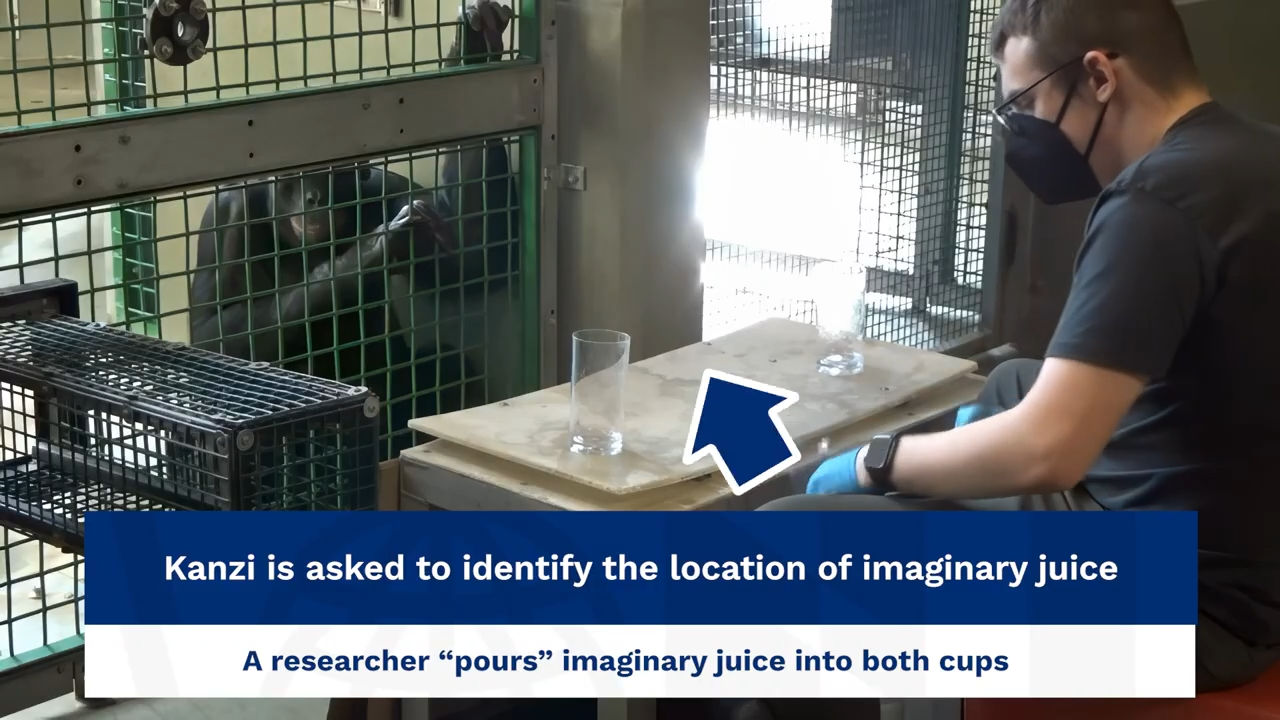
In the first experiment, the scientist verbally prompted the bonobo, 'Kanzi, let's play a game! Find the juice!' Next, they placed two empty clear cups on a table and pretended to pour juice from an empty clear pitcher into them. They then verbally prompted another behavior, such as 'Kanzi, look!' The scientist pretended to pour the juice from one of the cups back into the pitcher, then placed the pitcher under the table. They then asked, 'Kanzi, where's the juice?' and recorded which cup the bonobo pointed to first.
If Kanji were tracking reality only, he would have chosen one of the two options (cups) by chance. On the other hand, if Kanji's choice was guided by stimulus reinforcement, he would have chosen the 'empty' (incorrect) cup over chance. In contrast, if Kanji could imagine the imaginary juice, he would have chosen the 'cup with the imaginary juice'—the cup that hadn't been put back in the pitcher—over chance. In this experiment, Kanji chose the correct cup (the cup with the imaginary juice) 34 times out of 50 (68%).
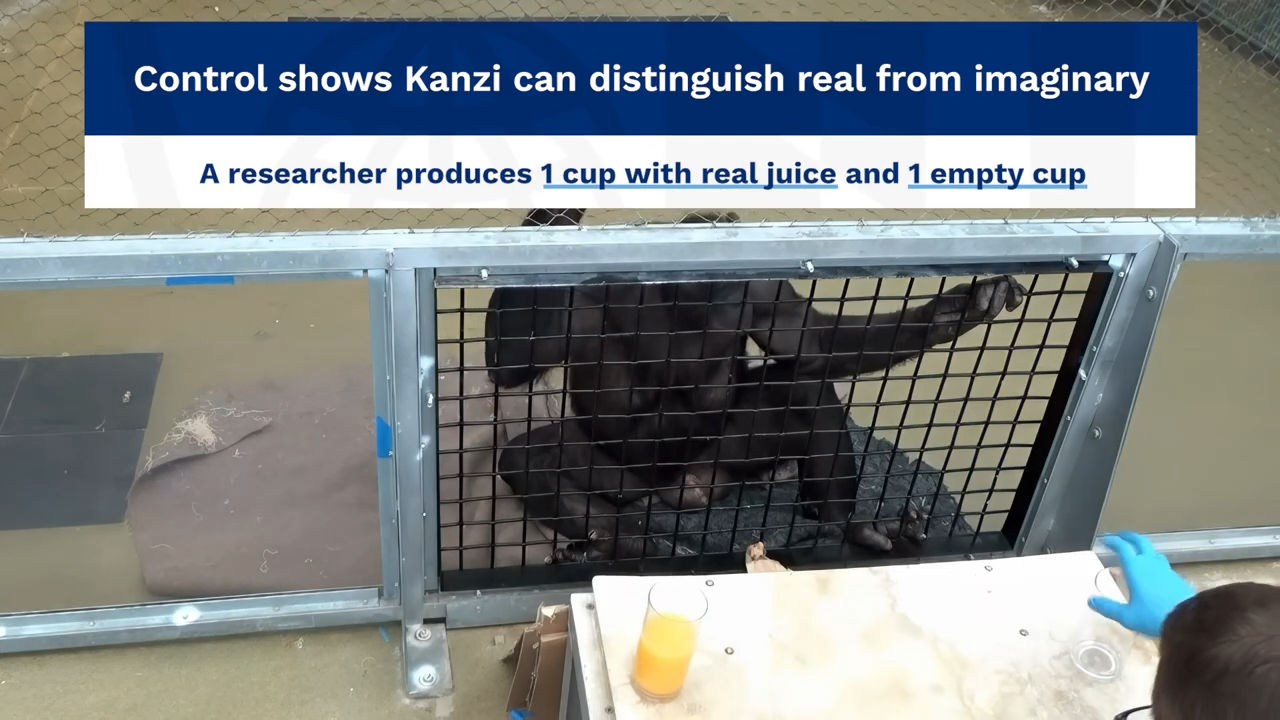
To rule out the possibility that Kanzi simply believed the empty cups contained real juice, the research team conducted a second experiment using the same procedure, except that one of the cups contained real juice. When Kanzi was then asked to choose which one he wanted, he successfully chose the cup with the real juice 78% of the time (14 out of 18 times), demonstrating that Kanzi can tell the difference between real juice and imaginary juice.
Finally, the research team conducted a third experiment. The experimenter pretended to pick a grape from an empty clear plastic container and placed the grape into one of two clear jars. After pretending to empty one of the jars, the experimenter asked Kanji, 'Where are the grapes?' Kanji successfully chose the jar containing the imaginary grape 69% of the time (31 out of 45 times).
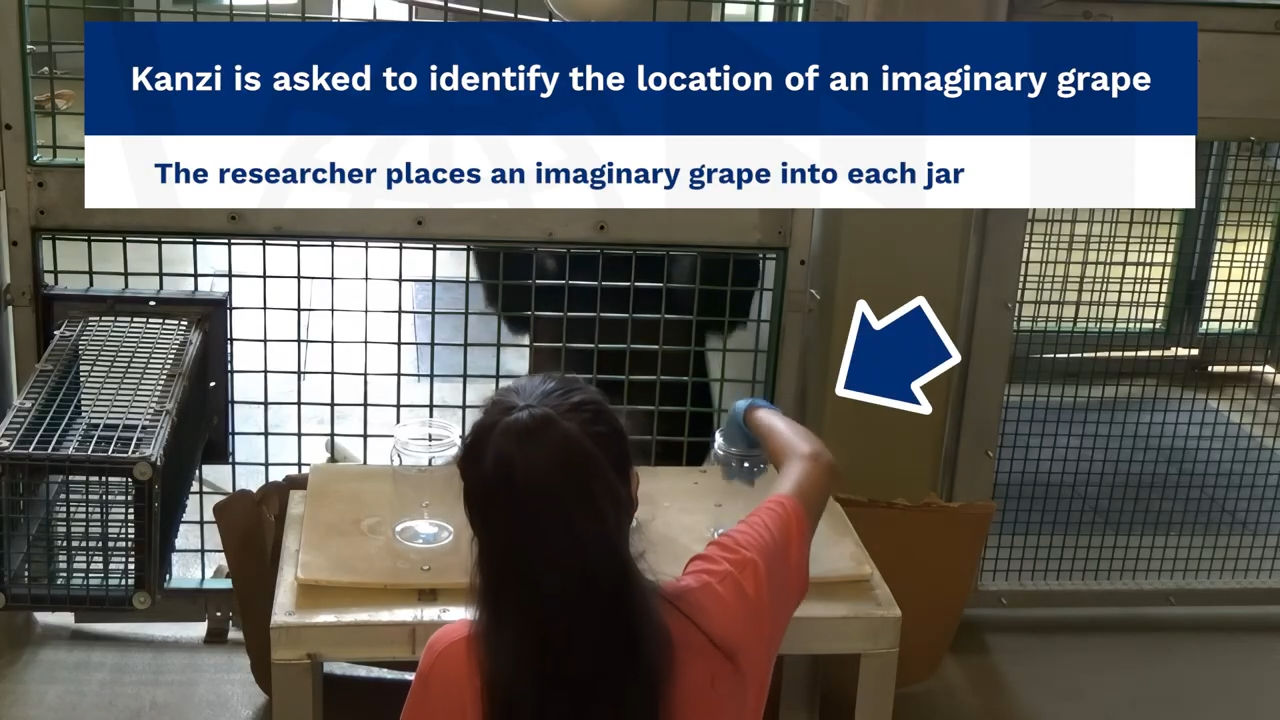
Kanzi didn't perform perfectly on the imaginary tasks, but Amalia Bastos of the University of St Andrews, one of the researchers, said: 'Kanzi is able to imagine imaginary objects and at the same time understand that they are not real.'
'Imagination has long been considered a key element of what it means to be human, but the idea that it may not be unique to humans is truly transformative,' Krupenje said. ' Jane Goodall 's discovery that chimpanzees make tools changed our definition of what it means to be human, and it also forces us to rethink what makes us special and what the mental lives of other species are like.'
Related Posts: