A study analyzing old hair reveals how serious 'lead contamination' was in the 20th century
Lead in archived hair documents a decline in lead exposure to humans since the establishment of the US Environmental Protection Agency | PNAS
https://www.pnas.org/doi/10.1073/pnas.2525498123
Banning lead in gas worked. The proof is in our hair – @theU
https://attheu.utah.edu/health-medicine/banning-lead-in-gas-worked-the-proof-is-in-our-hair/
Preserved hair reveals just how bad lead exposure was in the 20th century | Live Science
https://www.livescience.com/health/preserved-hair-reveals-just-how-bad-lead-exposure-was-in-the-20th-century
Because lead is very easy to process, it was used in water pipes, toys, etc. Lead-containing paints were also widely used to improve paint durability, speed up drying, and achieve vibrant colors. Leaded gasoline was also used worldwide because it prevented engines from making strange noises and knocking , which could lead to engine damage.
However, like mercury and arsenic, lead accumulates in biological tissues and has harmful effects on the human body. Lead can damage the nervous system, causing developmental delays, seizures, and learning disabilities. It is also known to increase the risk of infertility and high blood pressure . Research has also shown that excessive lead exposure during prenatal or childhood exposure increases the likelihood of committing crimes later in life.
Excessive lead exposure before birth or during childhood increases the likelihood of committing crimes later in life - Research Results

In 1970, when the health risks of lead were already well known, then-President Richard Nixon established the U.S. Environmental Protection Agency (EPA) . The EPA quickly cracked down on the use of lead in consumer products, and lead exposure among Americans appears to have declined rapidly.
In this study, Ken Smith, professor emeritus of family and consumer studies at the University of Utah, and his team obtained current and past hair samples from 48 participants who lived along the Wasatch Front in north-central Utah. These individuals had lived along the Wasatch Front throughout their childhood and adulthood, and provided past hair samples stored in photo albums.
The team measured lead concentrations in both ancient and modern hair samples using mass spectrometry, a method for identifying compounds in samples. 'Hair has a unique surface, allowing us to see that certain elements accumulate at high concentrations on the surface. Lead is one of these elements, and it's easy to analyze because it doesn't get lost over time,' said Diego Fernandez , a geologist at the University of Utah who collaborated on the mass spectrometry.
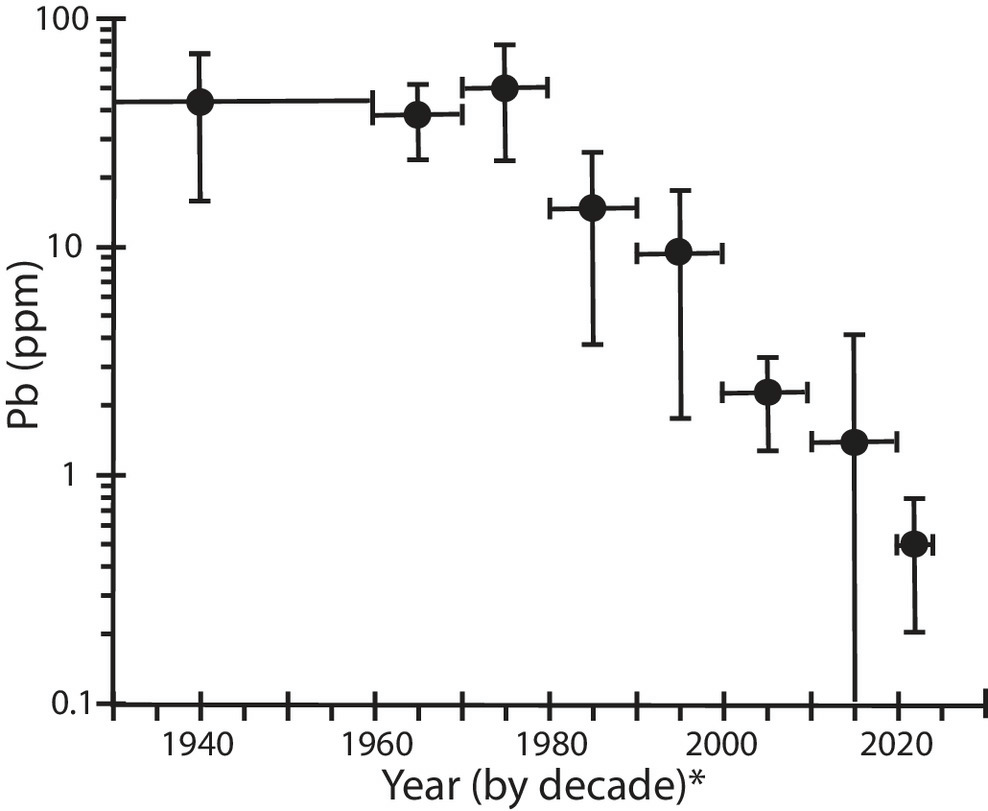
The analysis showed that lead levels in hair from people on the Wasatch Front were extremely high, ranging from 28 to 100
The high levels of lead in hair samples from people living on the Wasatch Front may be due to a lack of lead regulation across the US, as well as the region's role as a 20th-century lead industry. The Wasatch Front was home to two major lead smelters, which closed in the 1970s following stricter EPA regulations on lead products.
The graph below shows the lead concentration (ppm) in hair samples on the vertical axis and the age of the hair samples on the horizontal axis. The '1940' section of the graph includes all hair samples from 1916 to 1959. The graph shows that lead concentrations, which were high until the 1970s, have dropped sharply since the 1980s, and since 2020 have been several tens to hundreds of their previous levels.
The lead levels in hair samples don't necessarily reflect the lead levels in people's bodies at the time, but they do indicate the amount of lead a person was exposed to overall in their environment, giving us clues about the level of lead contamination at the time.
In winter, the Wasatch Front experiences a phenomenon known as an inversion , where the upper air is warmer and the lower air is cooler, making it difficult for air to convect. This means that lead emitted from exhaust pipes and other sources may have remained in the air for a long time and been absorbed into people's hair and lungs.
The research team cited President Donald Trump's ongoing deregulation of air and water quality protections and expressed concern that lead pollution regulations may also be relaxed.
Trump administration to ease regulations to protect air and water quality | Reuters
https://jp.reuters.com/markets/commodities/CCBWH67SQFND3PWEVOCPTDRRZM-2025-03-13/
'We shouldn't forget the lesson of history that these lead regulations were very important,' said Toure Selling , lead author of the paper and professor emeritus of geology and geophysics at the University of Utah. 'Sometimes regulations are burdensome and don't allow industry to do what they want to do when or as quickly as they want. But they really did have a positive effect.'
Related Posts:





in Free Member, Science, Posted by log1h_ik