GPTZero detects 100 new cases of hallucinations in papers accepted at NeurIPS 2025
GPTZero is an AI detection tool that can determine whether text is written by a human or generated by an AI such as ChatGPT. GPTZero announced in a paper accepted at
GPTZero finds 100 new hallucinations in NeurIPS 2025 accepted papers
https://gptzero.me/news/neurips/
Using the hallucination check tool in December 2025, GPTZero found that ICLR 2026 peer-reviewed papers contained 50 hallucinatory citations .
A review of 4,841 papers accepted to the equally prestigious international conference, NeurIPS, uncovered hundreds of hallucinatory citations that had been overlooked by the three or more reviewers who evaluated each paper. The table below shows 100 previously unreported hallucinatory citations in over 51 NeurIPS papers.
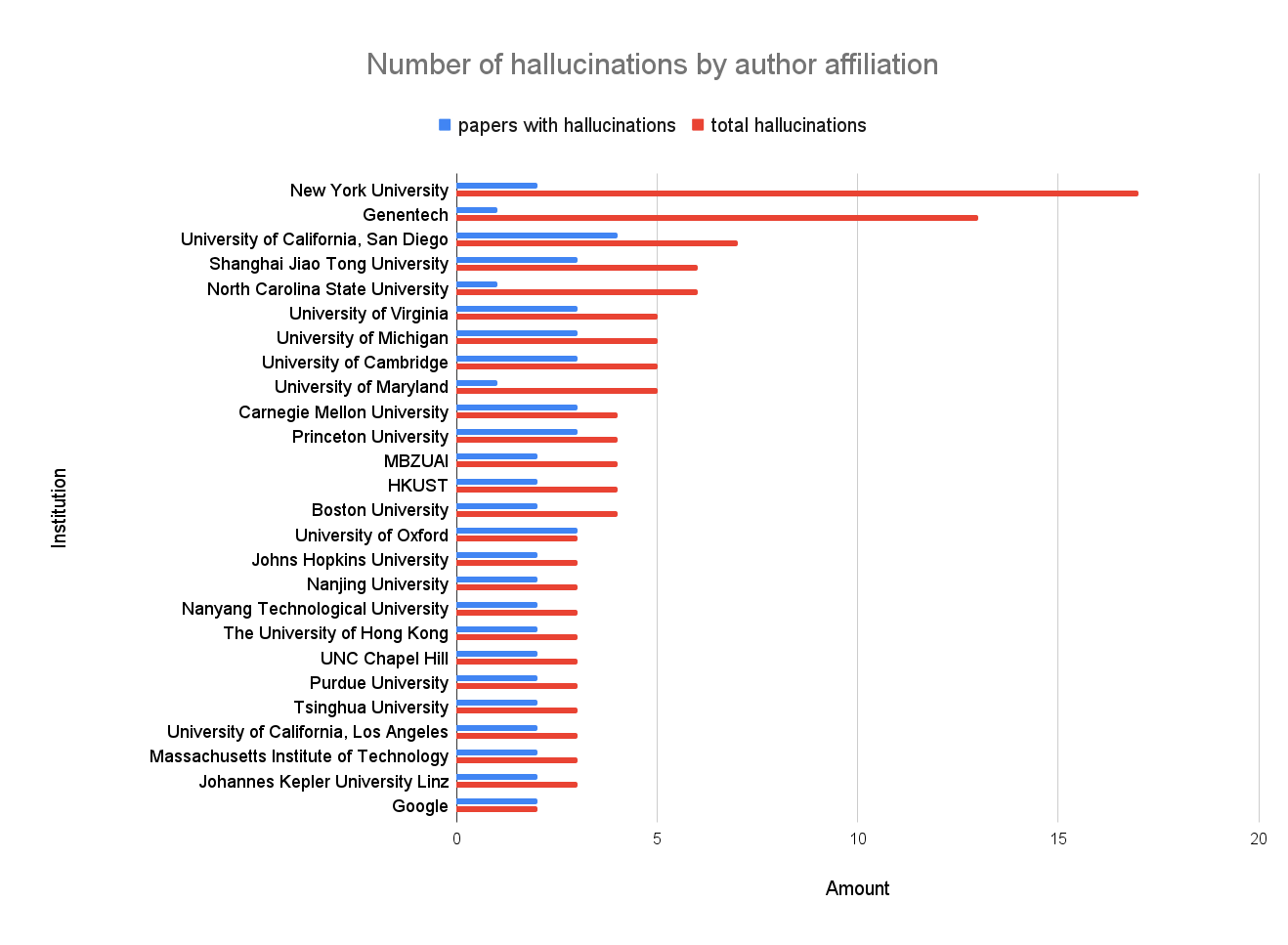
The graph below summarizes the number of hallucinatory citations by the institution to which the author belongs. For example, if a paper written by authors affiliated with two universities contains two hallucinatory citations, it is counted as one hallucinatory citation detected at both universities.
ICLR, NeurIPS, ICML, and AAAI are world-class machine learning and AI conferences, attracting thousands of paper submissions and attendees each year. However, GPTZero pointed out that the rapid increase in paper submissions caused by generative AI, paper writing, and publishing pressures has pushed the peer review pipelines of these conferences to their limits.
In 2020, NeurIPS received 9,467 paper submissions, but by 2025, that number is expected to grow to 21,575—an increase of more than 220%. In response, organizers are having to recruit more peer reviewers than ever before, resulting in problems with oversight, coordination of expertise, negligence, and even fraud.
GPTZero explains that the high number of hallucinatory citations detected is due to the following: 'Our goal is to expose significant vulnerabilities in the peer review pipeline and is not intended to criticize any specific organizers, field representatives, or reviewers at NeurIPS 2025. Over the past few years, NeurIPS has made several changes to its peer review process to address challenges posed by increased submission volumes and generative AI tools. Nevertheless, our results reveal the consequences of a system in which academic reviewers, editors, and conference organizers are overwhelmed by the numbers and resources they need to protect the rigor of peer review from challenges it was never designed to address.'
GPTZero said about its Hallucination Check tool, 'Authors can check their papers for citation errors, including common issues like broken links and incomplete titles that can occur without the involvement of large-scale language models (LLMs). It then significantly reduces the time and effort required for reviewers to verify the sources of submitted papers and identify potential vibe citations (citations with AI-fabricated elements). Furthermore, by using Hallucination Check in conjunction with GPTZero's AI Detector , editors and conference chairs can simultaneously check AI-generated text and suspicious citations, enabling faster and more accurate editorial decisions.'
The list of papers in which GPTZero detected hallucinatory citations is summarized on the following page.
GPTZero finds 100 new hallucinations in NeurIPS 2025 accepted papers
https://gptzero.me/news/neurips/
Related Posts:







in AI, Posted by logu_ii