Over 90% of Alzheimer's disease may be caused by just one gene

The proportion of Alzheimer's disease attributable to apolipoprotein E | npj Dementia
https://www.nature.com/articles/s44400-025-00045-9
Most Alzheimer's cases linked to variants in a single gene | UCL News
https://www.ucl.ac.uk/news/2026/jan/most-alzheimers-cases-linked-variants-single-gene
Just One Gene May Be Responsible For Over 90% of Alzheimer's Cases : ScienceAlert
https://www.sciencealert.com/just-one-gene-may-be-responsible-for-over-90-of-alzheimers-cases

The APOE gene is a blueprint for producing apolipoprotein E , a protein that transports cholesterol and other fats in the body and brain.
There are three main types of APOE genes, commonly referred to as 'ε2,' 'ε3,' and 'ε4.' Science Alert explains, 'The combination of these three types affects the shape and function of proteins produced, which affect brain functions such as maintaining nerve cells, controlling inflammation, and removing amyloid beta buildup in the brain.'
Dylan Williams and his research team at University College London conducted this study to determine the scale of Alzheimer's disease cases, which may be related to variations in the APOE gene. If variations in the APOE gene are related to Alzheimer's disease in a large proportion of cases, this would provide a reason to prioritize research into the APOE gene and apolipoprotein E for the prevention and treatment of Alzheimer's disease.
The question used in this analysis was, 'If the APOE gene had no effect, how many fewer cases would there be?' To make their estimates, Williams and his colleagues used four large datasets totaling more than 450,000 participants. They used data tracking Alzheimer's disease and dementia through diagnostic information in medical records, data confirming amyloid buildup through brain imaging, and data including cases where the disease was confirmed through autopsies.
As a result of their analysis, Williams et al. reported that 'without the APOE gene ε3 and ε4, 72-93% of Alzheimer's disease cases may not have occurred. It is estimated that approximately 45% of all dementia cases are related to the influence of the APOE gene.' The PAF on the vertical axis of the graph below stands for 'Population Attributable Fraction,' and is an estimate of 'what percentage of patients would be reduced in the entire population if the gene's influence were absent.' As can be seen from the graph, the correlation between ε3 and ε4 is particularly pronounced compared to other risk genes.
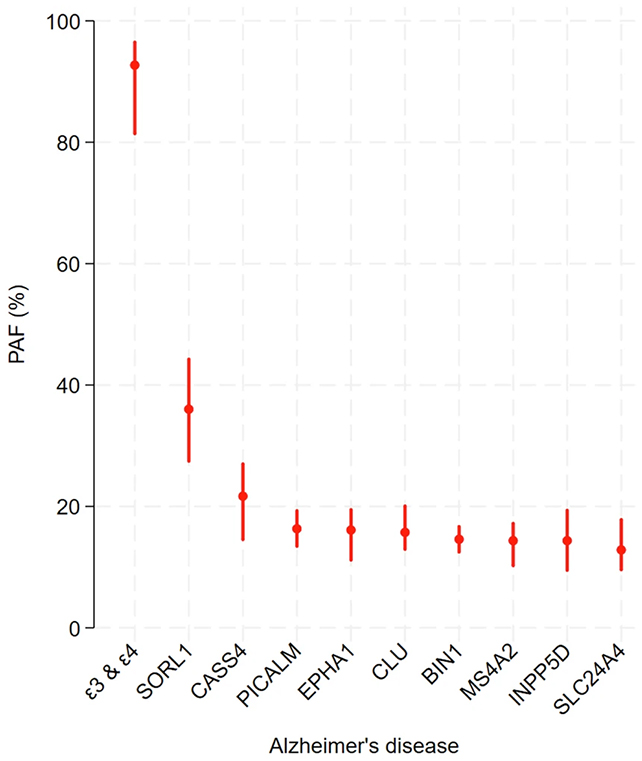
It's important to note the difference between dementia and Alzheimer's disease. Dementia is a general term that refers to a condition in which functions such as memory and judgment decline, and there are a number of diseases that can cause it. On the other hand, Alzheimer's disease is just one type of dementia, so when calculating the overall number of dementia cases, the proportion of the APOE gene's influence is smaller due to the inclusion of causes other than Alzheimer's disease.
What's important about this study is that it treated ε3, which has traditionally been considered the 'most common type,' as a significant factor. Science Alert explains that 'because ε3 is so common, its significance may have been overlooked.'
'When we consider not only ε4 but also ε3, which has been thought to be the common form, as a risk factor, the scope of the APOE gene's influence expands dramatically, and it appears to be involved in the majority of Alzheimer's disease,' Williams and his colleagues wrote. Furthermore, they argue that the APOE gene and apolipoprotein E are powerful but under-recognized drug targets, and that 'research analyzing the APOE gene itself and the molecular pathway from the APOE gene to Alzheimer's disease should be prioritized.'
However, Williams and his colleagues explain that 'even in people with two ε4 genes, who are considered to be at the highest risk, the lifetime risk is estimated to be less than 70%, not 100%. In other words, it is not just genes that determine whether or not you will develop Alzheimer's disease, but other genetic factors, environment, and lifestyle factors also play a role in determining whether or not you will develop the disease.'
While Williams and his colleagues acknowledge that targeting genes or proteins for treatment is not easy, they say, 'If the APOE gene's involvement is greater than we thought, then it's well worth studying.' They also point out that future challenges include elucidating the mechanism by which the APOE gene affects Alzheimer's risk and the factors that determine that risk.
Related Posts:








in Science, Posted by log1b_ok