How does banning smartphones at school affect grades?

As Australia became the first country in the world to enact
School Cell Phone Bans and Student Achievement | NBER
https://www.nber.org/digest?page=1&perPage=50
The Impact of Cellphone Bans in Schools on Student Outcomes: Evidence from Florida | NBER
https://www.nber.org/papers/w34388
(PDF file) THE IMPACT OF CELLPHONE BANS IN SCHOOLS ON STUDENT OUTCOMES: EVIDENCE FROM FLORIDA
The study was conducted by David N. Figlio of the University of Rochester and Umut Ozek of the RAND Corporation. The study took place in a large urban school district in Florida. While Florida House Bill 379 (K-12 Public School Technology Legislation) strictly restricts smartphone use in schools, this school district goes even further, banning smartphone use not only during class but throughout the school day.
For example, Florida House Bill 379 states:
- Students are prohibited from using wireless communication devices during class time.
- Require teachers to have a designated place to store wireless communication devices.
- Limiting student access to age-appropriate materials and information
- Protecting students' personal information
- Prohibiting the use of social media via the school district network
・TikTok usage restrictions
- Mandatory education on the impact of social media
The large urban school district that was the subject of this study operates under the following rules:
・Wireless communication devices are not permitted to be used at any time while on school grounds.
- Violations may result in disciplinary action, including confiscation and suspension.
Figlio and his colleagues analyzed official school data, such as students' academic achievement test results, records of absences and truancy, and disciplinary actions such as suspensions, as well as location data showing smartphone usage on school grounds. Their analysis is notable for comparing 'schools with high smartphone usage' with 'schools with low smartphone usage' before the smartphone ban. They examined whether the impact would be greater in schools with a higher smartphone dependency.
◆ The first thing that happened when smartphones were banned was confusion
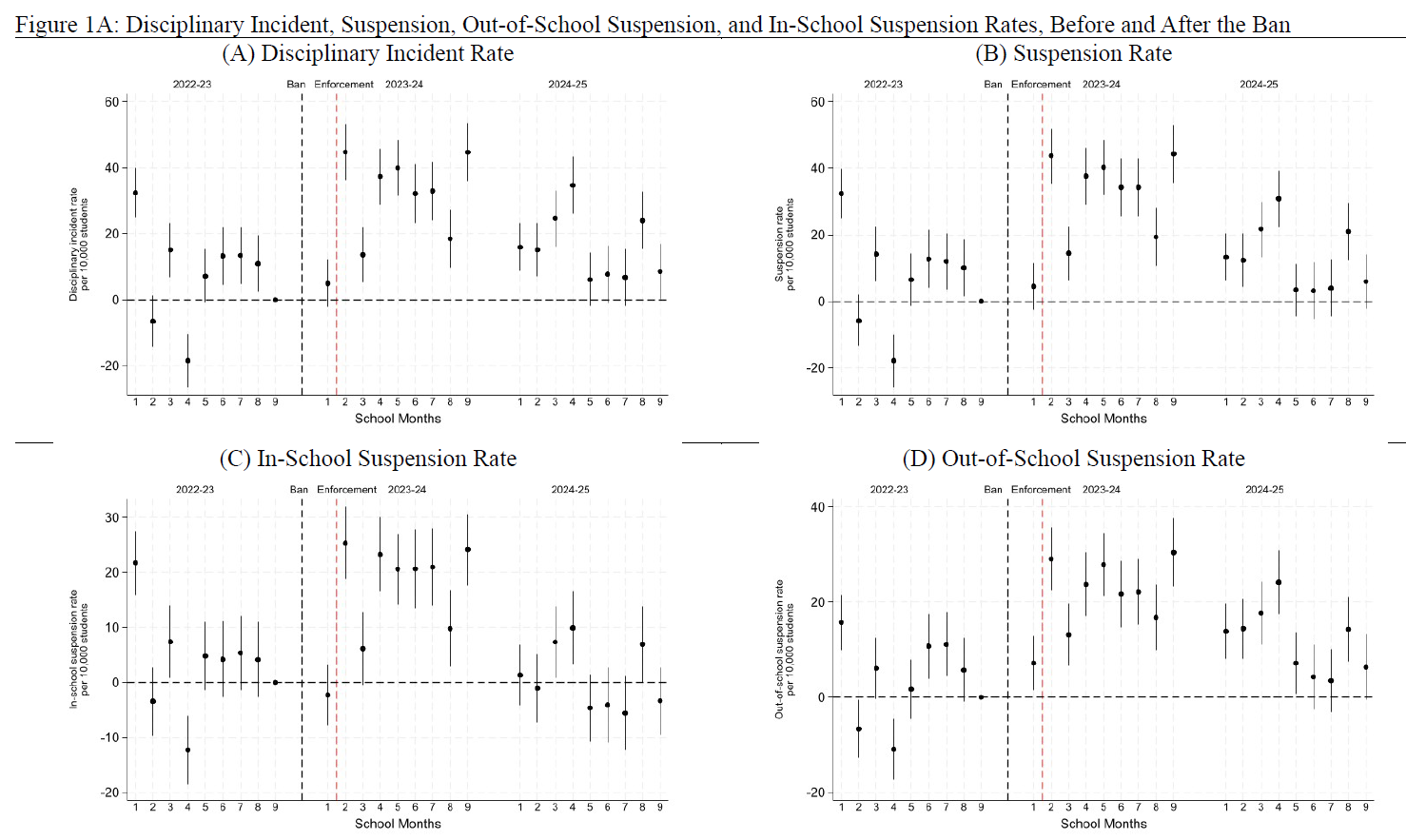
The analysis showed a temporary increase in suspensions and disciplinary actions immediately after the smartphone ban was implemented. In particular, smartphone-related violations and disobedience to teacher instructions were prominent in the first year of the smartphone ban, resulting in what appeared to be a deterioration in discipline.
However, this did not last long: by the second year, disciplinary action rates had returned to roughly their previous levels, which Figlio and his colleagues attributed to a ' temporary adjustment cost .'
◆Changes in grades
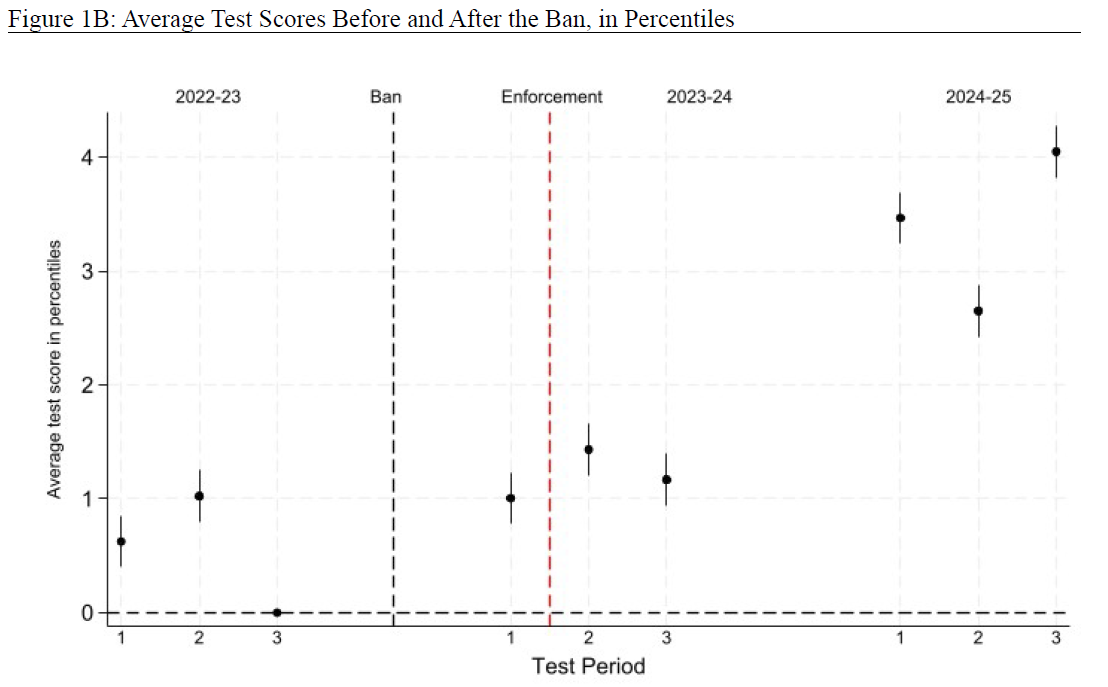
No significant changes were observed in test scores in the first year after the smartphone ban was imposed, indicating that banning smartphones is not a simple matter of immediately improving academic performance.
However, things changed in the second year. Test scores in both English and mathematics showed statistically significant increases, demonstrating the impact on academic achievement. This was evident after the initial confusion had subsided.
This improvement in grades was not seen equally among all students. The effect was particularly strong among junior and senior high school students, and the improvement in grades was more pronounced in schools where smartphone use was more prevalent before the ban. It is possible that the older students are, the more the distractions caused by smartphones may have had an impact on their studies.
While the increase in grades is not dramatic, it is equivalent to a few percentiles on a national scale. In the field of educational research, even improvements of this magnitude are often considered to have a significant effect.
Reduced absences are key to improved grades
The study also conducted a detailed analysis of why grades improved. One area that drew attention was the change in the number of student absences. After the smartphone ban was implemented, the number of times students missed school decreased overall. The decrease was particularly notable in 'unexcused absences' where students had no valid reason, such as illness. This does not simply mean that the number of days absent decreased, but also that fewer students were absent because they did not want to go to school. This trend was more pronounced among junior and senior high school students, and in schools where smartphone use was common before the smartphone ban. Figlio and his colleagues point out that this may not only have improved students' ability to concentrate during class, but also that their overall involvement in school life may have increased.
Furthermore, 30 to 40 percent of the improvement in grades can be explained by this 'reduced absences.' The ban on smartphones meant that students came to school more often, which resulted in more time to study, which may have been one of the reasons for the improvement in grades.

This study shows that although banning smartphones in schools causes confusion immediately after their introduction, it is too early to judge them as failures based solely on that stage. In fact, in the first year of the smartphone ban, there was a temporary increase in suspensions and disciplinary actions, but as students and teachers became accustomed to the new rules, the situation calmed down, and from the second year onwards, changes were confirmed, with fewer absenteeism and improved grades.
However, the study has limitations. Figlio and his colleagues point out that the analysis was limited to a single school district, and because the smartphone ban was implemented simultaneously across the entire district, it may be an underestimate of the true effect. It's also unclear what the long-term impact will be, or what changes will occur in students' mental health and social skills.
Related Posts:







in Education, Smartphone, Posted by log1b_ok