A simple and practical method for abusing stablecoins to launder money has been revealed

Governments impose
How a Cryptocurrency Helps Criminals Launder Money and Evade Sanctions
https://www.nytimes.com/2025/12/07/technology/how-a-cryptocurrency-helps-criminals-launder-money-and-evade-sanctions.html
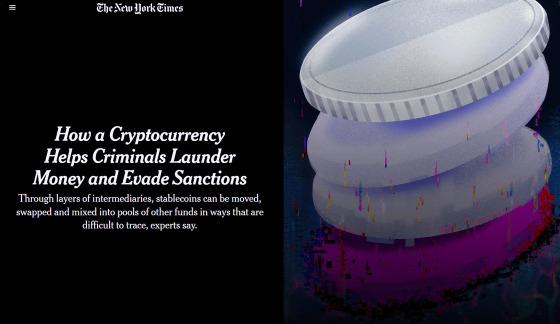
In the past, smugglers, money launderers, and individuals subject to economic sanctions would purchase diamonds, fine art, and other items to hide their illicit wealth, but these items were difficult to move and had limited uses.
In recent years, criminals have turned to stablecoins, such as those pegged to the US dollar, as a much more viable alternative to jewelry or fine art. Stablecoins can be easily purchased with local currencies, moved almost instantly across borders, and used within the traditional banking system by converting them into debit cards. In many cases, these money laundering schemes can be carried out without detection by law enforcement.
According to a report released in February by blockchain analysis company Chainalysis, the total value of illicit transactions via stablecoins could reach up to $25 billion (approximately 3.9 trillion yen) by 2024. Krolik points out that wealthy Russians and leaders of Islamic countries have begun using stablecoins, undermining America's most powerful diplomatic tool: economic sanctions, which cut off adversaries from the dollar and the global banking system.
For years, the U.S. Treasury Department has relied on banks and credit card companies to root out illicit financial activity. These companies have spent billions of dollars tracking and eliminating entities targeted by government economic sanctions, helping to exclude them from dollar-denominated trade, which dominates global trade.
However, stablecoins can bypass this system entirely by passing through multiple layers of intermediaries, allowing funds to be moved, exchanged, or mixed into other pools in ways that are difficult for authorities to trace. 'Criminals are moving faster than ever,' said Ari Redboud, a former Treasury Department official and head of policy at blockchain data company TRM Labs, arguing that economic sanctions and other penalties become ineffective when criminals can move millions of dollars with a few clicks.

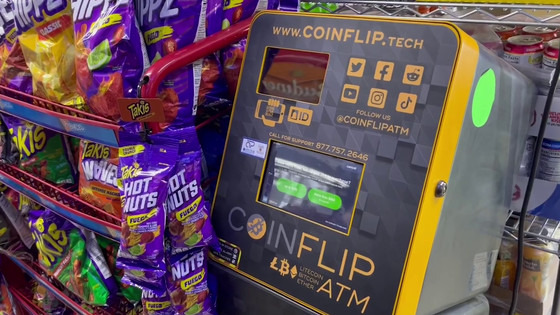
To test how easily stablecoins can circumvent banking regulations, Krolik converted cash into stablecoins at a cryptocurrency ATM in New Jersey. He inserted two $20 bills and immediately received a notification on his smartphone that the cryptocurrency had been deposited into his digital wallet.
The pre-configured Telegram bot then guided him through the steps of using the stablecoin to generate a Visa payment card with a balance that could be used anywhere. While the payment card resembled a debit card, it was not connected to Krolik's bank account and did not require him to provide any address or identification. This meant that Krolik was able to convert his cash into a 'partially anonymous payment method.'
The Telegram bot that issued Krolik's payment card was operated by a company called 'WantToPay,' run by a Russian resident in Thailand. WantToPay provides Visa and MasterCard payment cards to Russians who want to shop abroad or online but are subject to US sanctions. This allows Russians to use services like ChatGPT and Netflix, which don't accept payments from Russian banks.
WantToPay did not respond to Krolik's request for comment. After contacting them, the company removed any references to Visa or MasterCard from its website and sent a notice to Telegram stating that it had stopped issuing cards. After Krolik notified Visa after his test, Visa responded that it had launched an investigation into WantToPay. A MasterCard spokesperson said the company has a zero-tolerance policy toward illegal activity and is actively reviewing potential issues to ensure compliance with local laws and standards.
Further investigation revealed that WantToPay was only one part of a stablecoin-based money laundering scheme, and that the payment cards were issued by Brazilian financial technology company Dock. While Dock helps businesses issue Visa and MasterCard cards through banks, the company is not a government-regulated financial institution and is therefore not held to the same compliance standards as its banking partners.

Krolik's research identified 24 companies advertising anonymous Visa and Mastercard products funded by stablecoins on Telegram and other platforms, offering withdrawal limits of up to $30,000. The companies are based in countries around the world, including Costa Rica, Malta, Georgia, Kazakhstan, and Russia.
In July 2025, the United States passed the GENIUS Act, which established a regulatory framework for stablecoins and established a compliance program to combat illegal activity and sanctions violations. However, Krolick points out that the regulations primarily apply to U.S.-based exchanges, meaning funds can still move freely through overseas platforms, unregulated cryptocurrencies, and decentralized finance systems that do not meet any of these requirements.
In fact, Tether , which has over $180 billion in stablecoins in circulation, is based in El Salvador and is exempt from the new regulations. Furthermore, because Tether holds over $112 billion in U.S. Treasury securities, enforcement action against Tether could destabilize financial markets.
Additionally, the chairman and executive vice chairman of Cantor Fitzgerald , an investment bank that services Tether, are the sons of U.S. Secretary of Commerce Howard Lutnick , adding that the political and financial ties surrounding Tether further complicate the situation, Krolick said.
Related Posts:



in Note, Posted by log1h_ik