Why do people believe the podcast 'Telepathy Tapes,' which makes the absurd claim that 'people with autism have telepathy'?
The Perplexing Appeal of The Telepathy Tapes — Asterisk
https://asteriskmag.com/issues/12-books/paradigm-shifted-the-perplexing-appeal-of-the-telepathy-tapes
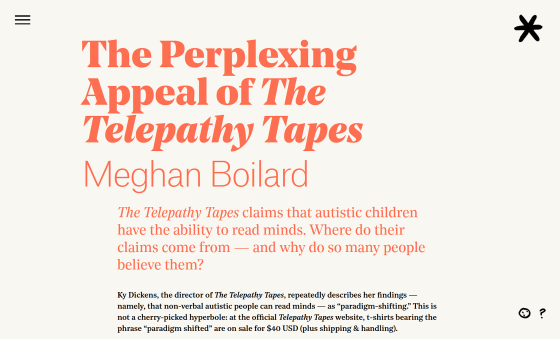
Season 1 of The Telepathy Tapes spans 10 episodes and approximately 500 minutes, and features testimonies from families of patients diagnosed with severe autism. The episodes depict the cruel doctors who tell patients that verbal communication is impossible, and the parents and family members who struggle to find ways to communicate with them. While it's understandable that episodes like this, in which people in difficult situations overcome their difficulties, are popular, Boilard points out that The Telepathy Tapes has a number of problems.
The Telepathy Tapes gained a lot of support in 2025, with Spotify's editorial team naming it one of the 'Best Breakout Series of 2025' in July. Joe Rogan , a well-known podcaster who has been criticized for spreading conspiracy theories and leaning toward pseudoscience, invited Kai Dickens, director of The Telepathy Tapes, to speak to his millions of listeners in February.
In The Telepathy Tapes, Dickens argues that even autistic people, who are thought to be unable to communicate verbally or non-verbally, can communicate if they use ingenuity. He argues that non-verbal autistic people are not only able to communicate, but also possess 'telepathy,' which allows them to see things that should be invisible, predict the future, and access a universal collective consciousness.
In the episode, Dickens and his team meet with people who have found ways to communicate with people with severe autism and conduct tests to assess their communication skills. These tests involve presenting people with autism with a board with numbers and letters written on it and observing them spell out messages. They also conduct psychic experiments, such as having them guess the numbers on a randomly selected UNO card or write randomly generated words on an unseen iPad.
The autistic individuals featured in the Telepathy Tapes performed remarkably well on these tests. Their parents, who knew the answers, enthusiastically encouraged them as they answered. Dickens hypothesizes that the psychic powers exhibited by autistic individuals may be due to the crystal-clear telepathic communication they share with those closest to them.
As the episodes progress, Dickens hints that the telepathic communication abilities of autistic people are only a part of their psychic abilities. Episode 3 tells the story of mute people from all over the world gathering in a spirit world called 'the Hill' to communicate with each other, while episode 7 features a story in which an autistic girl named Emilia deciphers ancient Egyptian hieroglyphics. When Dickens and his colleagues ask Emilia how she can read ancient Egyptian hieroglyphics, she replies that 'God taught her' using a tablet, letter by letter.
The Telepathy Tapes also feature segments in which self-proclaimed scientists attempt to explain these phenomena, such as an electrical engineer-turned-parapsychologist discussing psychic abilities and a Cambridge researcher describing experiments on human-dog telepathy. In one segment, the concept of quantum entanglement is presented as an explanation for telepathy.
Dickens himself acknowledged that these explanations were absurd, but he maintained that the mysterious events described in the Telepathy Tapes could not be explained because 'people's perception of reality itself is seriously flawed.' Boilard points out, 'Ultimately, the argument for autistic telepathy depends on faith; specifically, faith in a single assumption: that all thoughts communicated through nonverbal thought are accurate.'
Individuals with autism who have difficulty speaking typically use a variety of reliable
For example, Boilard's brother sporadically uses a method called 'sticking cards with simple illustrations one after the other with Velcro,' and when asked what he wants to eat, he sticks on cards saying 'shrimp' or 'chicken.' However, this method doesn't convey details like how the food should be cooked, what side dishes they want, or whether they want to eat at home or eat out.
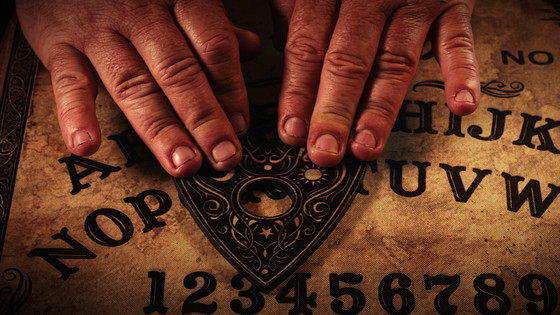
Meanwhile, the autistic individuals featured in the Telepathy Tapes communicate through a method known as 'spelling,' in which they point to a letter board held by a caregiver, who then reads the message. This is a kind of collaborative process, and the caregiver not only helps interpret the message, but also corrects errors in the message and sometimes acts as a guide for the autistic individual.
Boilard points out that these spellings are a continuation of ' Facilitated Communication ,' a method of communication now scientifically discredited. Dickens himself acknowledges that spellings are the spiritual successors of FC, but he casually suggests that FC was unfairly ignored by the ableist public, and he conveniently ignores the historical flaws surrounding FC in The Telepathy Tapes.
FC is a communication method introduced by Australian educator Rosemary Crossley in the mid-1970s. Crossley developed this method while caring for a teenage girl diagnosed with cerebral palsy and severe intellectual disability. She supported the girl's unsteady arms and had her use her fingers to select words or letter blocks.
Despite having no formal education, the girl was able to write perfect sentences in just three weeks. She was also found to be knowledgeable about advanced mathematics and international nuclear policy, leading Crossley to speculate that she 'probably learned these topics through overheard conversations and television.' Ultimately, the girl expressed a desire to escape her squalid living conditions, earned a degree in humanities, and co-authored a memoir with Crossley. These stories touched the hearts of Australians and sparked a rethinking of the human rights violations against people with disabilities that have long been committed in psychiatric hospitals and psychiatric facilities.
Meanwhile, the Australian scientific community was skeptical of FC, but remained silent for a long time due to fears that it might 'interfere with a promising step towards freedom for people with disabilities.' It wasn't until 1987 that Australia's leading communication experts came together to express concerns about FC, stating that 'caregivers' beliefs and prejudices may interfere with the message.'
However, FC has spread outside Australia, and in the 1990s it was enthusiastically adopted in North America, where facilities for training FC caregivers were opened. Since then, there have been numerous reports of children who were unable to communicate verbally demonstrating literacy and intelligence far beyond expectations. At the same time, there has also been a sharp increase in cases of children reporting sexual abuse or violence at the hands of family members or close friends.
While it is true that abuse rates among people with intellectual disabilities are significantly higher than in the general population, and that perpetrators are often primary caregivers or disability support service providers, the number of cases is unusually high given the small number of FC practitioners, and far exceeds the number of cases reported by autistic people who are able to communicate nonverbally.
Following reports of abuse through FC, trusted teachers were fired, devoted parents were accused of rape, and criminal charges were filed one after another. In 1993, a 16-year-old autistic woman named Betsy accused her entire family, including her parents, siblings, and grandparents, of sexual abuse through FC. As a preventative measure, Betsy was separated from her family and placed with foster parents. However, during her time away from her family, she lost approximately 4.5 kg, developed bruises on both eyes, and suffered from severe ear infections that were left untreated, resulting in severe weakness.
Investigators realized something was wrong when Betsy, who should have been in unbearable physical pain, showed no signs of discomfort during the FC session. A local lawyer then questioned whether Betsy was truly capable of communicating. After an agreement between the parties, Dr. Howard Shane of Boston Children's Hospital conducted an examination of Betsy.
To determine whether it was Betsy herself or her caregiver who was creating the messages through FC, Shane devised an objective, double-blind experiment. Officially, the experiment involved showing Betsy and her caregiver the same pictures and instructing them to communicate what they saw through FC. However, the pictures shown to Betsy and her caregiver were actually different. The real experiment, then, was to determine what message was conveyed through FC if Betsy was shown a picture of a cup and her caregiver a picture of a hat.
The results of the experiment showed that when Betsy and her caregiver were shown the same picture, Betsy relayed the correct word. However, when Betsy was shown a picture of a 'cup' and her caregiver was shown a picture of a 'hat,' the word relayed through FC was 'hat.' This was also true when the pictures were paired differently, such as 'boat' and 'sandwich' or 'dog' and 'sneakers,' and the FC consistently relayed the word associated with the picture the caregiver saw.
Although Betsy's family was ultimately acquitted, the results of this experiment suggested that, whether intentionally or not, caregivers influence the content of messages in FC. Following this case, experiments to verify the accuracy of FC were conducted on a total of more than 360 people by 2014, but almost none of the subjects were able to pass the double-blind test devised by Shane. The caregivers themselves were the most surprised by these results, and it is believed that they too were unconsciously fabricating messages.
Although scientifically discredited, FC has been around for about 30 years, and fewer people are aware of its historical blemishes. It's making a comeback in the form of 'spelling,' a technique featured in the Telepathy Tapes. While the spelling technique differs slightly from FC, it allows caregivers to subtly move a handheld dial, and it's possible that they guide the movements of individuals with autism through unconscious movements and gaze. In fact, when Boilard reviewed the 'video evidence of telepathy' available as paid content on the Telepathy Tapes, he found various pieces of evidence of caregivers intervening in the creation of messages.
However, Boilard acknowledges that it is difficult to criticize parents who want to communicate with autistic people who cannot communicate because their desire is so strong. Boilard's grandmother also said with confidence that she had prayed to God for 30 years to be able to communicate with Boilard's brother, and one day she 'succeeded in talking to him in a dream.'
'Who among us can claim to understand the true nature of dreams, or challenge the beliefs that brought my grandmother unbridled joy?' Boilard asks. 'To point out the truth risks shattering the dreams of innocent people who have endured hardships unimaginable to the vast majority, without offering even a promising alternative.'
Still, Boilard points out the danger of the idea that people with severe autism can communicate like everyone else, or even have hidden abilities. 'My brother's greatness doesn't depend on him being like everyone else,' she said. 'He represents the worst of everything fearmongers imagine. He could suffer forever, or there could be things I'll never know. It doesn't matter. He's a fascinating and wonderful person, challenges and all,' she said. 'I want to show the world that my brother is human, nothing more, nothing less.'
Related Posts:



in Science, Posted by log1h_ik