EU again abandons 'chat control' initiative to combat child sexual abuse content

The EU has been discussing a proposed
Chat control proposal fails again after massive public opposition | Andrea Fortuna
https://andreafortuna.org/2025/11/01/chat-control-proposal-fails-again-after-massive-public-opposition/
Denmark reportedly withdraws Chat Control proposal following controversy | The Record from Recorded Future News
https://therecord.media/demark-reportedly-withdraws-chat-control-proposal
On Thursday, October 30, 2025, it was revealed that the Council of the European Union had once again withdrawn its chat control proposal. Peter Hummelgaard, Minister of Justice of Denmark, which holds the EU Council Presidency, announced that the promotion of chat control would be discontinued. The German government had just announced on October 8, 2025, that it would not support chat control.
Cybersecurity expert Andrea Fortuna said: 'While the repeal of chat controls is a victory for digital rights, the fight is far from over and fundamental misunderstandings about encryption technology continue to plague policy debates across Europe.'
Since its proposal in 2022, chat controls have faced continuous opposition from experts and the public. Despite this, chat controls have been resurrected multiple times, which is why they are sometimes referred to as 'zombie proposals.' The Electronic Frontier Foundation and over 80 civil society organizations strongly oppose chat controls, which would mandate client-side scanning of encrypted communications under the guise of combating CSAM.
In fact, some have pointed out that chat control is a dangerous bill that uses the anti-CSAM measure as a cover to disable encryption not only for messaging apps but for a wide range of digital services.
The EU's 'Chat Regulation Law' is a dangerous bill that disables encryption not only for messaging apps but also for a wide range of digital services under the guise of child sexual abuse content countermeasures - GIGAZINE

In response to these concerns, EU lawmakers proposing chat control argue that there is no risk of encryption collapsing because it includes privacy protections. However, technical experts have repeatedly demonstrated that the protections claimed by lawmakers are merely illusory. Fortuna explains that this cycle of making minor changes to chat control and then proposing a new bill is a recurring one. Furthermore, Fortuna points out that 'the withdrawal of the bill by Denmark, which currently holds the EU Council presidency, follows the same storyline, leaving the fundamental issues unresolved.'
The 'privacy measure' advocates of chat control claim is to install a backdoor within end-to-end encryption. They argue this allows users to decrypt specific messages while maintaining encryption. However, Fortuna points out that this is a dangerous misunderstanding of the encryption mechanism. 'Creating a mechanism for accessing encrypted content essentially weakens the entire system, making it vulnerable not only to authorized access but also to malicious actors,' he says.
'The fundamental problem with similar bills that include chat controls is a fundamental misunderstanding of encryption technology,' Fortuna said. 'End-to-end encryption works because only the sender and recipient have the key to decrypt the message. No third party, whether a government agency or a technology company, can read the contents. This is not a design choice, but a mathematical certainty that ensures the security of billions of communications every day.'
Another privacy measure advocates of chat control cite is client-side scanning, which scans messages on users' devices before encryption or after decryption, attempting to detect CSAM without harming the encryption technology. While this may sound like a clever workaround, Fortuna points out that it fundamentally breaks the encryption security model. If devices can scan and report message content, malware and hackers could exploit this security hole, putting everyone at greater risk, he says.
Apple also once proposed a CSAM detection system similar to chat controls, but ultimately abandoned the plan.
Why did Apple give up on developing a child pornography detection tool? - GIGAZINE
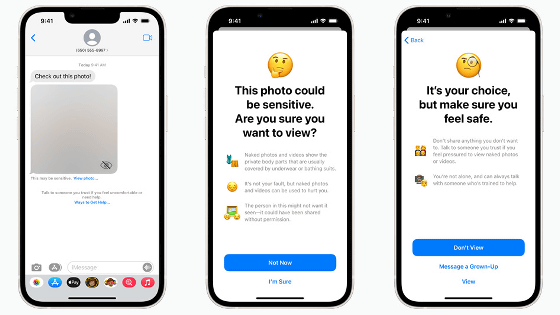
Additionally, the scope creep inherent in surveillance technology has been well documented: systems initially designed to detect illegal content can easily be expanded to monitor other communications of government concern.
The reason chat controls have been able to avoid passage is thanks to frequent public outreach by organizations like the Electronic Frontier Foundation and privacy advocates about the risks of chat controls. Fortuna points out that this growing public outcry makes it politically difficult for lawmakers to support chat controls, at least for now.
Fortuna also argued that the effectiveness of the nonprofit organization's opposition to chat controls offers important lessons for future policy debates. 'First, technical expertise matters. When security researchers unite in their voices about the impossibility of secure backdoors, it becomes harder for politicians to dismiss their concerns as overblown. Second, building coalitions across different sectors strengthens opposition. When civil society groups, technology companies, and individual users all oppose a policy, it suggests that the problem is real and widespread. Third, sustained pressure is essential because, as chat controls demonstrate, inappropriate proposals are rarely rejected on the first try,' he said.
Furthermore, Fortuna argues that the forces pushing for chat control haven't given up, and the underlying political dynamics that gave rise to this proposal remain unchanged. Politicians face serious pressure to be seen as 'doing something' about online harm, especially when it comes to child safety. 'Until an alternative approach that doesn't undermine encryption gains political support, proposals like chat control will continue to resurface,' Fortuna wrote.

Fortuna argued that a fundamental shift in approach to online security is necessary, saying, 'Policymakers need to invest in solutions that actually work, rather than seeking technological magic bullets that promise security without trade-offs.' Specifically, he cited increased funding for law enforcement training and tools that don't require decryption, increased international cooperation in criminal investigations, and addressing the root causes of online exploitation through social programs and education.
On the social message board Hacker News, some have pointed out that ' EU politicians may be the only ones exempt from chat control scanning due to 'professional confidentiality' regulations, ' and ' The real question is when and how chat controls will be re-proposed next .'
While chat control is a bill to prevent the spread of CSAM, there are concerns that the scope of censorship will expand beyond child pornography to also include drug use, anti-government protests, political criticism, etc. Some also point out that introducing chat control is pointless because a significant proportion of child pornography exchanges are consensual between teenage lovers, and much of the child pornography is produced by adults close to children who have offline access to them.
Why is the 'Chat Control Law' that censors all private chats and files at the government's command dangerous and pointless? - GIGAZINE

Related Posts:






in Note, Posted by logu_ii