EU's AI law will come into force on August 1, 2024, with fines for violations of up to 7% of annual turnover or 35 million euros.

The final full text of the EU's Artificial Intelligence (AI) Act, which was enacted in May 2024, has been published in the Official Gazette. The new law will come into force 20 days after publication, so it has been confirmed that the AI Act will come into force on August 1, 2024. All provisions will be fully applied from 2026, although some provisions will come into effect earlier.
REGULATION (EU) 2024/1689 OF THE EUROPEAN PARLIAMENT AND OF THE COUNCIL
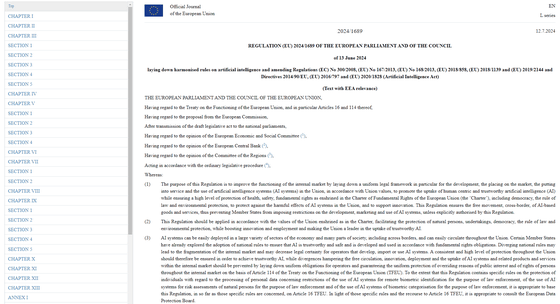
EU's AI Act gets published in bloc's Official Journal, starting clock on legal deadlines | TechCrunch

The AI Act compliance countdown begins - The Verge
https://www.theverge.com/2024/7/12/24197058/eu-ai-act-regulations-bans-deadline
The EU's 'AI Law' imposes various obligations on AI developers depending on the use case and perceived risks. Most AI use cases are considered low risk and will not be specifically regulated, but uses such as 'social credit rankings,' collecting and compiling facial recognition information for databases, and using real-time emotion recognition systems in schools and workplaces will be prohibited six months after the law comes into effect.
In nine months, the EU AI Secretariat, established by the European Commission, and a consulting firm will begin developing a code of conduct for AI developers.
Starting in August 2025, one year after the law comes into effect, makers of general-purpose AI models like ChatGPT will have to demonstrate that their models comply with new transparency requirements, are secure, and are easily explainable to users.
By August 2026, the AI Law rules will apply to all companies operating in the EU, although developers of high-risk AI systems, such as those for infrastructure, employment, critical services like banking and healthcare, and applications integrated into the judicial system, will be given up to August 2027 to comply with risk assessment and oversight rules.
Non-compliance with the AI law will result in violating companies being fined a percentage of their total turnover or a fixed amount, with the maximum being 7% of their global annual turnover or 35 million euros (approximately 6 billion yen).
In line with the principle of 'supporting innovation,' the AI Act stipulates that AI systems and models developed specifically for the sole purpose of scientific research and put into practical use must be excluded from its scope, and that the Act must not affect research and development of AI systems and models before they are commercially available or put into practical use.
Related Posts: