What is the reality of the research result that '98% of students who received one-on-one tutoring become better than average'?

In 1984, renowned American educational scholar Professor
Nintil - On Bloom's two sigma problem: A systematic review of the effectiveness of mastery learning, tutoring, and direct instruction
https://nintil.com/bloom-sigma/
In 1984, Professor Bloom published the results of a study showing that 'compared to general classroom instruction, mastery learning increases students' test scores by one standard deviation . Furthermore, one-on-one individualized instruction based on mastery learning increases test scores by two standard deviations.' This result means that '98% of students who received individualized instruction based on mastery learning achieved scores above the median of students who received classroom-based instruction.'
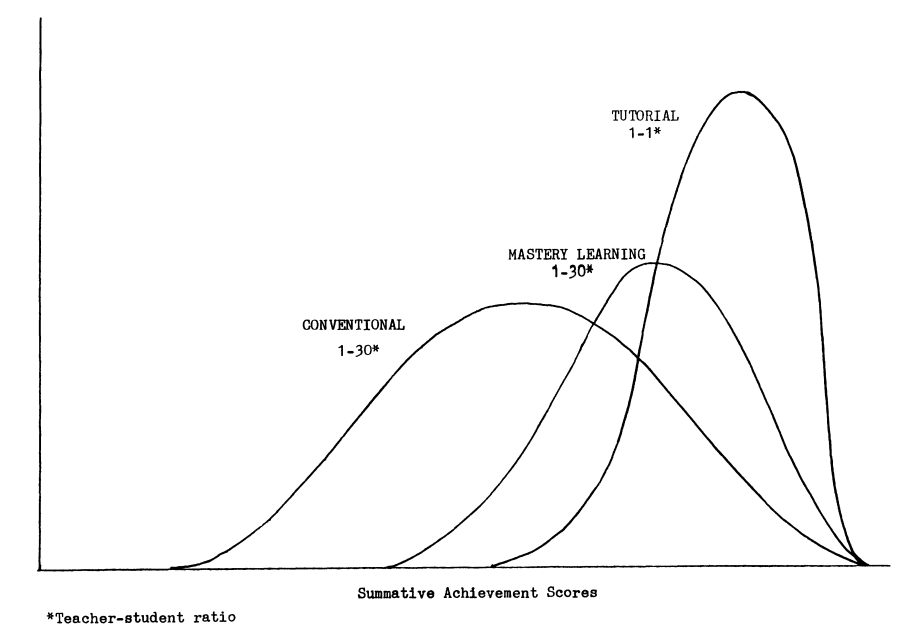
Mastery learning is an educational method in which students are given simple tests on the course content during the learning process to check whether the educational goals have been achieved, and if they have not, they are required to follow up by staying after school for extra lessons, doing homework, etc. until they pass the retest.
Mastery learning and formative testing
https://www.gsis.kumamoto-u.ac.jp/opencourses/pf/2Block/03/1_text.html
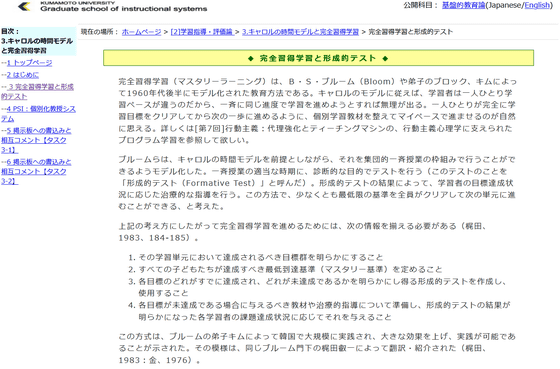
Professor Bloom's presentation had a major impact on the educational research community at the time, leading to the implementation of numerous verification studies. The effectiveness of one-on-one tutoring based on mastery learning varies depending on various conditions, such as the learning unit, but a comprehensive meta-analysis of 101 studies conducted between 2000 and 2014 found that the average effect was 0.79 standard deviations. While this is far less than the '2 standard deviations' result proposed by Professor Bloom, the effect is still significant.
On the other hand, the effect of mastery learning varied widely across studies, from 0.05 standard deviations in a 1983 meta-analysis of junior high school studies to 0.52 standard deviations in a 1990 meta-analysis of university studies. Nintil argues that the reason for this variation is the lack of a consistent teaching method for mastery learning.
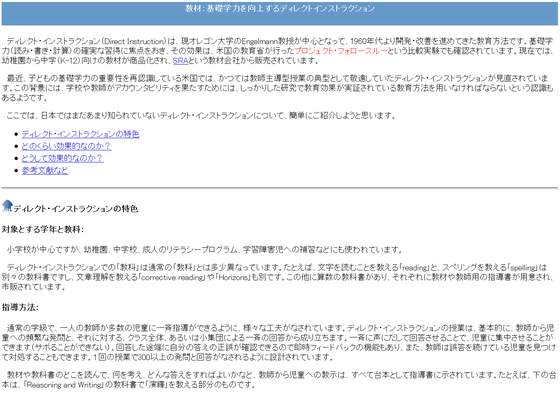
Nintil emphasizes the importance of the 'direct instruction' methodology in mastery learning. Direct instruction is an educational method in which the teacher 'eliminates improvisation during instruction and teaches completely according to a script.' In direct instruction, the teacher not only specifies the lines but also the timing of the pauses. See below for examples of direct instruction.
Teaching materials: Direct instruction to improve basic academic skills
https://www.workitout.jp/simamune/contents/s_DI.html
Numerous meta-analyses have been conducted on direct instruction, and the effect has been found to be approximately 0.5 standard deviations.
Following these results, Nintil discussed the possibility of 'personalized instruction by computer systems.' Citing an example from a 2010 study conducted by the Defense Advanced Research Projects Agency (DARPA) for the Navy, where students tutored by a digital tutoring system outperformed students tutored by human instructors by 1.25 standard deviations and students who only received classroom instruction by 2.81 standard deviations, Nintil noted that while this result presents a problem—the sample size is less than 50 students—he sees promise in computerized tutoring. While designing computerized tutoring systems is difficult enough that they are hardly practical, Nintil expressed hope for computerized tutoring because one-on-one tutoring by humans is costly.
Related Posts: