It turns out that teachers' stereotypes have a significant impact on students' academic performance and motivation

Education is a major issue in many countries, with decades of research and billions of dollars being spent on it. In the United States, where a diverse population of people from different races live, many educators hold stereotypes about racial differences in academic achievement. Researchers at Indiana University conducted a large-scale survey of more than 15,000 students and 150 teachers, and found that teachers' stereotypes have a significant impact on student motivation and academic performance.
STEM faculty who believe ability is fixed have larger racial achievement gaps and inspire less student motivation in their classes | Science Advances
Huge study finds professors' attitudes affect students' grades | Ars Technica
https://arstechnica.com/science/2019/02/huge-study-finds-professors-attitudes-affect-students-grades/
Just because a teacher has the stereotype that 'there is a racial gap in academic achievement,' does not mean that 'racist teachers are openly trying to discourage students.' However, the research team points out that teachers' stereotype that 'no matter how advanced their education, there is a limit to students' growth' may affect students' motivation to learn and stifle students' growth.

The research team conducted a survey of all faculty in STEM (science, technology, engineering, and mathematics) courses at Indiana University. 150 professors and instructors from 643 courses responded. The survey also included questions about whether or not they held stereotypes, as well as the instructors' experience and ethnicity. The research team also collected performance data from over 15,000 students who attended classes taught by the instructors who responded to the survey. They also collected anonymous student feedback ratings of the instructors.
The results showed a significant difference in the growth of students in the classes taught by teachers who held stereotypes and teachers who did not.
The graph below shows the average academic performance of students with teachers who have fixed mindsets (left: Fixed) and students with teachers who do not (right: Growth). The gray bars show the average academic performance of white and Asian students, while the black bars show the average academic performance of minority students, such as Latinos, African Americans, and Native Americans. In the Fixed group, minority students' grades were, on average, 0.19 points lower than those of whites and Asians, while for students in the Growth group, the academic performance gap was reduced to 0.10 points.
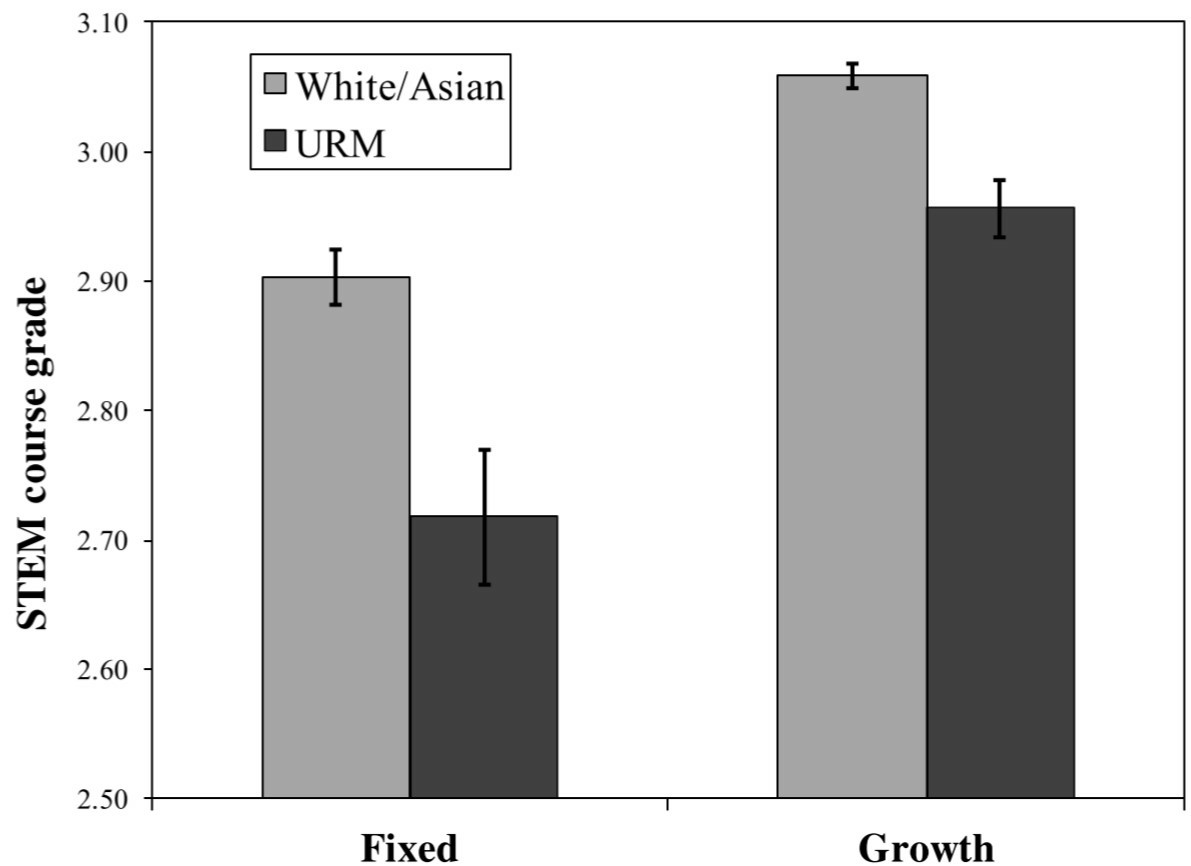
The results of the student survey also revealed that teachers with fixed mindsets were less likely to 'value student learning and development' and provide less motivating instruction, which, on average, lowered the motivation of all students, especially minority students.
The research team pointed out that 'classes with teachers who hold stereotypes have a larger racial achievement gap than those with teachers who do not,' and further stated that 'no significant differences were found between classes in terms of other factors, such as teacher experience, status, gender, or ethnicity,' suggesting that 'teacher attitudes and beliefs shape the motivation and achievement of students in their classes.'
Ars Technica commented on this research, saying, 'If teachers could abandon fixed mindsets and adopt a mindset that expects more growth from students, education would be more effective and students would benefit greatly.'
Related Posts: