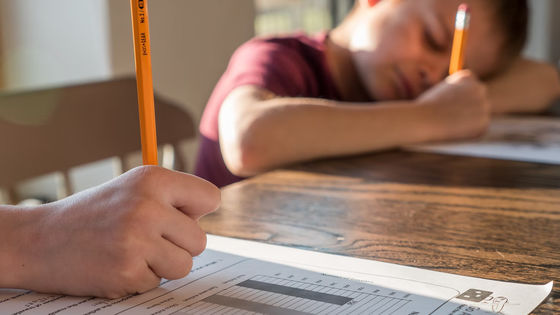
It is pointed out that the reason why young people are turning away from science is because they 'fail to fail'

In the United States, the 'young people turning away from science' has become a major issue, and there are concerns that if the Trump administration's immigration policy prevents researchers from entering the United States from overseas, it could undermine the country's status as a scientific powerhouse.
One Reason Young People Don't Go Into Science? We Don't Fail Well - Scientific American
https://www.scientificamerican.com/article/one-reason-young-people-dont-go-into-science-we-dont-fail-well1/
Whitlock majored in biological sciences at his undergraduate school, but after just four weeks, he was bombarded with questions like, 'Am I intelligent?' and 'Will I ever be able to get a science degree?' His confidence was shattered.
Whitlock was so stressed that he lost his appetite, but fortunately, he received support from his supervisor and friends from high school, and was able to pass his tests and ultimately earn an A-. Looking back on his school days at that time, he says it was a repeated process of 'failing and relearning,' which he continued to use in his life after entering graduate school. In other words, the life of a scientist is a series of failures: 'formulate a hypothesis, conduct an experiment to verify it, and reconsider if the results are not obtained.' Learning from failure is a required skill for a scientist, and his early days at university were a good opportunity to hone his skills as a budding scientist.

Now that Whitlock understands the importance of learning from failure and has acquired the ability to bounce back, he looks back and sees his peers who also aspired to a career in science but gave up halfway through. He believes that those who drop out of science have a trait of 'failing to fail.' In the world of science, where failure is inevitable, people are expected to 'fail well,' but failing to bounce back from failure ultimately leads them away from science.
'The trend of young people turning away from science has been going on for many years, with the percentage of American scientists declining and the percentage of international students and researchers increasing. It's not a bad thing for the United States to have talented scientists from abroad, and it could be said that race or nationality is irrelevant. However, Whitlock worries that depending on the outcome of the Trump administration's hardline immigration policy, the United States may be unable to accept foreign scientists and aspiring scientists. In some cases, foreign scientists in the United States may even be deported, which could destabilize America's position as a scientific powerhouse,' Whitlock says.
When thinking about what is needed to help students passionate about science recover from failure, Whitlock reflected on his own experience: 'I was only able to recover from my failure when someone shared it with me.' He believes that sharing failure experiences is effective. Talking about personal failure is not fun for anyone, but if students can learn from advice from others with similar experiences that their failure is not a big enough problem to ruin their careers in academia, it can serve as an attempt to change the current situation of students turning away from science.

Related Posts: