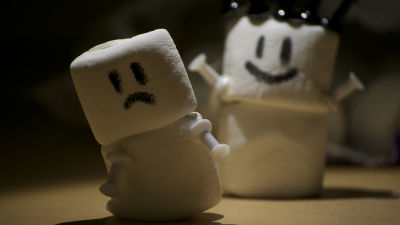
What is necessary for children to achieve social success in the future?
By
The ' Marshmallow Experiment ,' one of the most famous behavioral science experiments, showed that children who have self-control over their desires are more likely to achieve social success in the future. A new study has revealed the thinking needed to improve this experiment, conducted by psychologist Walter Mischel at Stanford University in the 1960s and 1970s. Psychology Today , a website covering psychology-related topics, reports.
The Marshmallow Myth | Psychology Today
https://www.psychologytoday.com/blog/strategic-thinking/201703/the-marshmallow-myth
The 'marshmallow experiment' involves calling a four-year-old child into a room with only a desk and chair, with no distractions, placing a single tasty marshmallow in front of them, and saying, 'If you can resist eating the marshmallow for 15 minutes until I come back, I'll give you another marshmallow. If you eat the marshmallow before I come back, I won't give you the second one.' The experiment then observes whether the child can resist eating the marshmallow.
The results of this experiment showed that only about one-third of the children were able to hold off on eating the marshmallow and get the second marshmallow. Furthermore, a follow-up study found that children who were able to exercise self-control for the sake of the second marshmallow (a future reward) at the age of four, before entering school, were relatively more likely to receive 'excellent' grades in school and had an average score on the Scholastic Aptitude Test (SAT) that was 210 points higher than the group that ate the marshmallow. Furthermore, it has been found that this strength of self-control persists throughout life. In other words, it has been found that people who have self-control as children are more likely to achieve social success in the future.
By
Research results that could help us remake the marshmallow experiment have been published by the National Center for Biotechnology Information ( NCBI) . The results were published by researchers Caitlin Woolley and Ayelet Fishbach of the University of Chicago. According to the study , immediate rewards, such as pleasurable activities, are more likely to lead to persistence than delayed rewards, such as improved health. Furthermore, immediate rewards are associated with persistence in activities like studying and exercise, while delayed rewards merely provide a reason to do these activities.
In other words, delayed rewards only motivate people to set long-term goals and engage in them, while immediate rewards are strongly related to the persistence of achieving long-term goals. What this means is that if you set the goal of losing weight and go jogging to wear skinny pants (delayed reward), finding a jogging partner who enjoys talking or trying Zumba instead of jogging will help you maintain your long-term goal by incorporating fun activities (immediate rewards) into the process of achieving your goal.

By John Benson
In the marshmallow experiment, children who were able to resist the temptation of the marshmallow were those who successfully distracted themselves by looking away from the marshmallow or doing something else. The children distracted themselves by singing songs or playing games in their heads, but not by doing anything that required strong self-control, such as staring at the marshmallow and waiting. Previously, children who resisted the marshmallow were thought to be 'children who can discipline themselves in order to secure a greater reward in the future.' However, taking these findings into account, it may be possible to consider that they were using an 'immediate reward' (singing a song or playing a game in their heads) as a prelude to a 'delayed reward' (receiving two marshmallows).
In other words, Psychology Today writes that the people judged to be 'socially successful' in the marshmallow experiment were not 'people who can tolerate the present for the sake of future success,' but 'people who can find satisfaction (immediate reward) in any situation.' While this may seem like a small difference, if it's important to 'find small pleasures' rather than 'give up small things for big ones,' the psychological impression from the practitioner should be quite different.
In addition, the book 'Marshmallow Test: Successful and Unsuccessful Children' by Walter Mischel, the psychologist who invented the marshmallow experiment, is sold on Amazon.co.jp, with the Kindle version costing 1,847 yen and the hardcover version costing 2,052 yen.
The Marshmallow Test: Children Who Succeed and Who Don't | Walter Mischel, Hiroyuki Shibata | Books | Online Shopping | Amazon

Related Posts: