'I'm not good at math' is not something you're born with, but it can be overcome with effort
By
It seems that people all over the world have a fear of math, and say things like, 'Just hearing the word 'equation' makes me break out in hives.' In the United States, people often say, 'I'm bad at math,' or, 'I'm just not a math person.' While there's a tendency to see people's abilities as innate, like 'humanities brain' or 'science brain,' Miles Kimball and Noah Smith have outlined the idea that ability isn't based on genetic factors, but can be overcome through hard work.
The Myth of 'I'm Bad at Math' - Miles Kimball & Noah Smith - The Atlantic
http://www.theatlantic.com/education/archive/2013/10/the-myth-of-im-bad-at-math/280914/
Miles Kimball, a professor of economics at the University of Michigan, and Noah Smith, an associate professor at the State University of New York at Stony Brook, have long taught mathematics to students and discovered that the following patterns shape people's aptitude for mathematics.
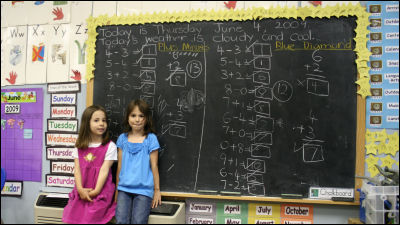
1: When children enter elementary school, they will take math classes. However, at this point, there is a wide range of prior knowledge, with some children having been taught math by their parents and others having no prior experience.
2: In the very early stages of the test, children with prior knowledge get full marks, but children without prior knowledge of mathematics can only solve problems that they can solve haphazardly, so they only get around 80 to 85 points. For convenience, we will call the former Group A and the latter Group B.
3: The children in Group B, unaware that the students who got perfect scores had prior knowledge, began to believe that 'arithmetic (math) is genetically related.' As a result, they decided that 'arithmetic (math) is not for me,' and from then on, they lost motivation and the gap only widened.
4: The children in Group A begin to think that they are good at arithmetic (math) and continue to study hard, thereby establishing their superiority.

By
Research by Patricia Louise Linehan , a psychologist at Purdue University in the United States, has found that students with a tendency to change or improve, such as those in Group A, perceive their abilities and knowledge as something that can change with effort, while students with a tendency to stay fixed, such as those in Group B, perceive their abilities as something that cannot change or improve with effort.
Research by psychologist Lisa Blackwell and others has also revealed that there are two ways of thinking about intelligence and knowledge: 'I can change my knowledge as much as I want' and 'I have a finite amount of knowledge and I can't change it myself.' It has also been found that students who believe 'I can change my knowledge' achieve higher grades.
In his book Intelligence and How to Get It , social psychologist Richard Nisbett shares an anecdote about how he taught a group of middle school students from poor minority groups that 'intelligence can be improved through hard work, and that learning shapes the brain.' According to Nisbett, the students' grades improved after they learned the importance of hard work. But what's more, one child who had believed he was born dumb and would be doomed to a lifetime of poverty was moved to tears when he learned that 'intelligence can be developed through hard work, and that it is up to you to decide.' In fact, there is a story about a boy who was determined to have an IQ of 80 on an intelligence test, but after three years of hard work, his IQ rose to 100 .
Professor Kimball and Associate Professor Smith point out that the 'nature theory'—the notion that innate aptitude influences later development—is particularly prevalent in mathematics. American students in grades four through eight (equivalent to fourth through eighth grade in Japan) outperform their counterparts in countries like Germany, the UK, and Sweden, but their performance declines by high school. They lament this, saying, 'Despite strong basic abilities, students lack the necessary effort to succeed, resulting in a decline in academic performance.' Regarding efforts to reduce the number of math classes, arguing that ' difficult 'algebra' is not required ,' they comment, 'This is tantamount to assuming that Americans are not suited to maths with x.'
By
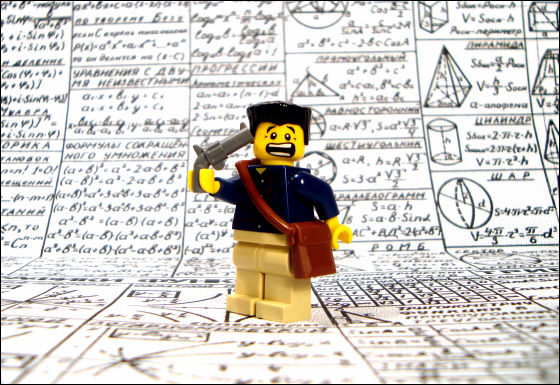
Professor Kimball and Associate Professor Smith say that many people are afraid of equations and mathematical symbols like 'x, y, z' because they don't want to associate it with being genetically inferior at math. However, distancing themselves from math because they think they're not cut out for it can also lead to missing out on high-paying jobs.
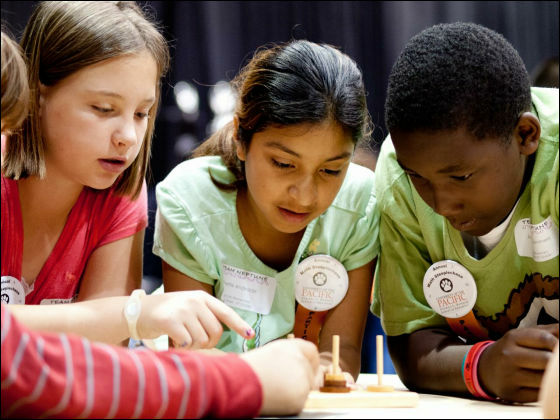
Professor Kimball and Associate Professor Smith argue that mathematics is the best tool for 'perseverance' and 'self-improvement through hard work' in modern society. In Japan, it has been pointed out that ' young people are turning away from science ,' but what should you do if you 'just don't have an interest in it in the first place'?
Related Posts: